
In the pretreatment of peat clay, the laboratory high-temperature muffle furnace acts as the primary activation vessel. It facilitates a precise calcination process at 600°C for a duration of one hour. This thermal treatment is not merely for drying; it is the critical step that converts raw earth into a chemically active material.
Core Takeaway: The muffle furnace transforms peat clay from a raw material into a highly reactive mineral additive. By stripping away organic impurities and rearranging the crystal structure, this process creates the necessary foundation for enhancing the hydrophilicity of subsequent membrane materials.
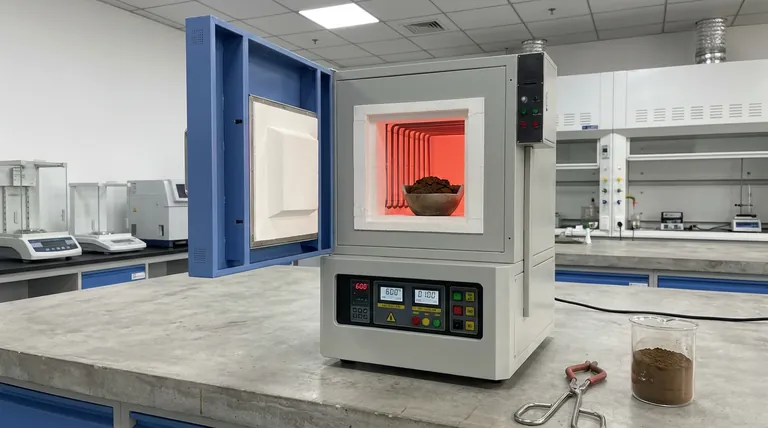
The Transformation Process
Calcination and Impurity Removal
The immediate function of the furnace is to subject the peat clay to high heat to burn off volatile substances. Raw peat clay naturally contains various organic impurities that can hinder chemical bonding.
By maintaining a steady temperature of 600°C, the furnace ensures the complete removal of these organics. This purification leaves behind a clean mineral base ready for modification.
Crystal Structure Modification
Beyond purification, the heat treatment fundamentally alters the physical properties of the clay. The thermal energy provided by the furnace changes the clay’s crystal lattice.
This structural shift effectively activates the material. The result is a mineral additive with high reactivity, specifically engineered to improve performance in downstream applications.
Enhancing Membrane Properties
The ultimate goal of this pretreatment is to prepare the clay for use in composite membranes. The furnace-treated clay serves as a foundation for increasing hydrophilicity (water attraction).
Without the specific structural changes induced by the muffle furnace, the clay would lack the reactivity required to bond effectively with membrane materials or improve their water-filtration capabilities.
Why a Muffle Furnace is Required
Precise Temperature Regulation
Peat clay calcination requires a specific window of operation—specifically 600°C for one hour. Muffle furnaces are designed to maintain this exact setpoint with minimal fluctuation.
This precision prevents the variability that occurs with open-flame heating or less sophisticated ovens. Consistent temperature is vital to ensure the crystal structure is altered uniformly across the entire batch.
Isolated Heating Environment
A key feature of a muffle furnace is the isolation of the sample from the heating elements and fuel byproducts. The "muffle" chamber protects the clay from direct exposure to flames or combustion gases.
This isolation prevents external contamination during the heating process. It ensures that the chemical changes in the clay are purely a result of thermal activation, maintaining the purity of the final mineral additive.
Understanding the Trade-offs
The Risk of Thermal Deviation
While the muffle furnace is capable of reaching temperatures up to 1800°C, operating outside the prescribed 600°C window for peat clay can be detrimental.
If the temperature is too low, organic impurities will remain, reducing reactivity. Conversely, if the temperature is set significantly higher (approaching sintering ranges of 800°C+), the clay particles may fuse or vitrify, destroying the porosity and surface area required for membrane applications.
Batch Uniformity Constraints
Muffle furnaces provide excellent uniform heating, but they are generally batch-process tools.
For large-scale production, the limitation is the size of the chamber. Overloading the furnace can disrupt the heat distribution, leading to inconsistent calcination where the center of the batch does not reach the target 600°C for the full hour.
Making the Right Choice for Your Goal
When configuring your muffle furnace for peat clay pretreatment, consider your specific end-goals:
- If your primary focus is Chemical Purity: Ensure the furnace is vented properly to allow the off-gassing of combusted organic impurities without re-contaminating the sample.
- If your primary focus is Material Reactivity: Strictly adhere to the 600°C/1-hour protocol to maximize the crystal structure transformation without inducing unwanted sintering.
Success in peat clay pretreatment relies not just on heating the material, but on maintaining the precise thermal environment that unlocks its reactive potential.
Summary Table:
| Parameter | Specification | Purpose of Step |
|---|---|---|
| Calcination Temp | 600°C | Removes organic impurities and volatiles |
| Duration | 1 Hour | Ensures uniform crystal structure modification |
| Key Outcome | Thermal Activation | Creates a hydrophilic mineral for membrane bonding |
| Risk Factor | >800°C (Sintering) | Prevents particle fusion and loss of porosity |
Elevate Your Material Research with KINTEK
Precision is critical when transforming raw minerals into high-performance additives. KINTEK provides industry-leading thermal solutions, including Muffle, Tube, Rotary, and Vacuum systems, specifically engineered for precise calcination and crystal modification.
Backed by expert R&D and advanced manufacturing, our lab high-temperature furnaces are fully customizable to meet your unique peat clay pretreatment protocols. Ensure batch uniformity and chemical purity with our specialized heating technology.
Ready to optimize your lab's thermal processes?
Contact KINTEK today for a custom consultation
References
- Synthesis and Characterization of Polysulfone/Peat Clay Hollow Fibre Membranes: The Effect of Composition and Morphology. DOI: 10.37934/arfmts.126.2.86105
This article is also based on technical information from Kintek Furnace Knowledge Base .
Related Products
- 1700℃ High Temperature Muffle Oven Furnace for Laboratory
- 1800℃ High Temperature Muffle Oven Furnace for Laboratory
- 1400℃ Muffle Oven Furnace for Laboratory
- 1200℃ Muffle Oven Furnace for Laboratory
- High Temperature Muffle Oven Furnace for Laboratory Debinding and Pre Sintering
People Also Ask
- What is the primary function of a high-temperature laboratory muffle furnace in chemical synthesis? Achieve Precision.
- How does a high-temperature laboratory muffle furnace affect material properties? Transform Anodic Oxide Films Fast
- What role does a muffle furnace play in BCZY712 electrolyte powder production? Achieve Perfect Phase Purity
- How does the two-stage sintering process contribute to the synthesis of MeCuFeO3 perovskite? Optimize crystal purity.
- What role does a muffle furnace play in sintering photocathodes? Enhance Electrode Conductivity & Catalytic Activity



















