
A high-temperature muffle furnace is essential for determining ash content because it provides the controlled thermal environment required to completely destroy the organic carbon structure.
Specifically, the furnace maintains a temperature typically around 650°C, facilitating total oxidative combustion. This process burns away all organic components as gas, leaving behind only the non-combustible inorganic residue, which is weighed to calculate the ash percentage.
Core Takeaway The muffle furnace acts as an isolation tool, using high heat and oxygen to strip away the carbon matrix of the sample. The remaining ash serves as a critical inverse metric for purity: the lower the ash content, the higher the purity of the biomass raw material and the final activated carbon product.
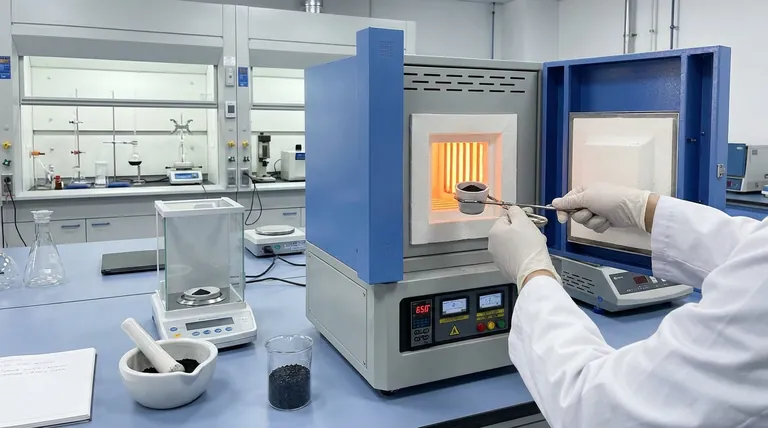
The Mechanics of Ash Determination
Achieving Complete Combustion
To accurately measure ash, you must ensure that absolutely no organic material remains in the sample. A standard drying oven cannot achieve the temperatures necessary to break down the stable carbon bonds in activated carbon.
The Role of Temperature
The primary reference indicates that a temperature around 650°C is typically required for this analysis. At this specific heat level, the furnace ensures the comprehensive oxidation of the carbon skeleton.
Isolating Inorganic Impurities
Once the organic carbon converts to gas (mostly CO2) and vents away, only the inorganic minerals remain. By comparing the weight of this residue to the original sample, you determine the concentration of non-carbon impurities.
Why This Metric Matters
Assessing Raw Material Quality
Ash content is not just a final spec; it is a diagnostic tool for your inputs. It reveals the inherent purity of the biomass raw material used before carbonization even begins.
Evaluating Adsorbent Performance
For activated carbon, purity is often a proxy for performance. A high concentration of inorganic impurities (high ash) can indicate lower quality, as these impurities may block pores or interfere with the material's adsorption capabilities.
Understanding the Operational Trade-offs
While the muffle furnace is the central tool for ash determination, it is a versatile instrument. It is critical to distinguish between using the furnace for analysis (ash) and synthesis (activation), as the operating parameters differ fundamentally.
Atmosphere: Oxidation vs. Protection
For ash determination, you want oxidation (combustion) to destroy the carbon. Conversely, when using the furnace for activation or pyrolysis (as noted in the supplementary data), you typically require a nitrogen protection atmosphere to prevent the carbon from burning away.
Temperature Specificity
The temperature setting dictates the chemical result.
- 650°C (Air): Used for ash determination (destruction of carbon).
- 500°C (Nitrogen): Used for pyrolysis and chemical activation (e.g., with ZnCl2).
- 1000°C (CO2): Used for physical activation to create structural defects and increase surface area.
Risk of Misapplication
Using the wrong atmosphere or temperature profile will ruin the data. If you attempt to measure ash in an inert atmosphere (like nitrogen), the carbon will not burn off, and your weight measurement will be meaningless.
How to Apply This to Your Project
The muffle furnace is a tool that changes function based on your thermal recipe. Ensure your protocol aligns with your specific objective.
- If your primary focus is Quality Control: Run the furnace typically around 650°C in an oxidative environment to burn off carbon and quantify inorganic impurities (ash).
- If your primary focus is Material Synthesis: Operate the furnace under a protective nitrogen atmosphere (e.g., 500°C) to pyrolyze precursors without burning the carbon yield.
- If your primary focus is Surface Modification: Use specific high temperatures (e.g., 1000°C with CO2) to physically develop micropores and increase specific surface area.
Mastering the muffle furnace allows you to not only create high-performance adsorbents but also rigorously verify their purity.
Summary Table:
| Feature | Ash Determination | Pyrolysis/Activation |
|---|---|---|
| Temperature | Typically 650°C | 500°C - 1000°C |
| Atmosphere | Oxidative (Air) | Inert (Nitrogen/CO2) |
| Goal | Destroy carbon to measure inorganic residue | Create/Modify carbon structures |
| Chemical Result | Total oxidative combustion | Controlled carbonization |
| Key Metric | Material purity (inverse of ash content) | Surface area and pore volume |
Elevate Your Material Analysis with KINTEK
Precision in ash determination and material synthesis requires uncompromising thermal control. Backed by expert R&D and manufacturing, KINTEK offers high-performance Muffle, Tube, Rotary, Vacuum, and CVD systems, as well as other lab high-temp furnaces—all fully customizable to meet your unique research or production needs.
Whether you are assessing raw material purity or engineering advanced adsorbents, our systems provide the uniform heating and atmospheric control essential for accurate results. Contact us today to find the perfect furnace solution for your laboratory!
References
- Alaa E. Ali, Hassan Shokry. Remediation of contaminated water using cellulose acetate membrane hybrid by sunflower seed shell–activated carbon. DOI: 10.1007/s13399-024-05326-6
This article is also based on technical information from Kintek Furnace Knowledge Base .
Related Products
- 1700℃ High Temperature Muffle Oven Furnace for Laboratory
- 1800℃ High Temperature Muffle Oven Furnace for Laboratory
- 1200℃ Muffle Oven Furnace for Laboratory
- 1400℃ Muffle Oven Furnace for Laboratory
- Laboratory Muffle Oven Furnace with Bottom Lifting
People Also Ask
- What is the primary function of a high-temperature laboratory muffle furnace in chemical synthesis? Achieve Precision.
- How does a high-temperature laboratory muffle furnace affect material properties? Transform Anodic Oxide Films Fast
- What role does a muffle furnace play in BCZY712 electrolyte powder production? Achieve Perfect Phase Purity
- How does the two-stage sintering process contribute to the synthesis of MeCuFeO3 perovskite? Optimize crystal purity.
- What is the role of a high-temperature muffle furnace in guava leaf carbonization? Master Precise Pyrolysis Control



















