
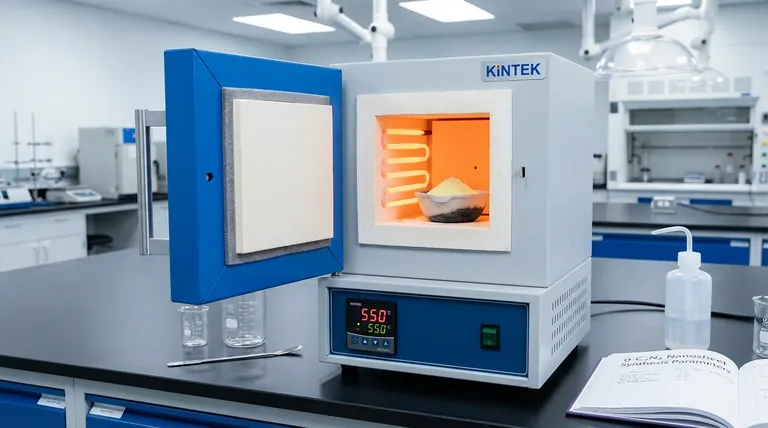
The core function of a muffle furnace in this context is to provide a stable, high-temperature calcination environment that drives the chemical transformation of precursors into semiconductor materials. specifically, it acts as a reactor for the pyrolysis of melamine, maintaining a precise temperature of 550 °C to synthesize g-C3N4 nanosheets.
The muffle furnace facilitates the polycondensation of melamine through a controlled heating profile. By sustaining specific temperatures and heating rates, it converts the precursor into a graphitic carbon nitride (g-C3N4) material with a characteristic layered structure.
The Mechanism of Synthesis
Facilitating Thermal Polycondensation
The primary role of the furnace is to supply the thermal energy required to trigger polycondensation. At 550 °C, the melamine precursor undergoes a chemical change, polymerizing to form the graphitic carbon nitride structure. This pyrolysis process is essential for creating the material's semiconductor properties.
Ensuring Structural Integrity
The furnace allows for the formation of a distinct layered structure. By holding the temperature for a set duration, typically 4 hours, the equipment ensures the reaction is complete. This results in successfully synthesized g-C3N4 nanosheets rather than incomplete intermediates.
Precision Control Parameters
Regulated Heating Rates
A critical function of the muffle furnace is controlling the speed at which the temperature rises. The standard protocol requires a controlled heating rate, commonly 5 °C/min. This gradual increase prevents thermal shock and ensures the chemical transition occurs uniformly throughout the sample.
Temperature Stability
The furnace must maintain a static thermal environment over the duration of the calcination. Fluctuations in temperature can lead to defects in the crystal lattice or inconsistent sheet thickness. High-quality insulation and heating elements ensure the chamber remains at exactly 550 °C during the dwell time.
Understanding the Trade-offs
Atmosphere Limitations
While muffle furnaces are excellent for general calcination in air, they differ from tube furnaces regarding atmosphere control. Tube furnaces are better suited for processes strictly requiring continuous inert gas flow (like nitrogen). In a standard muffle furnace, relying on a covered crucible is often necessary to approximate a semi-closed environment during pyrolysis.
Batch Uniformity Risks
The uniformity of the thermal field within the chamber dictates the consistency of the final product. If the furnace is overloaded or has poor heating element distribution, "cold spots" can occur. This leads to variations in the degree of polycondensation, resulting in heterogeneous nanosheets.
Making the Right Choice for Your Goal
To optimize the preparation of g-C3N4 nanosheets using a muffle furnace, consider the following approach:
- If your primary focus is standard synthesis: adhere strictly to the primary protocol of 550 °C for 4 hours with a ramp rate of 5 °C/min to ensure complete polycondensation.
- If your primary focus is enhanced surface area: consider investigating multi-stage calcination (e.g., adding a secondary dwell time at lower temperatures) to further promote thermal exfoliation and thinning of the sheets.
Precision in thermal history is the single most important factor in defining the electronic properties of your final nanosheets.
Summary Table:
| Feature | Parameter | Impact on g-C3N4 Synthesis |
|---|---|---|
| Calcination Temperature | 550 °C | Drives thermal polycondensation of melamine precursors |
| Heating Rate | 5 °C/min | Prevents thermal shock and ensures uniform chemical transition |
| Dwell Time | 4 Hours | Ensures complete reaction and formation of layered structure |
| Environment | Air / Semi-closed | Facilitates pyrolysis and structural integrity of the nanosheets |
Elevate Your Nanomaterial Synthesis with KINTEK Precision
Achieving the perfect graphitic carbon nitride structure requires more than just heat—it requires absolute thermal stability. Backed by expert R&D and manufacturing, KINTEK offers high-performance Muffle, Tube, Rotary, Vacuum, and CVD systems, all customizable to meet your unique laboratory needs.
Whether you are synthesizing g-C3N4 nanosheets or developing advanced semiconductor materials, our high-temperature furnaces provide the precision control and uniformity your research demands. Contact us today to find the perfect furnace solution for your lab!
References
- Hubing Li, Xin Xiao. The Preparation of g-C3N4/ZnIn2S4 Nano-Heterojunctions and Their Enhanced Efficient Photocatalytic Hydrogen Production. DOI: 10.3390/molecules29112571
This article is also based on technical information from Kintek Furnace Knowledge Base .
Related Products
- 1400℃ Muffle Oven Furnace for Laboratory
- 1700℃ High Temperature Muffle Oven Furnace for Laboratory
- 1800℃ High Temperature Muffle Oven Furnace for Laboratory
- 1200℃ Muffle Oven Furnace for Laboratory
- High Temperature Muffle Oven Furnace for Laboratory Debinding and Pre Sintering
People Also Ask
- How does a high-temperature laboratory muffle furnace affect material properties? Transform Anodic Oxide Films Fast
- What is the primary function of a high-temperature laboratory muffle furnace in chemical synthesis? Achieve Precision.
- What is the role of a laboratory high-temperature muffle furnace in H13 steel treatment? Optimize Tool Performance
- What is the purpose of using a laboratory high-temperature muffle furnace for drying Fe-Ni-Co catalysts? Boost Purity
- How does a laboratory high-temperature muffle furnace facilitate the homogenization of borosilicate glass samples? Expert Insights



















