
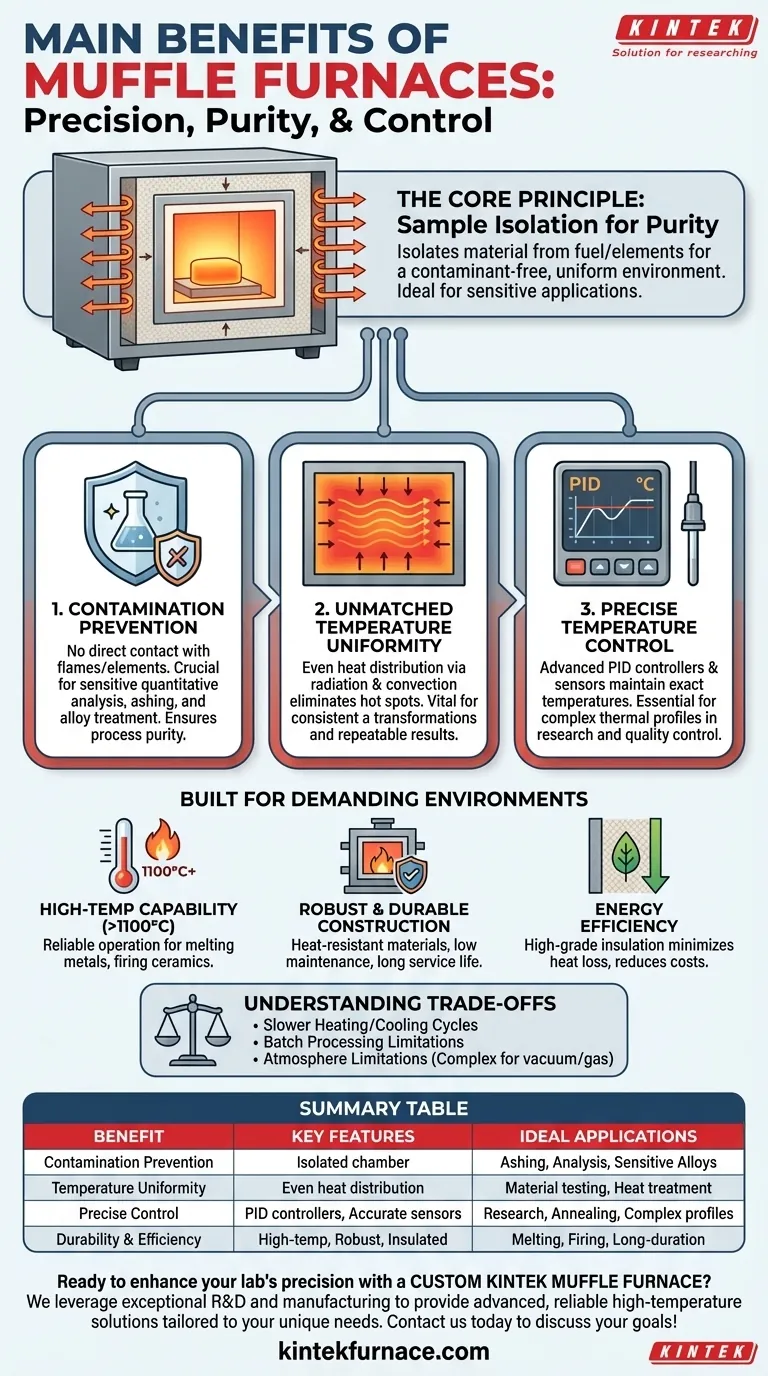
At its core, a muffle furnace provides three primary benefits: exceptional temperature uniformity, precise process control, and the prevention of sample contamination. Its design isolates the material being heated from the fuel source and any combustion byproducts, creating a highly controlled environment ideal for sensitive applications like material testing, ashing, and heat treating.
The defining advantage of a muffle furnace is its ability to create a chemically isolated and thermally uniform environment. This separation between the heating elements and the internal chamber is what ensures process purity and repeatable, accurate results.
The Core Principle: Isolating the Sample for Purity and Precision
The name "muffle" refers to the furnace's inner chamber, which encloses the sample and separates it from the heating elements. This fundamental design is the source of its most critical advantages.
Contamination Prevention
By design, the material inside a muffle furnace never comes into direct contact with flames or the electrical heating elements. This is crucial for processes where even minute contamination from combustion gases or element degradation could compromise the results.
This makes it the standard for applications like quantitative analysis, ashing organic matter, or treating highly sensitive alloys.
Unmatched Temperature Uniformity
The enclosed muffle chamber allows heat to be distributed evenly through both radiation and convection. This eliminates hot spots and ensures the entire sample experiences the same temperature, which is vital for consistent material transformations.
Advanced models utilize multiple heating zones and sophisticated control logic to guarantee uniformity throughout the chamber volume, leading to highly accurate and repeatable test outcomes.
Precise Temperature Control
Modern muffle furnaces use advanced controllers, often with PID (Proportional-Integral-Derivative) auto-tuning capabilities. Paired with sensitive temperature sensors (like J-type thermocouples) and Solid-State Relays (SSRs) for the heaters, this system can maintain a set temperature with extreme accuracy.
This level of control is essential for executing complex thermal profiles required in materials research, quality control, and delicate annealing processes.
Built for Demanding Environments
Beyond precision, muffle furnaces are engineered for durability and efficiency in high-heat, long-duration operations.
High-Temperature Capability
Muffle furnaces are specifically built to operate reliably at very high temperatures, often exceeding 1100°C (2012°F), making them suitable for demanding applications like melting metals, firing ceramics, and advanced material synthesis.
Robust and Durable Construction
These furnaces are constructed from heat-resistant materials that resist oxidation and corrosion. The chamber lining and external insulation, such as high-density glass wool blankets, are designed for maximum thermal efficiency and a long service life with low maintenance costs.
Energy Efficiency
The high-grade insulation minimizes heat loss to the surrounding environment. This not only improves safety by keeping the external surfaces cooler but also significantly reduces energy consumption, making the furnace more cost-effective to operate over its lifetime.
Understanding the Trade-offs
While highly effective, the muffle furnace design comes with inherent trade-offs that are important to consider.
Slower Heating and Cooling Cycles
The same robust insulation that provides excellent thermal efficiency and uniformity also means the furnace takes longer to heat up and cool down. For processes requiring rapid thermal cycling, other types of furnaces might be more suitable.
Batch Processing Limitations
Standard muffle furnaces are designed for batch processing, where a set amount of material is loaded, heated, and then removed. They are less ideal for continuous, high-volume industrial production, where a tunnel furnace might be a better fit.
Atmosphere Limitations
While many muffle furnaces can operate with inert atmospheres like nitrogen or in a vacuum, achieving and maintaining a perfect, high-purity vacuum or specialized gas environment can require more complex and expensive models.
Making the Right Choice for Your Goal
Selecting a muffle furnace depends entirely on the specific requirements of your process.
- If your primary focus is high-purity analysis (e.g., ashing, trace element testing): The key benefit is the muffle's ability to completely prevent contamination of your sample.
- If your primary focus is repeatable material testing (e.g., heat treatment, quality control): The unparalleled temperature uniformity and precise PID control will ensure your results are consistent and reliable.
- If your primary focus is versatile lab heating: The robust design, broad temperature range, and compatibility with various materials make it a durable and flexible workhorse for many applications.
Ultimately, a muffle furnace is the definitive choice when the integrity of your sample and the precision of your thermal process cannot be compromised.
Summary Table:
| Benefit | Key Features | Ideal Applications |
|---|---|---|
| Contamination Prevention | Isolated chamber, no direct contact with heating elements | Ashing, quantitative analysis, sensitive alloys |
| Temperature Uniformity | Even heat distribution, multiple heating zones | Material testing, heat treatment, quality control |
| Precise Temperature Control | PID controllers, SSRs, accurate sensors | Materials research, annealing, complex thermal profiles |
| Durability and Efficiency | High-temperature capability, robust construction, energy-saving insulation | Melting metals, firing ceramics, long-duration operations |
Ready to enhance your lab's precision and efficiency with a custom muffle furnace? At KINTEK, we leverage exceptional R&D and in-house manufacturing to provide advanced high-temperature furnace solutions tailored to your unique needs. Our product line includes Muffle, Tube, Rotary Furnaces, Vacuum & Atmosphere Furnaces, and CVD/PECVD Systems, all backed by strong deep customization capabilities. Whether you're in material testing, ashing, or other sensitive applications, we can deliver reliable, contamination-free performance. Contact us today to discuss how we can support your goals with a bespoke solution!
Visual Guide
Related Products
- 1400℃ Muffle Oven Furnace for Laboratory
- 1700℃ High Temperature Muffle Oven Furnace for Laboratory
- 1800℃ High Temperature Muffle Oven Furnace for Laboratory
- 1200℃ Muffle Oven Furnace for Laboratory
- High Temperature Muffle Oven Furnace for Laboratory Debinding and Pre Sintering
People Also Ask
- How does a high-temperature laboratory muffle furnace affect material properties? Transform Anodic Oxide Films Fast
- What is the primary function of a high-temperature laboratory muffle furnace in chemical synthesis? Achieve Precision.
- How does a muffle furnace facilitate Ag/ATP catalyst preparation? Optimize Calcination for Superior Performance
- What function does a muffle furnace perform in perovskite formation? Optimize Your Thermal Synthesis
- How does a laboratory high-temperature muffle furnace facilitate the homogenization of borosilicate glass samples? Expert Insights



















