
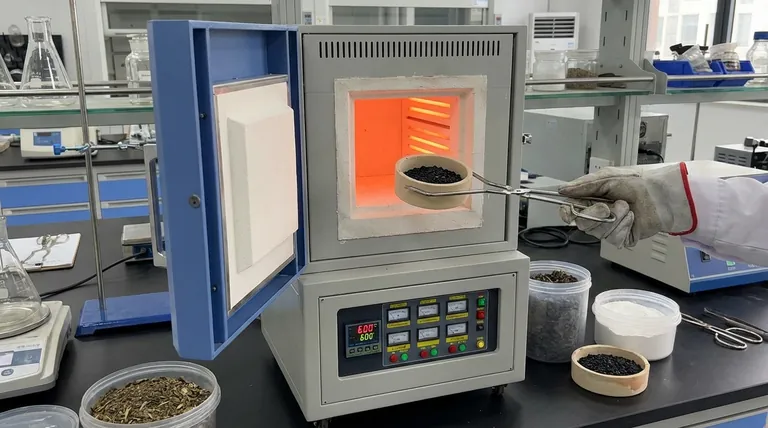
The muffle furnace functions as a precision thermal reactor, creating a stable, oxygen-limited environment essential for converting biomass into high-quality modified biochar. Specifically, it maintains temperatures around 600°C to drive the simultaneous carbonization of biomass and the structural integration of kaolin minerals.
The muffle furnace does more than simply heat the material; it creates a controlled environment that allows for the reconstruction of carbon structures into aromatic rings. This process ensures the successful implantation of kaolin minerals into the biochar matrix, directly enhancing the material's thermal stability and carbon sequestration capacity.
The Role of Thermal Stability in Chemical Conversion
Driving Carbon Reconstruction
The primary contribution of the muffle furnace is the provision of a stable high-temperature environment, typically maintained at 600°C.
At this specific temperature, the furnace facilitates the thermochemical conversion of biomass. This heat drives the rearrangement of the carbon structure, transforming it into stable aromatic rings.
Facilitating Kaolin Implantation
Beyond simple carbonization, the furnace’s controlled environment is critical for the modification process.
It ensures that kaolin minerals are successfully implanted into the biochar matrix during pyrolysis. This integration is what differentiates modified biochar from standard biochar, yielding a composite material with superior properties.
Regulating the Reaction Environment
The Oxygen-Limited Atmosphere
Unlike open-air combustion, the muffle furnace operates in an oxygen-limited state during this process.
This restriction is vital because it prevents the biomass from burning away into ash. Instead, it forces the material to undergo pyrolysis, preserving the carbon skeleton while removing volatile components.
Controlling Heating Rates
The muffle furnace allows for the precise management of heating rates (e.g., 15°C/min).
This control influences the internal heat transfer within the biomass and the rate at which volatiles are released. By regulating this rate, you can optimize the biochar yield and adjust the microscopic pore network to suit specific adsorption needs.
Understanding the Trade-offs
Muffle Furnace vs. Tube Furnace
While muffle furnaces are excellent for batch processing and general "oxygen-limited" pyrolysis, they differ from tube furnaces.
Tube furnaces typically use a strictly inert flowing gas (like Nitrogen) to ensure a completely oxygen-free state. A muffle furnace is often "oxygen-limited" rather than purely inert, which is sufficient for many biochar applications but provides a slightly different surface chemistry.
The Risk of Overheating
Precise temperature regulation is critical to avoid damaging the material.
If the furnace temperature exceeds the optimal range (e.g., going well beyond 600°C-900°C depending on the target), the carbon skeleton may crack. This degradation reduces the surface area and destroys the pore structure required for effective adsorption.
Making the Right Choice for Your Goal
To maximize the effectiveness of your kaolin-modified biochar, align your furnace settings with your specific objectives:
- If your primary focus is Structural Stability: specific maintenance of 600°C is required to ensure the formation of aromatic rings and the proper fixation of kaolin within the matrix.
- If your primary focus is Pore Customization: Prioritize precise control of the heating rate (e.g., 15°C/min) to manage the release of volatiles and the ratio of micropores to mesopores.
- If your primary focus is Yield Optimization: Ensure the environment remains strictly oxygen-limited to prevent the oxidation of carbon into ash.
By precisely controlling temperature and residence time, the muffle furnace transforms raw biomass into a sophisticated, distinct composite material capable of enhanced carbon storage.
Summary Table:
| Feature | Role in Biochar Modification | Benefit for Kaolin Integration |
|---|---|---|
| Precise Temp Control | Maintains constant 600°C | Ensures stable aromatic ring formation |
| Oxygen Limitation | Prevents combustion to ash | Preserves carbon skeleton for mineral loading |
| Heating Rate (15°C/min) | Regulates volatile release | Optimizes pore network for mineral fixation |
| Thermal Stability | Drives thermochemical conversion | Enhances final composite structural integrity |
Elevate Your Biochar Research with KINTEK Precision
Unlock superior material properties with KINTEK’s advanced thermal solutions. Backed by expert R&D and manufacturing, we provide high-performance Muffle, Tube, Rotary, Vacuum, and CVD systems tailored for precise biomass pyrolysis and mineral modification. Whether you need to optimize pore structures or ensure perfect kaolin implantation, our customizable lab high-temp furnaces deliver the control you need.
Ready to transform your material synthesis? Contact KINTEK today for a customized consultation.
References
- Hamed A. Al-Swadi, Muhammad Imran Rafique. Impacts of kaolinite enrichment on biochar and hydrochar characterization, stability, toxicity, and maize germination and growth. DOI: 10.1038/s41598-024-51786-1
This article is also based on technical information from Kintek Furnace Knowledge Base .
Related Products
- Electric Rotary Kiln Small Rotary Furnace Biomass Pyrolysis Plant Rotating Furnace
- 1400℃ Muffle Oven Furnace for Laboratory
- 1200℃ Muffle Oven Furnace for Laboratory
- High Temperature Muffle Oven Furnace for Laboratory Debinding and Pre Sintering
- Laboratory Muffle Oven Furnace with Bottom Lifting
People Also Ask
- What are the key components of a rotary kiln electric furnace? Unlock Efficient Thermal Processing
- What are the main applications of a rotary kiln electric furnace? Achieve Uniform Heat Treatment for Powders
- What is the significance of the refractory lining in a rotary kiln electric furnace? Unlock Efficiency and Longevity
- What are the key components of a rotary kiln's construction? Discover the Essential Parts for Efficient Industrial Processing
- What role does the rotary kiln serve in coal-based DRI production? Unlock Cost-Effective Ironmaking Efficiency












