
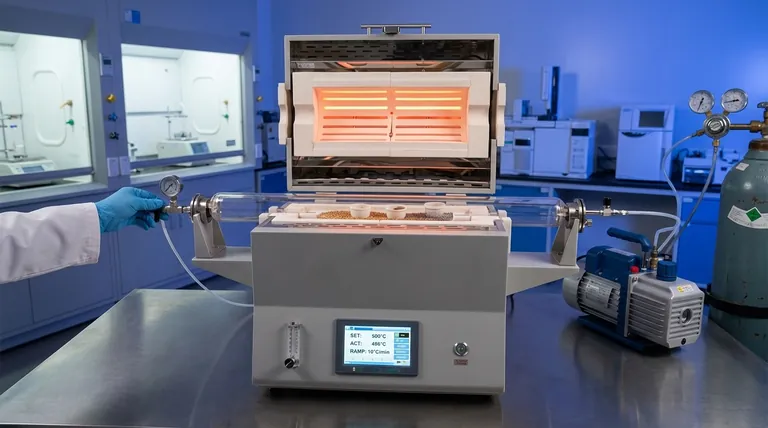
A commercial high-temperature furnace is a non-negotiable requirement for the pretreatment of Thermoluminescence (TL) materials in laboratory retrospective dosimetry. Its primary function is to subject the materials to a precisely controlled annealing or activation process, heating them to several hundred degrees Celsius to reset their physical state before measurement.
Core Takeaway The furnace provides a controlled thermal environment that stabilizes the material's energy band structure and eliminates residual thermal effects. By removing unstable electron traps and resetting the material, this process ensures that subsequent radiation dose measurements are repeatable, accurate, and free from signal interference.
The Mechanics of Thermal Pretreatment
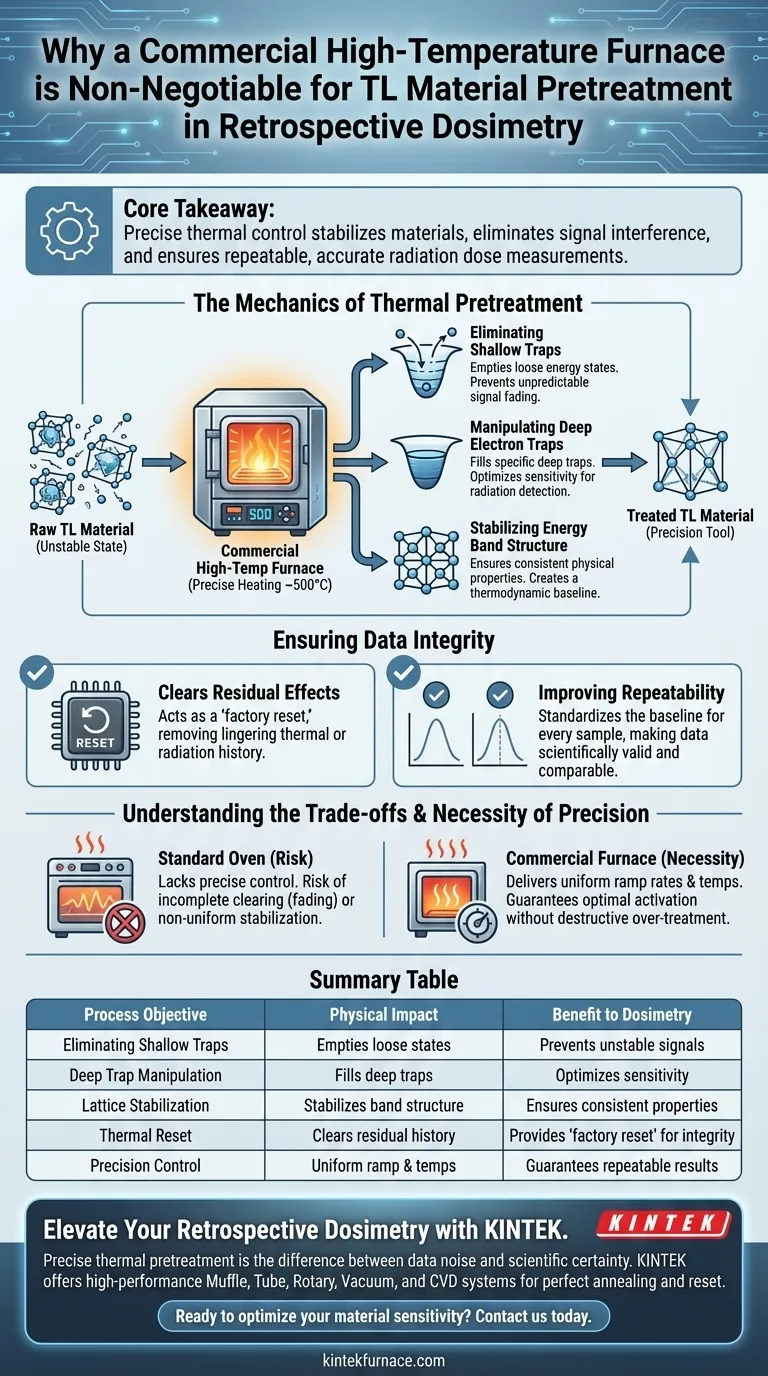
Eliminating Shallow Traps
The primary physical objective of high-temperature treatment is to eliminate shallow traps. These are energy states within the material's lattice that hold electrons loosely.
If left untreated, these shallow traps release electrons unpredictably, causing unstable signals. Heating the material empties these traps, preventing them from interfering with the accurate reading of the dosimetric signal.
Manipulating Deep Electron Traps
Beyond clearing shallow traps, the thermal process is used to fill deep traps with electrons. This is a specific activation treatment that prepares the material for measurement.
By ensuring deep traps are occupied, the sensitivity of the TL material is optimized for the specific type of radiation detection required in retrospective dosimetry.
Stabilizing the Energy Band Structure
The furnace does more than just move electrons; it stabilizes the energy band structure of the crystal lattice.
Thermoluminescence materials can be thermodynamically unstable. A precise heat treatment brings the material to a consistent energy state, ensuring that its physical properties remain constant during the actual readout process.
Ensuring Data Integrity
Clearing Residual Effects
Materials often carry a "history" of previous thermal or radiation exposures. The furnace is used to clear residual thermal stability effects.
This acts as a "factory reset" for the sample. It removes any lingering data or noise from previous uses, ensuring the signal you measure is solely from the radiation dose you intend to study.
Improving Repeatability
The ultimate goal of using a commercial furnace is significantly improving repeatability.
Without a standardized, high-temperature reset, two measurements of the same dose could yield different results. The furnace ensures every sample starts from the exact same baseline, making the data scientifically valid and comparable.
Understanding the Trade-offs
The Necessity of Precision
The reference emphasizes a precisely controlled thermal environment. A standard oven often lacks the necessary temperature uniformity and ramp-rate control required for this delicate physics.
If the temperature is too low, shallow traps remain, leading to signal fading. If the temperature fluctuates, the energy band structure may not stabilize uniformly across the batch.
Risk of Over-treatment
While the reference highlights the need for heating to "several hundred degrees," there is a balance to be struck.
The goal is activation and annealing, not destruction. The commercial furnace allows for specific temperature ceilings to ensure the material is cleared without permanently altering its physical sensitivity to radiation.
Making the Right Choice for Your Goal
To maximize the effectiveness of your retrospective dosimetry, align your furnace usage with your specific experimental needs:
- If your primary focus is signal purity: Prioritize protocols that ensure the complete elimination of shallow traps to prevent unstable "fading" signals.
- If your primary focus is longitudinal study: strict adherence to identical annealing temperatures is critical to maintain the energy band structure across measurements taken at different times.
A precisely controlled thermal pretreatment is the foundation of reliable dosimetry, converting a raw material into a precision measurement tool.
Summary Table:
| Process Objective | Physical Impact | Benefit to Dosimetry |
|---|---|---|
| Eliminating Shallow Traps | Empties loose energy states | Prevents unstable signals and fading |
| Deep Trap Manipulation | Fills deep electron traps | Optimizes sensitivity for radiation detection |
| Lattice Stabilization | Stabilizes energy band structure | Ensures consistent physical properties |
| Thermal Reset | Clears residual thermal history | Provides a "factory reset" for data integrity |
| Precision Control | Uniform ramp rates & temps | Guarantees repeatable, scientifically valid results |
Elevate Your Retrospective Dosimetry with KINTEK
Precise thermal pretreatment is the difference between data noise and scientific certainty. KINTEK provides the high-performance laboratory solutions necessary to ensure your Thermoluminescence materials are perfectly annealed and reset.
Backed by expert R&D and world-class manufacturing, we offer a comprehensive range of Muffle, Tube, Rotary, Vacuum, and CVD systems. Whether you need standard protocols or a custom-engineered furnace for unique research requirements, KINTEK delivers the temperature uniformity and stability your lab demands.
Ready to optimize your material sensitivity? Contact us today to discuss your high-temperature furnace needs with our technical specialists.
Visual Guide
References
- Hayder Khudhair Obayes. Review: Theory of Thermoluminescence & Related by Reuven Chen (Author), Stephen W S Mckeever. DOI: 10.55640/eijmrms-05-07-02
This article is also based on technical information from Kintek Furnace Knowledge Base .
Related Products
- 2200 ℃ Tungsten Vacuum Heat Treat and Sintering Furnace
- High Temperature Muffle Oven Furnace for Laboratory Debinding and Pre Sintering
- 1400℃ High Temperature Laboratory Tube Furnace with Alumina Tube
- 2200 ℃ Graphite Vacuum Heat Treat Furnace
- 1700℃ High Temperature Laboratory Tube Furnace with Alumina Tube
People Also Ask
- How does a tungsten-heated vacuum sintering furnace prepare (TbxY1-x)2O3 ceramics? Achieve 99%+ Density & Purity
- What wear-resistance enhancements are achieved by powder coating? The Role of Vacuum Sintering Furnaces
- How do compaction pressure and vacuum sintering optimize porous ceramics? Maximize Density & Toughness
- What role does a high-temperature vacuum sintering furnace play in the densification of WC-10(Ni, Ni/Co) alloys?
- How does high-temp vacuum sintering influence Y-TZP mechanical properties? Achieve Max Toughness



















