
In the assembly of side-heated resistive gas sensors, the muffle furnace is primarily utilized to perform a critical annealing process on ceramic tubes that have been coated with gas-sensitive paste. Typically conducted at 350 °C, this thermal treatment ensures the physical durability and electrical precision of the sensor.
Core Takeaway The muffle furnace is not merely a drying tool; it is essential for burning off organic binders to ensure the sensing material adheres firmly to the ceramic substrate. This process is the deciding factor in establishing a high-quality ohmic contact between the sensing layer and the electrodes.
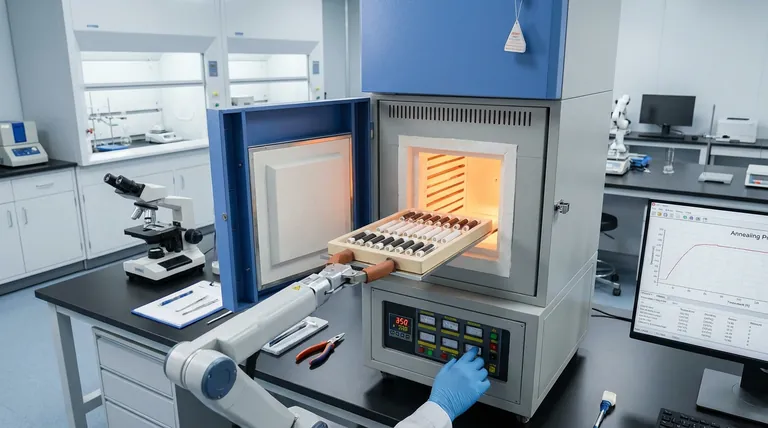
The Annealing Process Explained
Thermal Treatment Specifics
The central function of the muffle furnace in this context is to subject the coated ceramic tubes to a stable high-temperature environment.
The standard operating temperature for this specific assembly process is 350 °C.
Isolation from Contaminants
A defining feature of the muffle furnace is its ability to isolate the sensors from direct contact with heating elements and combustion byproducts.
The "muffle"—a heat-resistant lining—acts as a barrier, ensuring the delicate gas-sensitive paste is heated strictly by radiation and convection, preventing localized overheating or chemical contamination.
Why This Step Determines Sensor Quality
Removing Organic Binders
The gas-sensitive paste applied to the ceramic tubes contains organic binders to maintain consistency during application.
The high heat of the furnace effectively decomposes and removes these binders.
If these binders were left in place, they would interfere with the sensor's ability to interact with target gases.
Ensuring Mechanical Adhesion
The annealing process solidifies the physical structure of the coating.
By exposing the material to 350 °C, the furnace ensures the sensitive material adheres firmly to the ceramic substrate.
Without this step, the sensing layer could flake or detach during operation, leading to sensor failure.
Improving Ohmic Contact
The most critical electrical outcome of this process is the improvement of the connection between the sensing layer and the electrodes.
By removing insulating organic materials and settling the structure, the furnace creates a distinct ohmic contact.
This linear current-voltage relationship is vital for the sensor to provide accurate, linear resistance readings when gas is detected.
Understanding the Trade-offs
Temperature Sensitivity
While 350 °C is the standard, deviations in temperature can drastically alter the sensor's baseline resistance.
If the temperature is too low, residual binders may remain, causing high electrical noise.
If the temperature is excessive, it may alter the microstructure of the sensing material, reducing its sensitivity to specific gases.
Process Time vs. Throughput
Muffle furnaces provide excellent uniformity, but they are often batch-process tools rather than continuous flow tools.
This ensures high quality per batch but can act as a bottleneck in high-volume manufacturing compared to conveyor belt furnaces.
Making the Right Choice for Your Goal
The use of a muffle furnace is about balancing physical robustness with electrical precision.
- If your primary focus is mechanical durability: Ensure the annealing cycle is long enough to fully cure the paste, guaranteeing the sensing layer will not detach under vibration or thermal shock.
- If your primary focus is electrical accuracy: Prioritize precise temperature control at 350 °C to maximize binder removal, ensuring the cleanest possible ohmic contact for low-noise signal transmission.
Reliable gas detection begins with the purity and stability of the bond created in the furnace.
Summary Table:
| Feature | Function in Gas Sensor Assembly |
|---|---|
| Primary Process | High-temperature annealing of coated ceramic tubes |
| Target Temperature | Typically 350 °C |
| Binder Removal | Decomposes organic binders to ensure sensing purity |
| Adhesion | Ensures firm bonding between sensitive paste and substrate |
| Electrical Benefit | Establishes stable ohmic contact for accurate readings |
| Contamination Control | Muffle lining isolates sensors from heating elements |
Precision Heat Treatment for Sensitive Electronics
High-performance gas sensors demand the thermal stability and purity that only expert-engineered equipment can provide. KINTEK offers high-precision Muffle, Tube, Rotary, Vacuum, and CVD systems designed to meet the rigorous demands of laboratory research and sensor manufacturing.
Whether you need to optimize binder removal or ensure perfect ohmic contact, our customizable lab high-temp furnaces are backed by industry-leading R&D to deliver the accuracy your materials require.
Ready to elevate your sensor production? Contact KINTEK today to find your custom thermal solution!
References
- Zhenchao Sun, Pengfei Cheng. Gas Sensor for Efficient Acetone Detection and Application Based on Au-Modified ZnO Porous Nanofoam. DOI: 10.3390/s24248100
This article is also based on technical information from Kintek Furnace Knowledge Base .
Related Products
- 1400℃ Muffle Oven Furnace for Laboratory
- 1700℃ High Temperature Muffle Oven Furnace for Laboratory
- 1800℃ High Temperature Muffle Oven Furnace for Laboratory
- 1200℃ Muffle Oven Furnace for Laboratory
- High Temperature Muffle Oven Furnace for Laboratory Debinding and Pre Sintering
People Also Ask
- What is the primary function of a high-temperature laboratory muffle furnace in chemical synthesis? Achieve Precision.
- How does a high-temperature laboratory muffle furnace affect material properties? Transform Anodic Oxide Films Fast
- How is a laboratory high-temperature muffle furnace utilized in g-C3N4 synthesis? Optimize Your Thermal Polycondensation
- What role does a laboratory high-temperature muffle furnace play in the treatment of highly contaminated waste glass?
- How does a laboratory high-temperature muffle furnace facilitate the homogenization of borosilicate glass samples? Expert Insights



















