
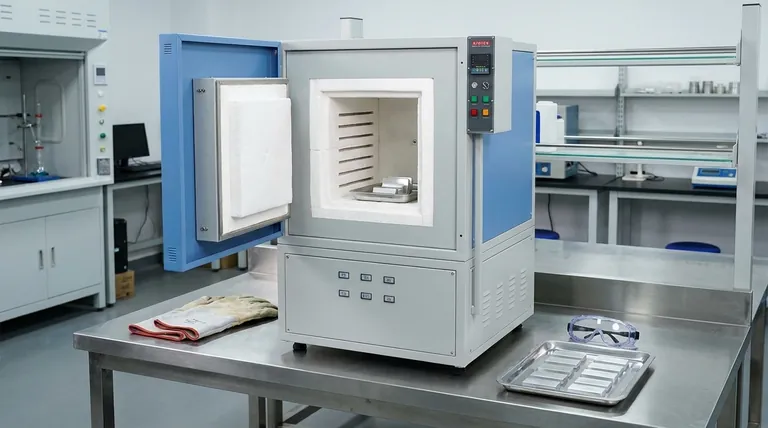
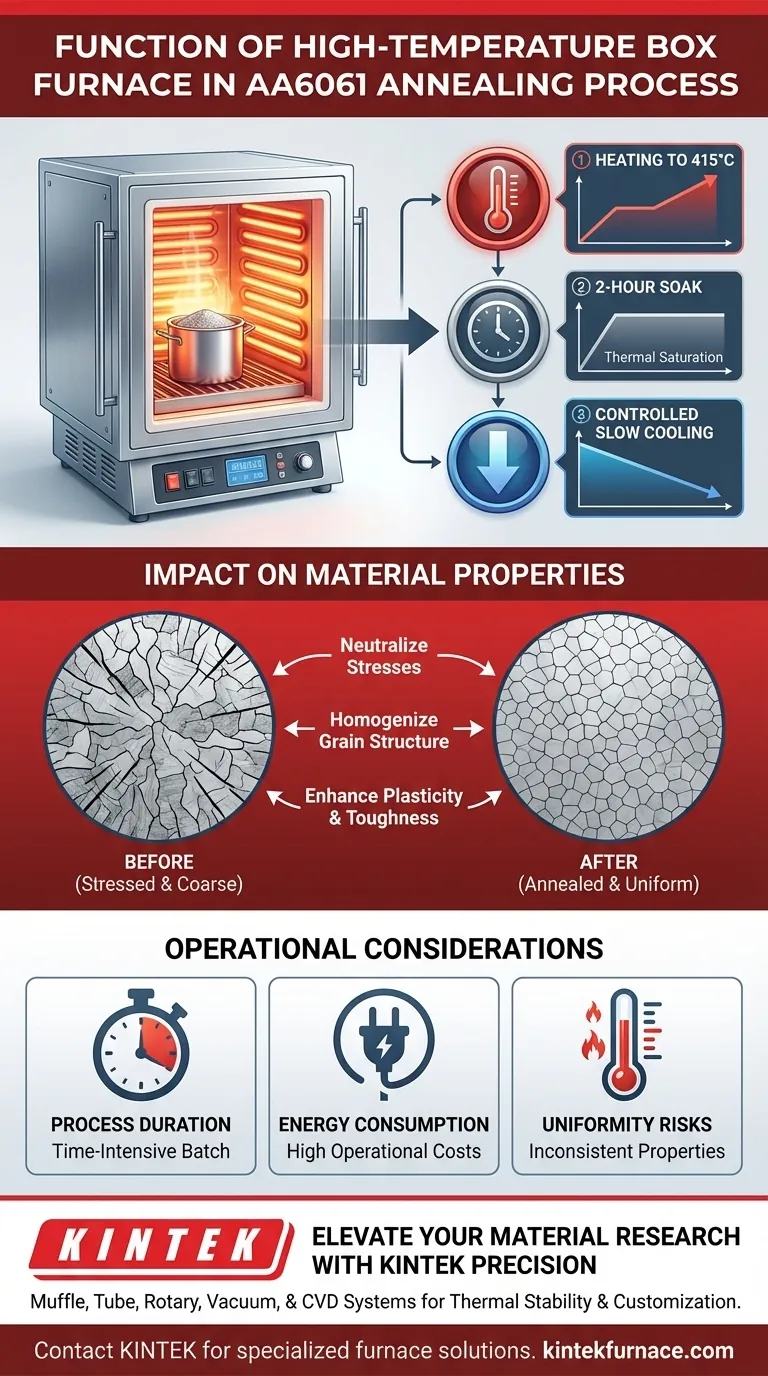
A high-temperature box furnace acts as a precision thermal chamber designed to fundamentally alter the microstructure of AA6061 aluminum alloy. Its specific function in this context is to execute a rigorous three-step thermal cycle: heating the material to exactly 415°C, maintaining this temperature for two hours, and facilitating a controlled slow cooling phase.
By stabilizing the thermal environment, the furnace removes internal manufacturing stresses and reconfigures the grain structure. This process is critical for creating a standardized material baseline, ensuring accurate data when observing complex phenomena like the electroplastic effect in later experiments.
The Mechanics of Thermal Treatment
Reaching the Critical Temperature
The furnace must reliably raise the AA6061 alloy to 415°C. This specific temperature threshold is required to initiate the necessary microstructural changes without melting or damaging the alloy.
The Two-Hour Soak
Once the target temperature is reached, the furnace maintains thermal equilibrium for a duration of two hours. This "holding" or "soaking" period allows heat to penetrate the material fully, ensuring the core reaches the same temperature as the surface.
Controlled Slow Cooling
Unlike quenching, which hardens material, the box furnace facilitates a slow cooling process. This gradual reduction in temperature is what permanently locks in the softer, more ductile state required for annealing.
Impact on Material Properties
Eliminating Residual Stresses
Prior to annealing, the alloy often contains internal forces left over from casting, forging, or cutting. The furnace's thermal cycle relaxes the atomic structure, effectively neutralizing these residual stresses.
Adjusting Grain Structure
The heat treatment promotes the reorganization of the metal's crystalline structure. This results in a more homogeneous grain distribution, which is essential for consistent mechanical behavior across the entire workpiece.
Enhancing Plasticity
By reducing hardness, the furnace significantly improves the material's plasticity and toughness. This makes the alloy softer and more pliable, preparing it for subsequent mechanical deformation processes.
Operational Trade-offs and Considerations
Process Duration
Annealing AA6061 is not a rapid fix. The requirement for a slow ramp-up, a two-hour hold, and a gradual cool-down makes this a time-intensive batch process that can create bottlenecks in production.
Energy Consumption
Maintaing a large chamber at 415°C requires significant energy input. Inefficient furnace insulation or loading practices can lead to high operational costs relative to the volume of material treated.
Temperature Uniformity Risks
If the box furnace fails to circulate heat evenly, "cold spots" may occur. This leads to inconsistent mechanical properties within a single batch, rendering the material unsuitable for precision testing like hydraulic bulging.
Ensuring Process Success
To achieve the best results when annealing AA6061, you must align the furnace capabilities with your specific end goals.
- If your primary focus is stress relief: Ensure the two-hour holding time is strictly observed to allow full thermal saturation of the workpiece.
- If your primary focus is experimental accuracy: Prioritize furnace temperature stability to guarantee the uniform properties needed for observing the electroplastic effect.
- If your primary focus is forming capability: Monitor the cooling rate closely, as cooling too quickly will negate the softening effects of the anneal.
The high-temperature box furnace is the gatekeeper of material consistency, transforming raw alloy into a reliable substrate for advanced engineering and experimentation.
Summary Table:
| Annealing Stage | Temperature/Duration | Function & Impact |
|---|---|---|
| Heating Phase | Reach 415°C | Initiates microstructural changes safely |
| Soaking Period | 2 Hours Holding | Ensures thermal saturation and core uniformity |
| Cooling Phase | Controlled Slow Cooling | Enhances plasticity and locks in ductile state |
| Final Result | Ambient Temperature | Neutralizes stresses and homogenizes grain structure |
Elevate Your Material Research with KINTEK Precision
Precision is non-negotiable when annealing high-performance alloys like AA6061. KINTEK provides industry-leading Muffle, Tube, Rotary, Vacuum, and CVD systems designed to deliver the thermal stability your laboratory demands. Backed by expert R&D and advanced manufacturing, our high-temperature furnaces are fully customizable to meet your unique experimental or production needs.
Ready to achieve superior material consistency? Contact KINTEK today to discuss how our specialized furnace solutions can optimize your annealing workflows.
Visual Guide
References
- A. Farkhondeh, Mohammad Javad Mirnia. Experimental Investigation of Electroplastic Effect on Ductile Fracture Phenomenon of Annealed AA6061 Aluminum Alloy in Different Stress States through Hydraulic Bulge Test. DOI: 10.5829/ije.2026.39.06c.09
This article is also based on technical information from Kintek Furnace Knowledge Base .
Related Products
- 1400℃ High Temperature Laboratory Tube Furnace with Alumina Tube
- 1700℃ High Temperature Laboratory Tube Furnace with Alumina Tube
- 1700℃ High Temperature Muffle Oven Furnace for Laboratory
- 1800℃ High Temperature Muffle Oven Furnace for Laboratory
- High Temperature Muffle Oven Furnace for Laboratory Debinding and Pre Sintering
People Also Ask
- How does zone-melting in tube furnaces synthesize bismuth micro-wires? Master Single-Crystal Thermoelectric Growth
- How are high-temp tube furnaces used to measure diffusion coefficients per Fick's law? Master Precision Annealing
- How do high-temperature laboratory tube furnaces ensure environmental stability? Precision Thermal Reduction Tips
- How are high-temperature laboratory tube furnaces applied in long-term vacuum homogenization heat treatments for intermetallic samples?
- How are high-temperature tube furnaces applied in testing ceramic-supported alloy membranes? Insights



















