
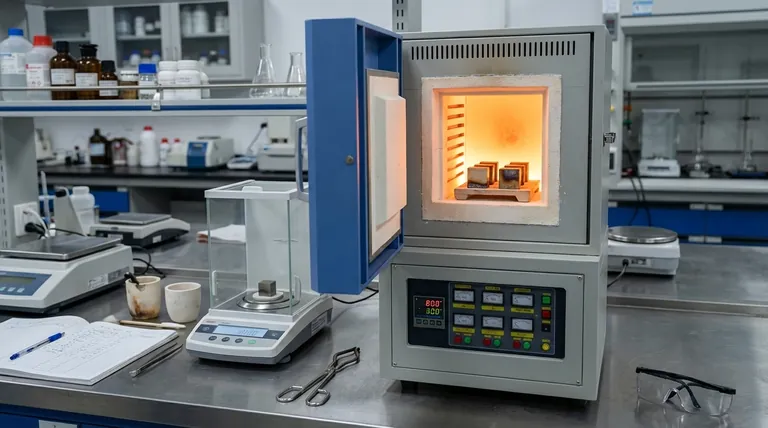
A muffle furnace serves as the critical testing ground for determining the chemical stability of WC-Fe-Ni-Co materials. It creates a stable, high-temperature environment—typically between 800°C and 900°C—with natural air circulation to rapidly accelerate the oxidation reaction on the material's surface. By subjecting samples to this simulated extreme heat, researchers can measure the resulting mass change to quantify the material's ability to resist degradation.
Core Insight: The muffle furnace is not just a heating element; it is a comparative analysis tool. Its primary function is to generate precise "mass gain" data, allowing engineers to determine if specific stabilizing additives successfully inhibit the formation of oxides under thermal stress.
Simulating Extreme Service Conditions
Precise Temperature Control
The fundamental role of the muffle furnace is to maintain a rigorously constant temperature over extended periods.
While standard operating temperatures for these tests often sit at 800°C, supplementary protocols may push this to 900°C to test failure limits.
This stability is essential for isolating temperature as the sole variable driving the oxidation process.
Accelerating Chemical Reactions
In a real-world application, oxidation might happen slowly over months.
The muffle furnace compresses this timeline by providing an energy-dense environment that forces the surface of the WC-Fe-Ni-Co composite to react with the oxygen in the air chamber.
This allows researchers to simulate the cumulative effects of long-term high-temperature exposure in a fraction of the time.
Quantifying Material Performance
Measuring Mass Change
The primary metric derived from muffle furnace testing is mass change, specifically mass gain.
As the material oxidizes, oxygen atoms bind to the surface, increasing the sample's weight.
By weighing the WC-Fe-Ni-Co samples before and after the furnace treatment, researchers calculate the extent of the oxidation.
Evaluating Stabilizing Additives
The data collected is used to benchmark the effectiveness of different alloy compositions.
If a sample with a specific additive shows significantly less mass gain than a control sample, the additive is confirmed to enhance antioxidant performance.
This helps in refining the material system to withstand harsh industrial environments.
Analyzing Oxidation Kinetics
Beyond simple start-and-stop measurements, the furnace allows for the analysis of oxidation kinetics curves.
By recording data at intervals, researchers can map the rate at which oxidation occurs, identifying whether the degradation is linear or if the material forms a protective passivation layer that slows the process over time.
Understanding the Trade-offs
Static vs. Dynamic Testing
A muffle furnace provides a static thermal environment.
While excellent for testing chemical stability, it does not simulate mechanical wear or physical stress (abrasion) that often accompanies high heat in real-world tool applications.
Atmosphere Limitations
Standard muffle furnaces typically rely on ambient air circulation.
If the material is intended for use in specific corrosive gas environments (like sulfur or chlorine), a standard air-atmosphere muffle furnace test may not fully predict performance limitations.
Making the Right Choice for Your Evaluation
Strategic Recommendations
To effectively utilize a muffle furnace for WC-Fe-Ni-Co assessment, consider your specific analytical goals:
- If your primary focus is screening new alloy formulas: Prioritize measuring mass gain differential at 800°C to quickly identify which additives reduce oxidation rates.
- If your primary focus is predicting lifecycle durability: Focus on oxidation kinetics curves at higher temperatures (900°C) to understand how the oxidation rate changes over extended exposure.
By isolating thermal oxidation from mechanical wear, the muffle furnace provides the baseline chemical data necessary to validate the longevity of your material system.
Summary Table:
| Feature | Function in WC-Fe-Ni-Co Testing |
|---|---|
| Temperature Range | Typically 800°C to 900°C to simulate extreme heat |
| Atmosphere | Natural air circulation for accelerated oxidation |
| Key Metric | Mass gain (quantifies oxygen binding to surface) |
| Analytical Goal | Determination of oxidation kinetics and alloy stability |
| Core Advantage | Compresses long-term thermal degradation into short-term data |
Optimize Your Material Performance with KINTEK
Precision is paramount when evaluating the oxidation resistance and chemical stability of advanced composites like WC-Fe-Ni-Co. KINTEK provides high-performance heating solutions backed by expert R&D and manufacturing. Our extensive range of Muffle, Tube, Rotary, Vacuum, and CVD systems offers the precise temperature control and uniform heating required for accurate mass change analysis and kinetic mapping.
Whether you are screening new alloy formulas or predicting industrial lifecycle durability, KINTEK lab high-temp furnaces are fully customizable to meet your unique research needs. Contact us today to enhance your lab's testing capabilities!
References
- Maksim Krinitcyn, М. И. Лернер. Structure and Properties of WC-Fe-Ni-Co Nanopowder Composites for Use in Additive Manufacturing Technologies. DOI: 10.3390/met14020167
This article is also based on technical information from Kintek Furnace Knowledge Base .
Related Products
- 1400℃ Muffle Oven Furnace for Laboratory
- 1700℃ High Temperature Muffle Oven Furnace for Laboratory
- 1800℃ High Temperature Muffle Oven Furnace for Laboratory
- 1200℃ Muffle Oven Furnace for Laboratory
- High Temperature Muffle Oven Furnace for Laboratory Debinding and Pre Sintering
People Also Ask
- What is the primary function of a high-temperature laboratory muffle furnace in chemical synthesis? Achieve Precision.
- How does a high-temperature laboratory muffle furnace affect material properties? Transform Anodic Oxide Films Fast
- How is a laboratory high-temperature muffle furnace utilized in g-C3N4 synthesis? Optimize Your Thermal Polycondensation
- What function does a muffle furnace perform in perovskite formation? Optimize Your Thermal Synthesis
- What role does a muffle furnace play in refractory bricks? Enhance Performance and Durability Testing



















