
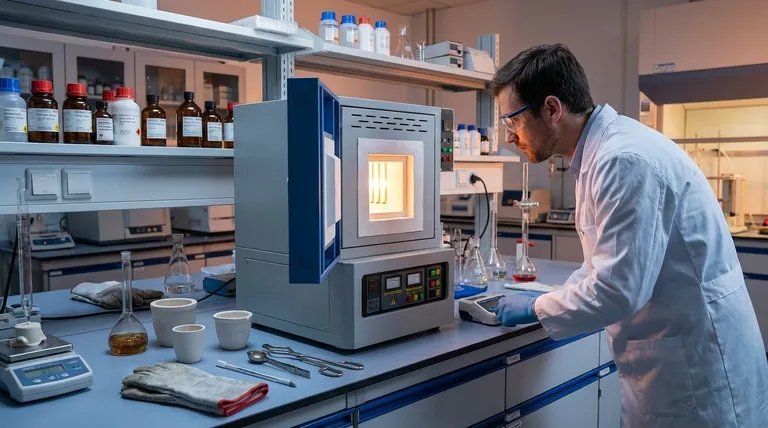
Precise temperature control in a muffle furnace is the deciding factor in the successful synthesis of Ba2M0.4Bi1.6O6. It ensures the stable thermodynamic environment required for solid-state reactions, specifically maintaining a constant sintering temperature of 950 °C for 12 hours. Without this stability, the material fails to achieve the correct double perovskite phase and risks developing undesirable amorphous structures.
Temperature uniformity within the furnace chamber is not merely an operational detail; it dictates the structural integrity of the final material. Accurate control facilitates the precise transition into specific crystal structures while suppressing defects that compromise material quality.
The Role of Thermodynamics in Phase Formation
Achieving the Double Perovskite Structure
The synthesis of Ba2M0.4Bi1.6O6 relies heavily on a consistent thermodynamic environment.
The furnace must maintain a constant temperature of 950 °C for an extended period, typically 12 hours. This sustained heat drives the chemical reactions necessary to form the high-quality double perovskite phase.
Controlling Crystal Transitions
Beyond simple phase formation, the specific crystal structure of the material is temperature-dependent.
Uniform heating allows for the precise transition between complex space groups, such as Monoclinic I2/m or Cubic Fm3m. Fluctuations in temperature can interrupt these transitions, leading to inconsistent material properties.
Microstructural Integrity and Grain Growth
Suppressing Amorphous Phases
Inconsistent heating often results in incomplete reactions.
When temperature control is accurate, it effectively suppresses the formation of amorphous phases. These are non-crystalline regions that can degrade the performance of the final material.
Promoting Proper Grain Development
The microstructure of the material is defined during the sintering process.
A uniform thermal environment promotes proper grain development. This ensures the material is dense and structurally sound, rather than porous or weakly bonded.
Operational Risks and Equipment Limitations
Preventing Component Burnout
While achieving high temperatures is necessary, how you reach them matters significantly.
The voltage applied to the furnace must be increased gradually. Rapid spikes in voltage to force a temperature increase can cause the heating element to exceed its maximum specification and burn out.
The Necessity of Supervision
Automatic control systems are reliable but not infallible.
It is crucial to supervise the furnace to detect potential failures in the automatic control system. Unchecked failures can lead to furnace wire burnout or other accidents that destroy both the equipment and the sample.
Making the Right Choice for Your Goal
To ensure the successful preparation of Ba2M0.4Bi1.6O6, prioritize the following operational strategies:
- If your primary focus is Phase Purity: Ensure your furnace creates a uniform thermal zone at exactly 950 °C to guarantee the formation of the double perovskite structure and correct space groups.
- If your primary focus is Microstructural Quality: Maintain strict temperature stability to prevent amorphous phase formation and encourage uniform grain growth.
- If your primary focus is Equipment Longevity: Increase voltage gradually and supervise the system to prevent heating element burnout due to control failures.
Mastering the thermal environment is the only way to transform raw precursors into a high-quality, crystalline double perovskite.
Summary Table:
| Synthesis Factor | Requirement | Impact on Ba2M0.4Bi1.6O6 |
|---|---|---|
| Sintering Temp | Constant 950 °C | Formation of high-quality double perovskite phase |
| Dwell Time | 12 Hours | Ensures complete solid-state reaction |
| Thermal Uniformity | High Consistency | Promotes correct crystal transitions (e.g., Cubic Fm3m) |
| Heating Method | Gradual Voltage Increase | Prevents heating element burnout and sample loss |
| Phase Control | Strict Stability | Suppresses amorphous phases and optimizes grain growth |
Elevate Your Materials Synthesis with KINTEK
Precision is non-negotiable when synthesizing complex materials like Ba2M0.4Bi1.6O6. At KINTEK, we understand that your research depends on unwavering thermal stability and uniform heating environments.
Backed by expert R&D and world-class manufacturing, we offer a comprehensive range of Muffle, Tube, Rotary, Vacuum, and CVD systems. Whether you require specific crystal transitions or dense microstructural development, our high-temp lab furnaces are fully customizable to meet your unique synthesis protocols.
Ready to achieve superior phase purity? Contact our technical specialists today to find the perfect furnace solution for your laboratory.
References
- Strategic Doping for Precise Structural Control and Intense Photocurrents Under Visible Light in Ba2M0.4Bi1.6O6 (M = La, Ce, Pr, Pb, Y) Double Perovskites. DOI: 10.3390/nano15131039
This article is also based on technical information from Kintek Furnace Knowledge Base .
Related Products
- 1400℃ Muffle Oven Furnace for Laboratory
- 1700℃ High Temperature Muffle Oven Furnace for Laboratory
- 1800℃ High Temperature Muffle Oven Furnace for Laboratory
- 1200℃ Muffle Oven Furnace for Laboratory
- High Temperature Muffle Oven Furnace for Laboratory Debinding and Pre Sintering
People Also Ask
- What is the primary function of a high-temperature laboratory muffle furnace in chemical synthesis? Achieve Precision.
- How does a high-temperature laboratory muffle furnace affect material properties? Transform Anodic Oxide Films Fast
- How does a muffle furnace facilitate Ag/ATP catalyst preparation? Optimize Calcination for Superior Performance
- How is a laboratory high-temperature muffle furnace utilized in g-C3N4 synthesis? Optimize Your Thermal Polycondensation
- How does a laboratory high-temperature muffle furnace contribute to the final formation of Bismuth Oxide nanosheets?



















