
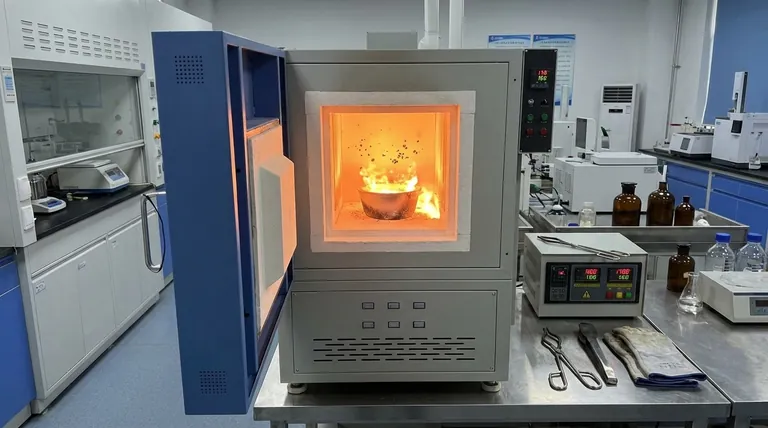
In molten salt carbonization, the high-temperature furnace and the crucible function as an integrated system to maintain a precise liquid-phase reaction environment. The furnace supplies the thermal energy necessary to exceed the salt's melting point, while the crucible serves as a chemically resistant vessel that contains the corrosive molten medium. This collaboration ensures the salt effectively coats biomass particles, acting as a "natural template" to direct the formation of the catalyst's structure.
The core advantage of this setup is the creation of a uniform liquid environment that prevents the carbon structure from fusing together (sintering). By maintaining this state, the process yields catalysts with distinct layered structures and high nitrogen doping levels that are difficult to achieve through standard solid-state heating.
The Mechanism of Interaction
Creating a Liquid Template
The primary goal of this equipment pairing is to transition the reaction medium from solid to liquid. When the furnace heats the crucible above the salt's melting point, the salt acts as a liquid medium.
Uniform Particle Coating
Once molten, the salt behaves as a natural template. It uniformly coats the biomass particles suspended within the crucible.
Preventing Structural Collapse
This liquid coating is critical for structure retention. It physically separates the carbonizing particles, preventing excessive sintering (the fusing of particles into a dense, non-porous mass) during the high-heat phase.
Equipment Roles and Requirements
The Furnace: Thermal Uniformity
The high-temperature furnace is responsible for the uniformity of the reaction. It must maintain a stable temperature profile that keeps the entire salt mixture in a liquid phase throughout the carbonization process.
The Crucible: Chemical Resistance
The crucible faces the most aggressive conditions in this setup. Because molten salts are highly corrosive, the crucible must be made of materials capable of resisting chemical corrosion at high temperatures. Failure here would lead to contamination of the catalyst or containment breach.
Understanding the Trade-offs
Material Compatibility Risks
The effectiveness of this method relies heavily on the durability of the crucible. If the crucible material reacts with the specific salt mixture used, it can introduce impurities into the final catalyst or degrade the vessel rapidly.
Thermal Control Sensitivity
The furnace must provide precise control. If the temperature fluctuates below the salt's melting point, the "liquid template" effect is lost, leading to uneven coating and inconsistent catalyst structures.
Making the Right Choice for Your Goal
To optimize your synthesis of catalysts using molten salt carbonization, consider these distinct priorities:
- If your primary focus is Structural Integrity: Ensure your furnace provides exceptional thermal uniformity to maintain the liquid phase, preventing sintering and ensuring layered structures.
- If your primary focus is Chemical Purity: Prioritize a crucible material with verified resistance to your specific salt mixture to prevent corrosion-related contamination.
Success in this process depends on balancing precise thermal input with robust chemical containment.
Summary Table:
| Component | Primary Role | Key Requirement |
|---|---|---|
| High-Temp Furnace | Thermal Energy Supply | Precise temperature control & thermal uniformity |
| Crucible | Chemical Containment | High resistance to corrosive molten salt mediums |
| Molten Salt | Liquid Template | Prevents sintering & facilitates nitrogen doping |
| The Synergy | Structural Control | Creation of layered, non-porous catalyst structures |
Elevate Your Catalyst Synthesis with KINTEK Precision
Are you struggling with structural collapse or contamination in your molten salt carbonization process? KINTEK provides the specialized hardware necessary for high-performance chemical engineering.
Backed by expert R&D and manufacturing, KINTEK offers Muffle, Tube, Rotary, Vacuum, and CVD systems, all customizable for your unique lab requirements. Our high-temperature furnaces ensure the absolute thermal uniformity required to maintain liquid templates, while our premium crucibles withstand the most aggressive molten salts.
Ready to optimize your material research? Contact us today to discuss your custom furnace needs and ensure every synthesis yields high-purity, perfectly structured results.
References
- Shuling Liu, Baojun Li. Catalytically Active Carbon for Oxygen Reduction Reaction in Energy Conversion: Recent Advances and Future Perspectives. DOI: 10.1002/advs.202308040
This article is also based on technical information from Kintek Furnace Knowledge Base .
Related Products
- Molybdenum Vacuum Heat Treat Furnace
- 1200℃ Muffle Oven Furnace for Laboratory
- 2200 ℃ Graphite Vacuum Heat Treat Furnace
- 2200 ℃ Tungsten Vacuum Heat Treat and Sintering Furnace
- 1800℃ High Temperature Muffle Oven Furnace for Laboratory
People Also Ask
- What is the primary application of vacuum heat treating furnaces in aerospace? Enhance Component Performance with Precision
- How does vacuum heat treating work in terms of temperature and time control? Master Precise Material Transformations
- Why are vacuum heat treating furnaces essential for aerospace? Ensure Superior Material Integrity for High-Stakes Applications
- How does a vacuum heat treating furnace improve the condition of metal alloys? Achieve Superior Metal Performance
- What is the process of vacuum heat treating? Achieve Superior Metallurgical Properties



















