
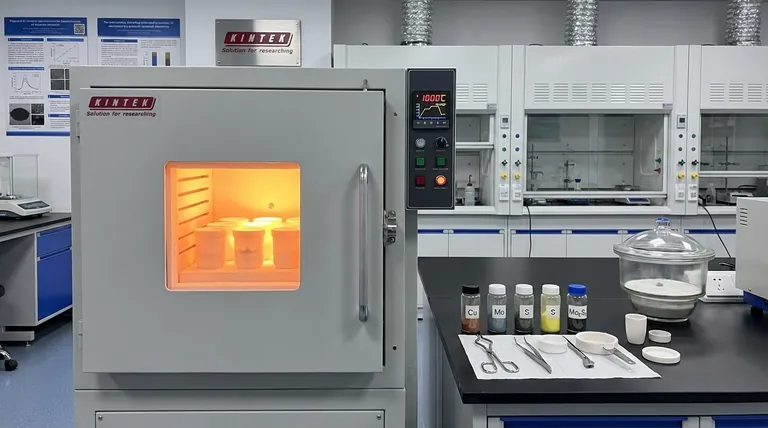
Precise temperature gradient control is the foundational requirement for synthesizing high-purity Mo6S8 cathode materials in a high-temperature box furnace. By regulating the thermal field, the furnace dictates the kinetic and thermodynamic conditions necessary to transform raw copper, molybdenum, and sulfur mixtures into the specific crystalline structures required for high-performance batteries.
Core Insight: The box furnace is not merely a heat source; it is a phase-control instrument. Its ability to maintain exact heating curves and cooling rates dictates the structural integrity of the Cu2Mo6S8.5 intermediate, which is the absolute prerequisite for extracting pure Chevrel phase Mo6S8.
The Critical Function of the Thermal Field
Orchestrating Phase Transformation
The primary role of the box furnace is to provide a stable, uniform thermal environment for annealing the precursor mixture. This stability allows for the implementation of specific heating curves essential for chemical reaction kinetics.
For example, maintaining a holding temperature of 1000°C for 20 minutes is a documented parameter for success. This precise exposure ensures the complete transformation of the raw materials into the Cu2Mo6S8.5 intermediate phase. Without this specific thermal "soak," the reaction remains incomplete, leading to impurities in the final product.
Ensuring Structural Integrity via Cooling
The role of the furnace extends beyond the heating phase into the cooling process. Controlled cooling rates are vital to facilitate the formation of active materials with intact crystal structures.
If cooling is haphazard, thermal stress can induce defects within the crystal lattice. A robust, intact structure is vital because it determines how effectively the pure Chevrel phase Mo6S8 can be extracted during the subsequent acid washing process.
Common Pitfalls in Thermal Processing
The Risk of Inadequate Holding Times
A common error is shortening the holding time to accelerate production. If the material is not held at the target temperature (e.g., 1000°C) for the full duration, the intermediate phase (Cu2Mo6S8.5) will not fully develop.
This results in a mixed-phase product that cannot be properly purified. No amount of post-processing or acid washing can correct a synthesis defect caused by an insufficient thermal budget.
Thermal Shock from Rapid Cooling
Neglecting the cooling ramp is equally detrimental. Rapid quenching or uncontrolled temperature drops can fracture the newly formed crystals.
These structural flaws compromise the material's mechanical stability. In the context of battery performance, this degradation often translates to reduced cycle life and lower capacity.
Making the Right Choice for Your Goal
To maximize the quality of your Mo6S8 cathode materials, you must treat the furnace profile as a critical variable in your synthesis equation.
- If your primary focus is Phase Purity: Strictly adhere to the 1000°C holding temperature for at least 20 minutes to ensure complete conversion of the Cu2Mo6S8.5 intermediate.
- If your primary focus is Crystallinity: Prioritize a regulated cooling rate to prevent thermal shock and ensure the crystal lattice remains intact for the acid washing step.
Mastering the thermal gradient is the only way to reliably bridge the gap between raw precursors and a high-performance Chevrel phase cathode.
Summary Table:
| Parameter | Role in Mo6S8 Synthesis | Impact on Material Quality |
|---|---|---|
| Heating Curve | Controls chemical reaction kinetics | Ensures complete precursor transformation |
| Soak Temp (1000°C) | Facilitates phase transformation | Forms the critical Cu2Mo6S8.5 intermediate |
| Holding Time (20m) | Prevents incomplete reactions | Eliminates impurities in final product |
| Cooling Rate | Manages thermal stress | Preserves crystal lattice and mechanical stability |
Elevate Your Material Research with KINTEK Precision
Don't let inconsistent thermal profiles compromise your Mo6S8 cathode synthesis. KINTEK provides industry-leading high-temperature box furnaces and specialized CVD systems designed for the rigorous demands of advanced battery research.
Backed by expert R&D and manufacturing, our systems offer the precise temperature gradient control and customizable heating/cooling ramps necessary to secure the Chevrel phase structural integrity your project demands. From Muffle and Tube furnaces to Rotary and Vacuum systems, we tailor our solutions to your unique lab specifications.
Ready to achieve superior phase purity? Contact our technical experts today to find the perfect furnace for your high-performance material production.
Visual Guide

References
- Andrijana Marojević, Jan Bitenc. Influence of Salt Concentration on the Electrochemical Performance of Magnesium Hexafluoroisopropoxy Aluminate Electrolyte. DOI: 10.1002/batt.202500497
This article is also based on technical information from Kintek Furnace Knowledge Base .
Related Products
- Molybdenum Vacuum Heat Treat Furnace
- 1400℃ High Temperature Laboratory Tube Furnace with Alumina Tube
- High Temperature Muffle Oven Furnace for Laboratory Debinding and Pre Sintering
- 1700℃ High Temperature Laboratory Tube Furnace with Alumina Tube
- 1700℃ Controlled Inert Nitrogen Atmosphere Furnace
People Also Ask
- How does vacuum heat treating work in terms of temperature and time control? Master Precise Material Transformations
- What is the primary application of vacuum heat treating furnaces in aerospace? Enhance Component Performance with Precision
- What is the process of vacuum heat treating? Achieve Superior Metallurgical Properties
- Why are vacuum heat treating furnaces essential for aerospace? Ensure Superior Material Integrity for High-Stakes Applications
- How does a vacuum heat treating furnace improve the condition of metal alloys? Achieve Superior Metal Performance















