
The primary performance benefits of a muffle furnace are its ability to deliver precise, uniform, and contamination-free heat at very high temperatures. This unique combination of control and purity ensures highly reliable and repeatable results for sensitive material processing, from scientific research to industrial quality control.
A muffle furnace's defining feature is its internal chamber, or "muffle," which isolates the workload from direct contact with the heating elements. This fundamental design is the source of its core performance advantages: superior temperature uniformity, contamination prevention, and process repeatability.
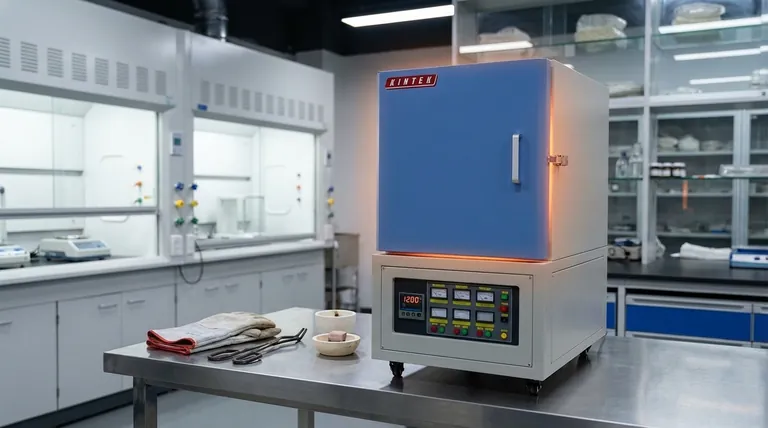
The Core Principle: How a "Muffle" Unlocks Performance
To understand the benefits of a muffle furnace, you must first understand its central component. The entire design is built around the "muffle" itself.
What is a Muffle?
A muffle is a sealed, high-temperature chamber that sits inside the furnace's insulated casing. The heating elements are located outside this chamber, heating the muffle's exterior walls.
Think of it like a high-tech covered baking dish placed inside a conventional oven. The oven's elements heat the dish, and the dish then heats the food inside it—gently and evenly.
Isolating the Sample
The muffle acts as a physical barrier between the heat source and your sample or workload. Heat is transferred indirectly, radiating from the muffle's hot interior walls onto the sample.
This separation is the key to most of the furnace's performance benefits. It creates a highly stable and controlled thermal environment that is independent of the fluctuations of the heating elements themselves.
Preventing Contamination
In many high-temperature processes, purity is paramount. Direct exposure to electric heating elements can release microscopic particles that contaminate the sample.
Because the muffle physically separates the sample from the elements, it provides a contamination-free environment. This design also allows for the introduction of controlled atmospheres (like nitrogen or argon) to prevent oxidation.
Key Performance Pillars Explained
The muffle design directly translates into three critical performance advantages that define this type of furnace.
Unmatched Temperature Uniformity
Because heat radiates from all interior surfaces of the muffle, it bathes the sample evenly from all sides. This eliminates hot spots that can occur with direct heating methods.
This uniformity is critical for processes like annealing, sintering, and ashing, where every part of the sample must experience the exact same temperature for a consistent and successful outcome.
Precise and Rapid Temperature Control
Modern muffle furnaces use advanced digital controllers that, combined with the stable muffle environment, allow for extremely precise temperature management. The system can hold a target temperature with very little deviation.
While the insulation means they hold heat well, many models are engineered for rapid heating, with some able to reach temperatures over 1200°C in about an hour, saving valuable time in a lab or production setting.
High-Temperature Capability
Muffle furnaces are built from durable, highly heat-resistant materials like advanced ceramics and alloys. This robust construction allows them to safely and consistently operate at extremely high temperatures, often up to 1200°C, 1600°C, or even 1800°C depending on the model.
Understanding the Trade-offs and Operational Realities
No tool is perfect for every job. Acknowledging the operational characteristics of a muffle furnace is key to using it effectively.
The Nuance of Energy Efficiency
Muffle furnaces are considered energy-efficient due to their heavy insulation, which minimizes heat loss to the surrounding environment. They are excellent at getting to temperature and staying there without wasting energy.
However, bringing a well-insulated chamber to 1200°C is an energy-intensive process. The "efficiency" is in heat retention, not necessarily in low absolute power consumption during heat-up.
Heating and Cooling Cycles
The same heavy insulation that provides thermal stability and efficiency means that muffle furnaces cool down slowly. This can be an advantage for processes that require gradual cooling, like annealing.
Conversely, it can be a drawback if your process requires rapid thermal cycling or quick access to the sample after a cycle is complete. This slower cooling rate can limit daily throughput.
Durability and Maintenance
The robust construction gives these furnaces a long service life, but they are not maintenance-free. The heating elements and the muffle chamber itself are long-term consumables that can eventually degrade from extreme thermal cycling.
Proper operation, avoiding rapid temperature shocks, and keeping the chamber clean are critical for maximizing the furnace's lifespan.
Making the Right Choice for Your Goal
Select a muffle furnace when the integrity and consistency of your thermal process are the highest priority.
- If your primary focus is process purity and repeatability: The muffle's isolation is your greatest asset, preventing contamination and ensuring uniform results for sensitive materials science or chemical analysis.
- If your primary focus is high-temperature material testing: The furnace's ability to reach and stably hold precise, high temperatures makes it the ideal tool for testing material properties, phase transitions, and durability.
- If your primary focus is quality control and ashing: The uniform, controlled heating ensures that organic compounds are burned off completely and consistently, providing accurate and repeatable results.
Ultimately, selecting a muffle furnace is an investment in a controlled, stable, and clean thermal environment, enabling the highest quality outcomes for your critical processes.
Summary Table:
| Key Benefit | Description |
|---|---|
| Temperature Uniformity | Eliminates hot spots with even heat distribution from all sides for consistent results in annealing, sintering, and ashing. |
| Precise Control | Advanced digital controllers ensure stable temperature management with minimal deviation for repeatable processes. |
| Contamination Prevention | Muffle chamber isolates samples from heating elements, providing a clean environment ideal for sensitive materials. |
| High-Temperature Capability | Built with durable materials to safely operate up to 1800°C, supporting demanding applications. |
| Energy Efficiency | Heavy insulation minimizes heat loss, maintaining temperature efficiently once reached. |
Unlock the full potential of your laboratory with KINTEK's advanced high-temperature furnace solutions! Leveraging exceptional R&D and in-house manufacturing, we provide diverse labs with reliable equipment like Muffle, Tube, Rotary Furnaces, Vacuum & Atmosphere Furnaces, and CVD/PECVD Systems. Our strong deep customization capability ensures precise alignment with your unique experimental needs, delivering contamination-free, uniform heating for superior results in research and quality control. Contact us today to discuss how we can enhance your thermal processes and drive innovation!
Visual Guide

Related Products
- 1400℃ Muffle Oven Furnace for Laboratory
- 1700℃ High Temperature Muffle Oven Furnace for Laboratory
- 1800℃ High Temperature Muffle Oven Furnace for Laboratory
- 1200℃ Muffle Oven Furnace for Laboratory
- High Temperature Muffle Oven Furnace for Laboratory Debinding and Pre Sintering
People Also Ask
- What is the primary function of a high-temperature laboratory muffle furnace in chemical synthesis? Achieve Precision.
- How does a high-temperature laboratory muffle furnace affect material properties? Transform Anodic Oxide Films Fast
- What is the purpose of using a laboratory high-temperature muffle furnace for drying Fe-Ni-Co catalysts? Boost Purity
- How is a laboratory high-temperature muffle furnace utilized to achieve the specific crystalline structure of LaFeO3 catalysts?
- What role does a muffle furnace play in refractory bricks? Enhance Performance and Durability Testing



















