
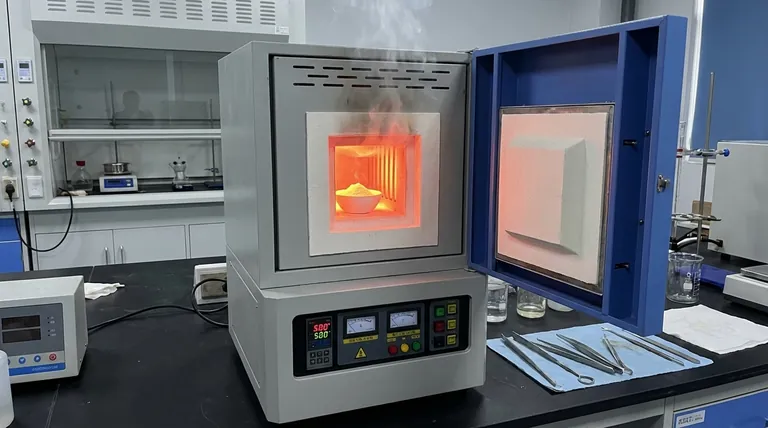
The box resistance furnace is required to provide a precise, high-temperature environment specifically engineered to transform chemical precursors into a stable material without destroying its architecture. For Au-modified ZnO, this equipment enables the controlled removal of organic templates at temperatures around 500 °C. It ensures that the transition from a precursor to a crystalline porous nanofoam happens gradually, preserving the material's structural integrity.
Core Insight The success of calcination lies not just in reaching high temperatures, but in how you get there. The box resistance furnace allows for a strictly controlled heating rate (e.g., 2 °C/min), which is the decisive factor in preventing structural collapse while removing organic binders like PVP to create a high-surface-area porous framework.
The Critical Role of Thermal Decomposition
Removing Organic Templates
The primary function of the furnace in this context is the removal of organic templates, specifically polyvinylpyrrolidone (PVP). PVP is used during the synthesis phase to shape the structure but must be eliminated to activate the material.
Preventing Structural Collapse
If the organic material is removed too quickly, the sudden release of gases can shatter the delicate nanofoam structure. The furnace provides a stable environment where PVP decomposes thermally at a controlled pace.
Creating the "Nanofoam" Architecture
As the PVP is removed, it leaves behind voids. This process transforms the solid precursor into a ZnO porous nanofoam, maximizing the surface area available for catalytic reactions.
Achieving Crystalline Stability
From Precursor to Crystal
The calcination process drives the phase transformation of the material. It converts the amorphous or intermediate precursor into a stable, crystalline ZnO structure.
Grain Growth Control
Heat drives the growth of crystal grains. The box resistance furnace maintains a uniform thermal field, promoting appropriate grain growth that is large enough for stability but small enough to maintain a high surface area.
Ensuring Component Integrity
For Au-modified materials, the high-temperature treatment stabilizes the interaction between the Gold (Au) and the Zinc Oxide (ZnO). This ensures the final material is chemically robust and ready for application.
Understanding the Trade-offs
The Risk of Rapid Heating
While it may be tempting to speed up the process, deviating from the prescribed heating rate (e.g., exceeding 2 °C/min) is a common pitfall. Rapid heating often causes thermal shock, resulting in cracks or a complete collapse of the porous network.
Temperature Balance
There is a delicate balance in selecting the hold temperature (e.g., 500 °C).
- Too Low: Organic residues (PVP) remain, blocking active sites and reducing performance.
- Too High: The material may "sinter" excessively, causing pores to close up and reducing the specific surface area.
Making the Right Choice for Your Goal
To optimize the calcination of Au-modified ZnO, you must tailor the furnace settings to your specific material targets.
- If your primary focus is Structural Integrity: Prioritize a slow ramp rate (2 °C/min or lower) to ensure gases escape slowly without rupturing the nanofoam walls.
- If your primary focus is Purity and Activity: Ensure the hold time is sufficient at the target temperature (500 °C) to fully oxidize and remove all traces of the PVP template.
** precise thermal management is the difference between a high-performance porous catalyst and a collapsed, inactive ceramic.**
Summary Table:
| Process Requirement | Critical Role of Box Resistance Furnace | Benefit to Au-modified ZnO |
|---|---|---|
| Template Removal | Controlled oxidation of PVP organic binders | Creates high-surface-area porous voids |
| Thermal Precision | Strict heating rate control (e.g., 2 °C/min) | Prevents structural collapse and gas ruptures |
| Crystallization | Uniform high-temperature field (500 °C) | Ensures stable grain growth and chemical robustness |
| Phase Transition | Stable thermal decomposition environment | Converts precursors into active crystalline nanofoam |
Elevate Your Material Research with KINTEK
Precise thermal management is the difference between a high-performance catalyst and a collapsed structure. KINTEK provides industry-leading laboratory solutions tailored for advanced material synthesis. Backed by expert R&D and manufacturing, we offer a comprehensive range of Muffle, Tube, Rotary, Vacuum, and CVD systems, all fully customizable to meet your unique calcination requirements.
Whether you are refining Au-modified ZnO or developing next-generation nanomaterials, our high-temperature furnaces ensure the uniform heating and ramp-rate precision your lab demands.
Ready to optimize your calcination process? Contact our technical experts today to find the perfect furnace solution for your needs.
References
- Zhenchao Sun, Pengfei Cheng. Gas Sensor for Efficient Acetone Detection and Application Based on Au-Modified ZnO Porous Nanofoam. DOI: 10.3390/s24248100
This article is also based on technical information from Kintek Furnace Knowledge Base .
Related Products
- 1700℃ High Temperature Laboratory Tube Furnace with Alumina Tube
- 1400℃ High Temperature Laboratory Tube Furnace with Alumina Tube
- 1700℃ Controlled Inert Nitrogen Atmosphere Furnace
- 1400℃ Controlled Inert Nitrogen Atmosphere Furnace
- Molybdenum Vacuum Heat Treat Furnace
People Also Ask
- How does zone-melting in tube furnaces synthesize bismuth micro-wires? Master Single-Crystal Thermoelectric Growth
- How are high-temp tube furnaces used to measure diffusion coefficients per Fick's law? Master Precision Annealing
- How do high-temperature laboratory tube furnaces ensure environmental stability? Precision Thermal Reduction Tips
- How are high-temperature laboratory tube furnaces applied in long-term vacuum homogenization heat treatments for intermetallic samples?
- How are high-temperature tube furnaces applied in testing ceramic-supported alloy membranes? Insights



















