
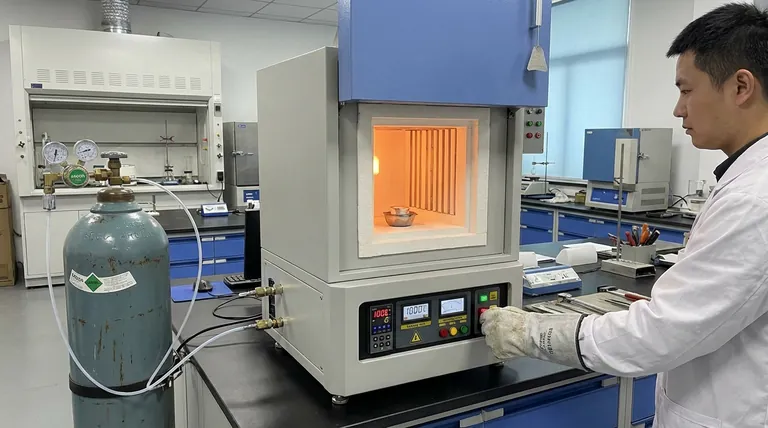
To ensure the successful solution heat treatment of Ti-xNb alloys, a laboratory muffle furnace must prioritize precise temperature control with stable heating rates (typically $10^\circ\text{C}/\text{min}$) and robust environmental isolation. Specifically, the unit must feature an integrated vacuum system or inert atmosphere protection (such as Argon) to prevent oxygen absorption. Without these specific capabilities, the alloy cannot accurately reach target phase regions like $1000^\circ\text{C}$ without becoming brittle.
Core Insight: The critical challenge in treating titanium alloys is not just reaching high temperatures, but maintaining chemical purity while doing so. A standard muffle furnace is insufficient; the equipment must effectively isolate the material from oxygen to secure desired alpha, beta, or martensite phase structures.
Protecting Material Integrity
The Necessity of Atmosphere Control
Titanium alloys are highly reactive at elevated temperatures. If exposed to air during heat treatment, Ti-xNb alloys will absorb oxygen.
This absorption leads to severe embrittlement, compromising the mechanical properties of the material. Therefore, the most critical characteristic of the furnace is the ability to maintain a clean heat treatment environment.
Vacuum and Inert Gas Integration
To mitigate oxidation, the furnace must be equipped with protection devices.
This typically involves a vacuum system or the capability to introduce an inert gas flow, such as Argon. These systems ensure the material remains chemically stable while heated, preventing surface contamination and preserving the alloy's ductility.
Achieving Target Phase Structures
Precision Temperature Regulation
Solution heat treatment is designed to target specific phase regions, often requiring temperatures around $1000^\circ\text{C}$ for Ti-xNb alloys (or varying ranges like $790^\circ\text{C}$ to $1350^\circ\text{C}$ for other titanium variants).
The furnace must offer precise control to reach and hold these temperatures accurately. This precision allows for the homogenization of the microstructure and the elimination of casting stresses.
Stable Heating Rates
How the furnace reaches the target temperature is as important as the final temperature itself.
A stable heating rate, such as $10^\circ\text{C}$ per minute, is recommended. Controlled ramping ensures the alloy reaches the target phase region uniformly, which is essential for obtaining the desired post-cooling structures, such as the martensite or metastable beta phases.
Understanding the Trade-offs
Standard vs. Specialized Furnaces
A common pitfall is attempting to use a standard high-temperature muffle furnace without atmosphere control.
While a standard furnace can easily reach $1000^\circ\text{C}$, the lack of oxygen protection renders it useless for Titanium alloys. You must trade the lower cost of a standard unit for the higher complexity of a vacuum or atmosphere-controlled unit to ensure material viability.
Processing Speed vs. Structural Homogeneity
It may be tempting to prioritize rapid heating to save time.
However, Ti-xNb alloys require thermal equilibrium to induce proper recrystallization and phase transformation. Adhering to a moderate, controlled rate (like $10^\circ\text{C}/\text{min}$) yields a superior microstructure compared to rapid, uncontrolled heating.
Making the Right Choice for Your Goal
Select your equipment configuration based on the specific metallurgical outcome you need to achieve.
- If your primary focus is Avoiding Embrittlement: Prioritize a furnace with a high-integrity vacuum seal or positive-pressure inert gas capability to strictly limit oxygen exposure.
- If your primary focus is Phase Structure Control: Prioritize a furnace with programmable PID controllers that guarantee stable ramp rates ($10^\circ\text{C}/\text{min}$) and precise dwell times.
Ultimately, the furnace serves as the gatekeeper for the alloy's microstructure, determining whether you achieve a high-performance material or a brittle failure.
Summary Table:
| Feature | Requirement for Ti-xNb Treatment | Impact on Material Outcome |
|---|---|---|
| Atmosphere Control | Vacuum or Inert Gas (Argon) | Prevents oxygen absorption and embrittlement |
| Temperature Precision | Accurate control up to 1000°C+ | Ensures homogenization and target phase region |
| Heating Rate | Stable 10°C/min ramp rate | Uniform phase transformation; prevents stress |
| Cooling Flexibility | Integrated quenching capability | Controls final phase (Martensite/Beta) |
Elevate Your Titanium Research with KINTEK
Precision is non-negotiable when treating reactive Ti-xNb alloys. KINTEK provides industry-leading Muffle, Tube, Vacuum, and CVD systems specifically designed to eliminate oxygen contamination and deliver the stable 10°C/min heating rates your research demands.
Backed by expert R&D and world-class manufacturing, our laboratory high-temp furnaces are fully customizable to meet your unique metallurgical goals. Don't compromise your alloy's integrity with standard equipment—partner with KINTEK for superior thermal solutions.
Contact KINTEK Experts Today" Form)"
References
- Felype Narciso de Mattos, Conrado Ramos Moreira Afonso. Wear Behavior of Ti-xNb Biomedical Alloys by Ball Cratering. DOI: 10.1590/1980-5373-mr-2023-0494
This article is also based on technical information from Kintek Furnace Knowledge Base .
Related Products
- 1800℃ High Temperature Muffle Oven Furnace for Laboratory
- 1200℃ Muffle Oven Furnace for Laboratory
- 1700℃ High Temperature Muffle Oven Furnace for Laboratory
- 1400℃ Muffle Oven Furnace for Laboratory
- High Temperature Muffle Oven Furnace for Laboratory Debinding and Pre Sintering
People Also Ask
- What is the primary function of a high-temperature laboratory muffle furnace in chemical synthesis? Achieve Precision.
- How does a high-temperature laboratory muffle furnace affect material properties? Transform Anodic Oxide Films Fast
- What is the critical role of a laboratory high-temperature muffle furnace in TiO2/LDH? Unlock Superior Crystallization
- What is the role of a laboratory high-temperature muffle furnace in iron analysis? Key to Precise Sample Mineralization
- Why is a laboratory high-temperature muffle furnace required for LaNixFe1-xO3 catalysts? Optimize Two-Stage Synthesis



















