
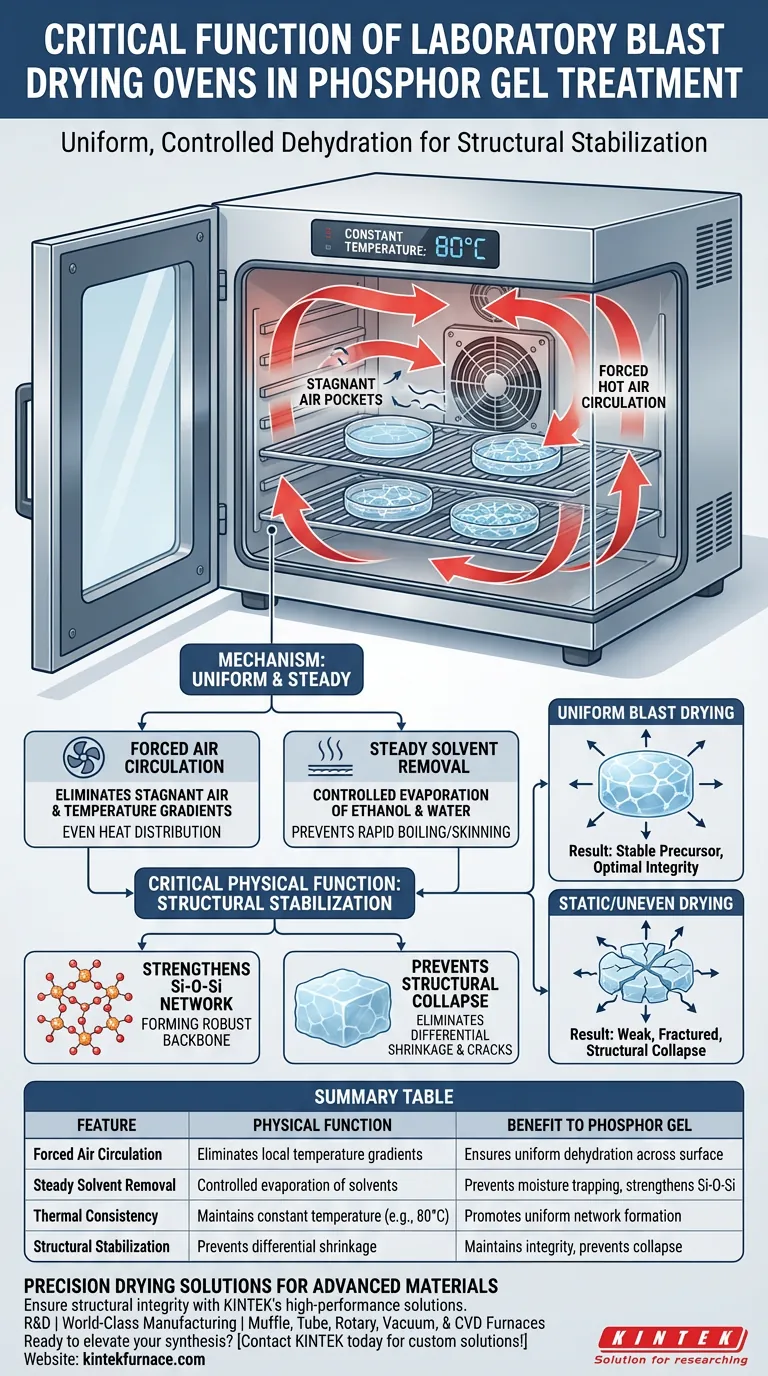
The critical physical function of a laboratory electric blast drying oven is to execute a uniform, controlled dehydration process that stabilizes the gel’s internal structure prior to high-temperature synthesis. By utilizing forced hot air circulation at a constant temperature (typically 80°C), the oven steadily removes residual ethanol and excess water while actively preventing the physical defects associated with uneven drying.
Core Takeaway Drying is not merely about solvent removal; it is a structural stabilization step. The blast drying oven ensures the Si-O-Si network strengthens uniformly, preventing the structural collapse that often results from local temperature gradients during static drying.
The Mechanism of Controlled Dehydration
Forced Hot Air Circulation
The defining feature of a "blast" oven is its ability to circulate heated air actively. This mechanism ensures that heat is distributed evenly across the entire surface area of the gel.
Without this forced circulation, stagnant air pockets can create uneven drying rates. The blast function guarantees that the thermal environment remains consistent throughout the chamber.
Steady Solvent Removal
The gel treatment process requires the removal of volatile components, specifically residual ethanol and excess water.
The oven operates at a constant temperature to drive these solvents out at a steady, predictable rate. This controlled evaporation prevents the rapid boiling or skinning that might trap moisture inside the material.
Structural Stabilization of the Precursor
Strengthening the Si-O-Si Network
As the solvents are removed, the chemical structure of the gel evolves. The steady heat promotes the further condensation and strengthening of the Si-O-Si (silicon-oxygen-silicon) network.
This network is the backbone of the precursor. Ensuring it forms correctly during this low-temperature phase is vital for the material's performance in later stages.
Preventing Structural Collapse
The most critical protective function of the oven is the prevention of structural collapse.
In uneven heating environments, local temperature gradients cause different parts of the gel to shrink at different rates. This differential shrinkage leads to cracks and collapse. The blast oven’s uniform heat profile eliminates these gradients, maintaining the precursor's ideal physical form.
Understanding the Trade-offs
The Risk of Non-Uniformity
If the forced air circulation is interrupted or the oven is overloaded, the uniformity of the process is compromised.
Even a slight variance in airflow can reintroduce temperature gradients. This defeats the purpose of the equipment, potentially leading to a weak or fractured Si-O-Si network despite the correct temperature setting.
Temperature Precision vs. Speed
While it may be tempting to increase temperatures to speed up drying, the process relies on a constant, moderate temperature (e.g., 80°C).
Excessive heat can drive solvents off too violently, damaging the pore structure before the network has time to rigidify. The goal is stability, not speed.
Making the Right Choice for Your Goal
To maximize the effectiveness of the gel treatment process, prioritize the following parameters:
- If your primary focus is Structural Integrity: Ensure the oven's airflow vents are unobstructed to guarantee the uniform dehydration required to prevent collapse.
- If your primary focus is Chemical Purity: Monitor the duration of the cycle to ensure the complete removal of ethanol and water, which facilitates the optimal strengthening of the Si-O-Si network.
A stable, uniformly dried precursor is the prerequisite for high-performance phosphor production.
Summary Table:
| Feature | Physical Function | Benefit to Phosphor Gel |
|---|---|---|
| Forced Air Circulation | Eliminates local temperature gradients | Ensures uniform dehydration across the entire gel surface |
| Steady Solvent Removal | Controlled evaporation of ethanol and water | Prevents rapid boiling and moisture trapping |
| Thermal Consistency | Constant temperature maintenance (e.g., 80°C) | Strengthens the Si-O-Si network backbone |
| Structural Stabilization | Prevention of differential shrinkage | Maintains precursor integrity and prevents structural collapse |
Precision Drying Solutions for Advanced Materials
Ensure the structural integrity of your precursors with KINTEK’s high-performance laboratory solutions. Backed by expert R&D and world-class manufacturing, we provide high-precision electric blast drying ovens and specialized high-temperature systems including Muffle, Tube, Rotary, Vacuum, and CVD furnaces.
Whether you are stabilizing delicate Si-O-Si networks for phosphor production or require a fully customizable thermal process for unique lab needs, KINTEK delivers the reliability and uniform heat control your research demands.
Ready to elevate your material synthesis? Contact KINTEK today to find your custom solution!
Visual Guide
References
- K. A. K. Durga Prasad, D. Haranath. Enhanced blue emission and afterglow properties of Sr2MgSi2O7:Eu2+, Dy3+ phosphors for flexible transparent labels. DOI: 10.1063/5.0230526
This article is also based on technical information from Kintek Furnace Knowledge Base .
Related Products
- Laboratory Muffle Oven Furnace with Bottom Lifting
- 1200℃ Muffle Oven Furnace for Laboratory
- 1800℃ High Temperature Muffle Oven Furnace for Laboratory
- 1400℃ Muffle Oven Furnace for Laboratory
- 1700℃ High Temperature Muffle Oven Furnace for Laboratory
People Also Ask
- What function does a muffle furnace perform in Ba0.75Ca0.25TiO3 calcination? Ensure Phase Purity & Synthesis
- Why is a high-temperature muffle furnace required for FeOx-MOx/TiO2? Engineering High-Performance Nanocomposites
- Why is a high-temperature laboratory muffle furnace essential for the alkali fusion process in zeolite synthesis?
- What is the importance of the calcination process? Master High-Purity Calcium Phosphate Nanopowder Production
- What are the primary functions of a high-temperature laboratory muffle furnace in the preparation of biosorbent materials?








