
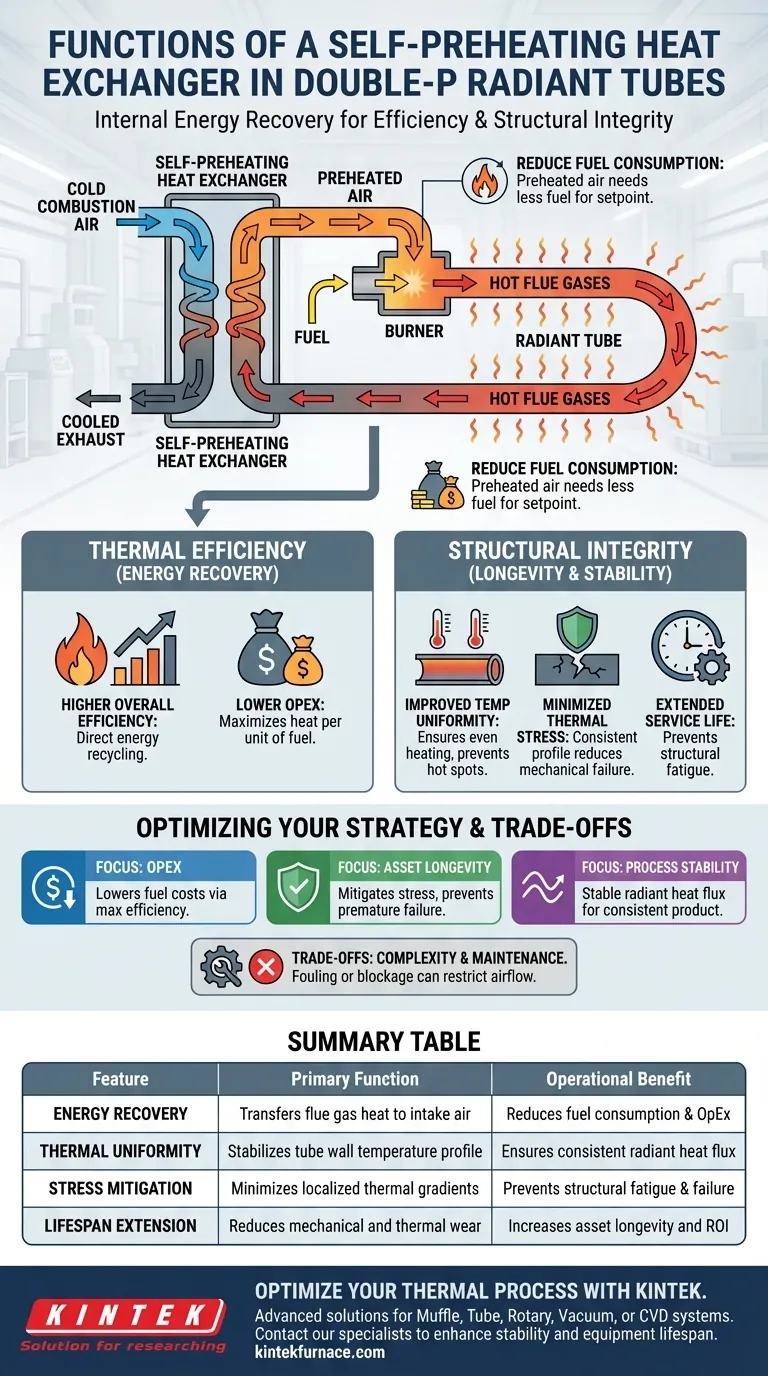
The primary function of a self-preheating heat exchanger within double-P radiant tubes is to act as an internal energy recovery system. It specifically captures waste heat from high-temperature flue gases and transfers it to the incoming combustion air before that air reaches the burner.
By recycling thermal energy that would otherwise be lost, this component significantly increases overall thermal efficiency while simultaneously stabilizing the tube's temperature profile to prevent structural damage.

The Mechanics of Thermal Efficiency
Recovering Waste Energy
The fundamental operation involves heat transfer from exhaust to intake. As high-temperature flue gases exit the system, they pass through the heat exchanger, warming the cold combustion air entering the tube.
Reducing Fuel Consumption
Because the combustion air is preheated, the system requires less fuel to raise the flame temperature to the desired setpoint. This direct recycling of energy creates a higher overall thermal efficiency for the radiant tube system compared to designs without preheating.
Enhancing Structural Integrity
Improving Temperature Uniformity
Beyond simple energy savings, the heat exchanger plays a vital role in how heat is distributed. It enhances the uniformity of the tube wall temperature, ensuring the radiant tube heats evenly rather than developing dangerous hot or cold spots.
Minimizing Thermal Stress
Uneven temperature distribution is a leading cause of mechanical failure in radiant tubes. By ensuring a consistent temperature profile, the heat exchanger minimizes localized thermal stress across the tube's geometry.
Extending Service Life
The reduction in thermal stress directly correlates to durability. By preventing the structural fatigue caused by uneven heating and cooling, the heat exchanger helps to extend the operational lifespan of the double-P radiant tube.
Understanding the Trade-offs
Complexity and Maintenance
While the benefits are clear, introducing a heat exchanger adds mechanical complexity to the tube design. Users must be aware that fouling or blockage within the exchanger can occur over time, potentially restricting airflow and reducing the very efficiency it was designed to create.
Optimizing Your Heating Strategy
If your primary focus is Operational Expenditure (OpEx):
- The self-preheating capability is essential, as it directly lowers fuel costs by maximizing thermal efficiency per unit of heat generated.
If your primary focus is Asset Longevity:
- Prioritize this design to mitigate thermal stress, as the improved temperature uniformity is the key factor in preventing premature tube failure.
If your primary focus is Process Stability:
- The consistent wall temperatures provided by the system ensure a more stable radiant heat flux to your product load.
Integrating a self-preheating heat exchanger transforms a radiant tube from a simple heating element into a sophisticated, self-regulating thermal system.
Summary Table:
| Feature | Primary Function | Operational Benefit |
|---|---|---|
| Energy Recovery | Transfers flue gas heat to intake air | Reduces fuel consumption & OpEx |
| Thermal Uniformity | Stabilizes tube wall temperature profile | Ensures consistent radiant heat flux |
| Stress Mitigation | Minimizes localized thermal gradients | Prevents structural fatigue & failure |
| Lifespan Extension | Reduces mechanical and thermal wear | Increases asset longevity and ROI |
Optimize Your Thermal Process with KINTEK
Don’t let waste heat impact your bottom line. KINTEK’s advanced thermal solutions, backed by expert R&D and world-class manufacturing, provide the precision and durability your laboratory requires. Whether you need Muffle, Tube, Rotary, Vacuum, or CVD systems, our high-temp furnaces are fully customizable to meet your unique operational demands.
Ready to reduce fuel costs and minimize thermal stress in your lab?
Contact our specialists today to discover how our high-efficiency heating technologies can enhance your production stability and equipment lifespan.
Visual Guide
References
- Chien-Cheng Lin, Chien-Hsiung Tsai. Simulation of Staged Combustion Function in Double P-Type Radiant Tubes. DOI: 10.3390/engproc2025092094
This article is also based on technical information from Kintek Furnace Knowledge Base .
Related Products
- High Temperature Muffle Oven Furnace for Laboratory Debinding and Pre Sintering
- Multi Heating Zones CVD Tube Furnace Machine for Chemical Vapor Deposition Equipment
- Multi Zone Laboratory Quartz Tube Furnace Tubular Furnace
- Split Multi Heating Zone Rotary Tube Furnace Rotating Tube Furnace
- Vacuum Heat Treat Furnace with Ceramic Fiber Liner
People Also Ask
- What thermal phenomena occur during polymer binder burnout in ceramic green bodies? Lab Furnace Guide
- What role does a high-temperature muffle furnace play in STFO synthesis? Achieve Pure Perovskite Results
- Why is controlled heat treatment in a muffle furnace necessary for calcined clay? Achieve Optimal Pozzolanic Activity
- How does a high-temperature muffle furnace facilitate the formation of LaNbxAl1−xO3+δ perovskite structures? Key Roles
- What role does a high-temperature muffle furnace play in the formation of biochar catalysts? Master Catalyst Synthesis



















