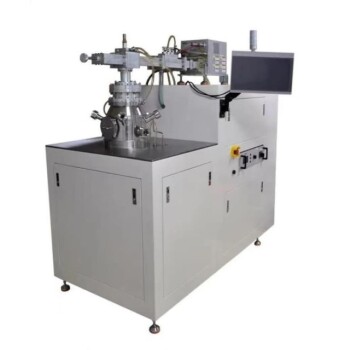
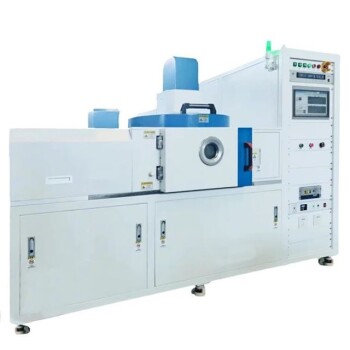
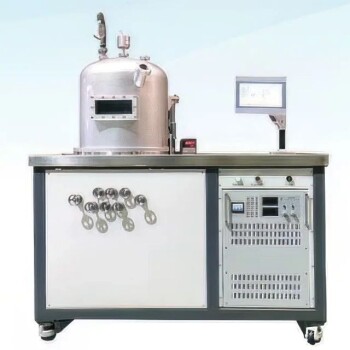
Microwave Plasma Chemical Vapor Deposition (MPCVD) is an advanced manufacturing process that grows high-quality thin films, most notably synthetic diamond, onto a substrate. It uses microwave energy to excite precursor gases into a plasma state, creating a highly controlled environment where atoms can deposit onto a surface to form a perfect crystal lattice. This method avoids the contamination common in other techniques, enabling the production of exceptionally pure materials.
At its core, MPCVD solves the problem of material purity and control. By using contactless microwave energy to generate a plasma, it creates an ultra-clean growth environment, allowing for the synthesis of materials like single-crystal diamond with a quality and size previously unattainable.
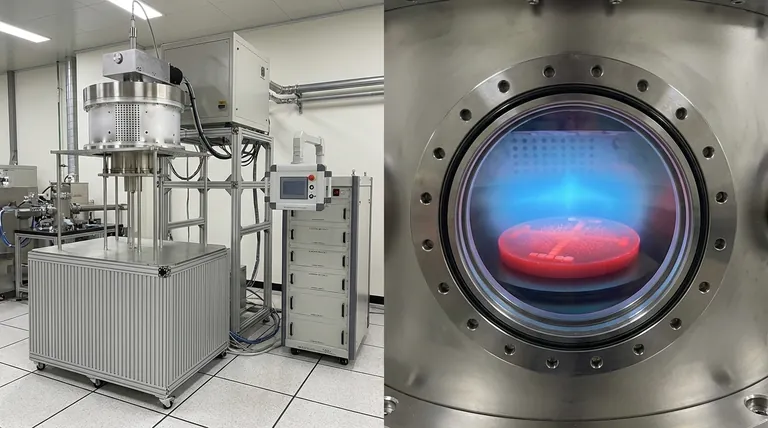
Deconstructing the MPCVD Process
To understand MPCVD, it's best to break down its name. It is a specific and highly refined version of a more general process known as Chemical Vapor Deposition (CVD).
The Foundation: Chemical Vapor Deposition (CVD)
Chemical Vapor Deposition is a foundational technique for creating thin, durable coatings. The process occurs in a vacuum chamber where one or more volatile precursor gases are introduced.
These gases decompose on a heated substrate, undergoing chemical reactions that deposit a solid film onto the surface. This happens molecule by molecule, ensuring a dense and uniform coating.
The 'Plasma' Enhancement
Standard CVD relies on high temperatures (thermal energy) to break down the precursor gases. Plasma-Enhanced CVD (PECVD), however, uses an electrical field to excite the gases into a plasma.
Plasma, often called the fourth state of matter, is an ionized gas containing highly reactive ions and free radicals. This high reactivity allows the deposition process to occur at much lower temperatures while enabling new chemical pathways for film growth.
The 'Microwave' Advantage
MPCVD is a specialized form of PECVD that uses microwaves to generate the plasma. This is a critical distinction. Microwaves energize the gas inside the chamber without any physical contact.
Other plasma methods often require electrodes inside the chamber, which can erode and introduce contaminants into the film. By using microwaves, MPCVD creates a completely isolated and exceptionally clean plasma, which is the key to its ability to grow ultra-pure materials.
Why MPCVD is a Game-Changer for Diamond Synthesis
While MPCVD can create many materials, its impact on lab-grown diamond production has been revolutionary.
Unprecedented Purity and Control
The electrode-free nature of the MPCVD process is paramount for diamond growth. Even trace amounts of impurities can disrupt the diamond's crystal structure, affecting its clarity, color, and electronic properties.
MPCVD offers precise, independent control over process variables like temperature, pressure, and gas chemistry. This allows producers to meticulously tailor the diamond's characteristics for specific applications, from flawless gemstones to advanced semiconductor components.
Enabling Large-Area, High-Quality Films
The microwave-generated plasma can be sustained uniformly over a large area. This allows for the simultaneous growth of multiple diamond crystals or the deposition of a large, consistent diamond film across a wide substrate.
This scalability is a significant advantage for industrial applications, such as creating diamond-coated cutting tools, heat sinks for electronics, or durable optical windows.
Understanding the Trade-offs
No technology is without its limitations. Being an objective advisor means acknowledging the challenges associated with MPCVD.
High Initial Investment
MPCVD reactors are highly complex and sophisticated machines. The cost of the microwave generator, vacuum system, and precise control components makes the initial capital investment substantial.
Process Complexity
Achieving the exceptional results MPCVD is known for requires deep process knowledge. The interplay between gas composition, pressure, temperature, and microwave power is intricate. A slight deviation can dramatically affect the quality of the final product.
Slower Growth Rates
Compared to older methods like High-Pressure High-Temperature (HPHT), which mimics the geological formation of diamond, MPCVD can have a slower growth rate. The trade-off is clear: MPCVD prioritizes crystalline perfection and purity over raw production speed.
Making the Right Choice for Your Goal
The decision to use MPCVD depends entirely on the desired outcome and the material properties you need to achieve.
- If your primary focus is producing the highest-purity single-crystal materials for advanced electronics or optics: MPCVD is the industry-leading standard due to its contamination-free and highly controllable environment.
- If your primary focus is creating large, uniform polycrystalline diamond coatings for industrial tools or thermal management: MPCVD offers superior scalability and film uniformity compared to many other deposition techniques.
- If your primary focus is rapid, bulk production of industrial-grade diamond grit: A different method like High-Pressure High-Temperature (HPHT) synthesis may be more cost-effective and faster.
Ultimately, understanding MPCVD is about recognizing its power to create near-perfect materials by precisely controlling matter at the atomic level.
Summary Table:
| Aspect | Key Takeaway |
|---|---|
| Core Process | Uses microwave energy to create a contactless plasma for ultra-clean thin film deposition. |
| Primary Application | Revolutionary for high-purity single-crystal and large-area polycrystalline diamond synthesis. |
| Key Advantage | Electrode-free design prevents contamination, enabling unprecedented material purity and control. |
| Main Limitation | High initial investment and process complexity require specialized expertise. |
Need to grow ultra-pure diamond films or advanced coatings? KINTEK's expertise in high-temperature furnace solutions, including our advanced CVD/PECVD systems, is tailored for labs demanding precision and purity. Leveraging exceptional R&D and in-house manufacturing, we offer deep customization to meet your unique MPCVD requirements. Contact our experts today to discuss how we can optimize your thin film synthesis process.
Visual Guide

Related Products
- 915MHz MPCVD Diamond Machine Microwave Plasma Chemical Vapor Deposition System Reactor
- MPCVD Machine System Reactor Bell-jar Resonator for Lab and Diamond Growth
- Cylindrical Resonator MPCVD Machine System for Lab Diamond Growth
- Multi Heating Zones CVD Tube Furnace Machine for Chemical Vapor Deposition Equipment
- Slide PECVD Tube Furnace with Liquid Gasifier PECVD Machine
People Also Ask
- What is the MPCVD method and why is it considered effective for diamond deposition? Superior Purity & High Growth Rates
- What factors influence the quality of diamond deposition in the MPCVD method? Master the Critical Parameters for High-Quality Diamond Growth
- What are some key features and benefits of the microwave plasma chemical vapor deposition system? Achieve Unmatched Material Synthesis
- What is the purpose of a microwave plasma chemical vapor deposition system? Grow High-Purity Diamonds and Advanced Materials
- What is the basic principle of operation for the microwave plasma chemical vapor deposition system? Unlock High-Purity Material Growth