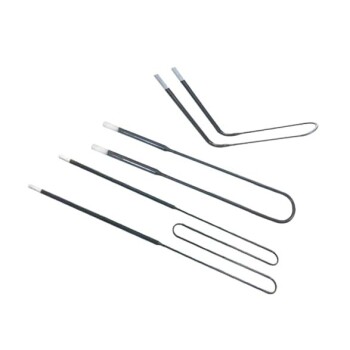
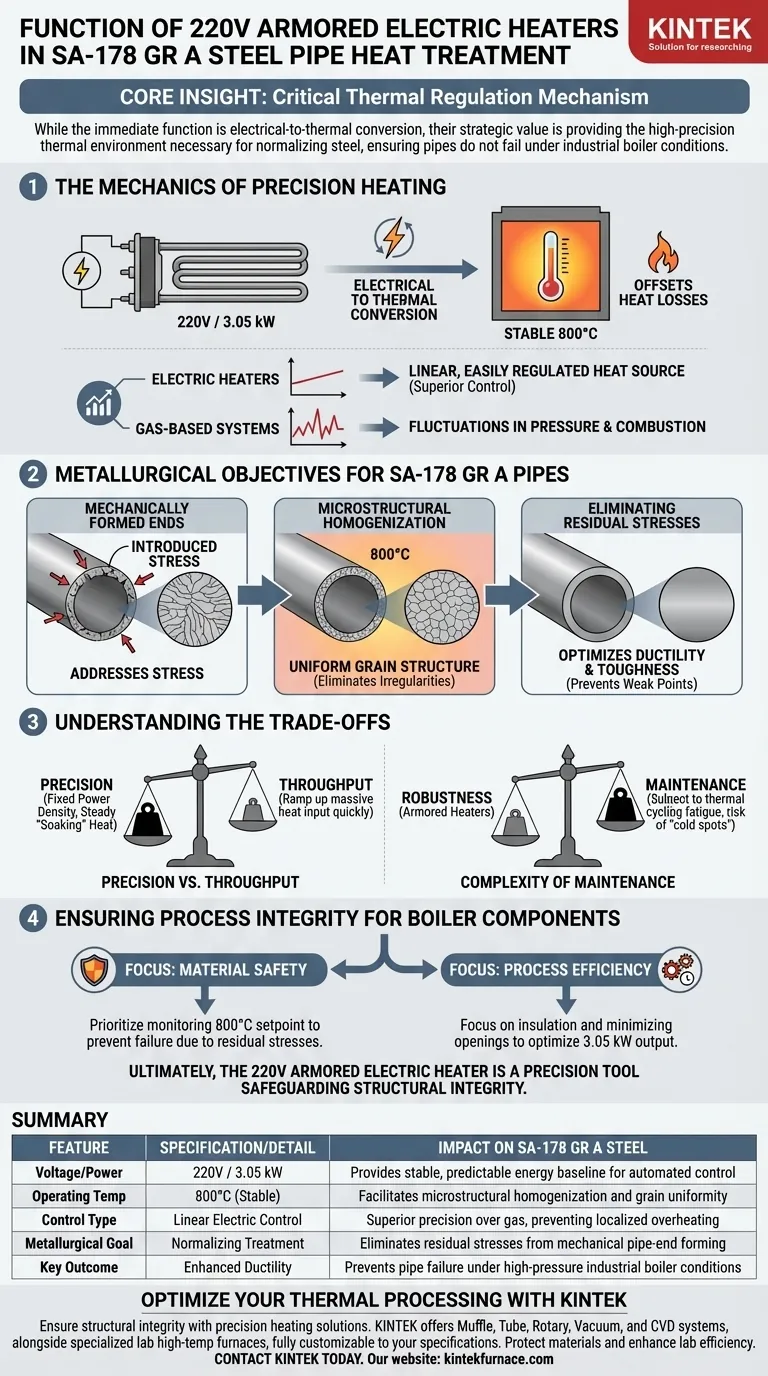
220V armored electric heaters serve as the critical thermal regulation mechanism for the precise heat treatment of SA-178 Gr A steel pipes. By converting electrical energy into thermal energy with specific outputs (such as 3.05 kW), these components actively offset heat losses to maintain a strictly stable operating temperature of 800°C.
Core Insight While the immediate function of these heaters is energy conversion, their strategic value lies in providing the high-precision thermal environment necessary for normalizing steel. Unlike gas-based systems, these heaters offer the stability required to achieve microstructural homogenization, ensuring the pipes do not fail under industrial boiler conditions.

The Mechanics of Precision Heating
Maintaining a Stable 800°C Environment
The primary technical function of the armored electric heater is to sustain a constant high-temperature environment.
Specifically, the process requires a steady operating temperature of 800°C. The heaters are engineered to continuously compensate for thermal energy lost to the surrounding environment during the treatment cycle.
Electrical to Thermal Conversion
These units function by converting electrical input directly into thermal energy.
With specific power ratings, such as 3.05 kW, they provide a consistent energy baseline. This predictable output is essential for automating the temperature control loop within industrial electric furnaces.
Superior Control Compared to Gas
A key advantage of using armored electric heaters over traditional gas-based heating is control precision.
Gas systems can suffer from fluctuations in fuel pressure or combustion consistency. Electric heaters provide a linear, easily regulated heat source, which is mandatory when the margin for error in the steel's temperature profile is narrow.
Metallurgical Objectives for SA-178 Gr A Pipes
Addressing Mechanically Formed Ends
The heat treatment specifically targets the ends of SA-178 Gr A steel pipes, which have undergone mechanical forming.
This mechanical forming introduces stress into the material structure. The heaters enable a "normalizing" heat treatment designed to address these specific localized changes.
Microstructural Homogenization
The ultimate goal of maintaining the 800°C temperature is microstructural homogenization.
By holding the steel at this precise temperature, the internal grain structure of the metal becomes uniform. This eliminates the irregularities caused by previous mechanical processing.
Eliminating Residual Stresses
The controlled heating process effectively relieves residual internal stresses.
If left untreated, these stresses creates weak points in the pipe. Removing them is critical for optimizing the ductility and toughness of the steel.
Understanding the Trade-offs
Precision vs. Energy Throughput
While armored electric heaters offer superior precision, they are generally limited by their fixed power density (e.g., 3.05 kW).
Unlike gas burners which can ramp up massive heat input quickly, electric heaters provide steady, "soaking" heat. They are excellent for maintaining temperature but may have slower recovery times if the furnace door is opened frequently or if the thermal load increases unexpectedly.
Complexity of Element Maintenance
Armored heaters are robust, but they are subject to thermal cycling fatigue.
Maintaining the strict 800°C requirement means the elements must be functioning at peak efficiency. A degrading heating element can create "cold spots" in the furnace, potentially leading to uneven heat treatment and inconsistent pipe quality.
Ensuring Process Integrity for Boiler Components
To ensure the safety and longevity of industrial boilers, the application of these heaters must be aligned with your specific processing goals.
- If your primary focus is Material Safety: Prioritize the monitoring of the 800°C setpoint, as deviations here prevent the elimination of residual stresses that lead to pipe failure.
- If your primary focus is Process Efficiency: Focus on insulation and minimizing furnace openings to allow the 3.05 kW output to offset natural losses rather than reheating the air.
Ultimately, the 220V armored electric heater is not just a heat source; it is a precision tool that safeguards the structural integrity of high-pressure boiler components.
Summary Table:
| Feature | Specification/Detail | Impact on SA-178 Gr A Steel |
|---|---|---|
| Voltage/Power | 220V / 3.05 kW | Provides stable, predictable energy baseline for automated control |
| Operating Temp | 800°C (Stable) | Facilitates microstructural homogenization and grain uniformity |
| Control Type | Linear Electric Control | Superior precision over gas, preventing localized overheating |
| Metallurgical Goal | Normalizing Treatment | Eliminates residual stresses from mechanical pipe-end forming |
| Key Outcome | Enhanced Ductility | Prevents pipe failure under high-pressure industrial boiler conditions |
Optimize Your Thermal Processing with KINTEK
Ensure the structural integrity of your high-pressure components with precision heating solutions. Backed by expert R&D and world-class manufacturing, KINTEK offers a comprehensive range of Muffle, Tube, Rotary, Vacuum, and CVD systems, alongside specialized lab high-temp furnaces.
Whether you need to maintain a strict 800°C environment or require a custom thermal setup for unique metallurgical needs, our systems are fully customizable to your specifications. Protect your materials and enhance your lab's efficiency—contact KINTEK today to discuss your custom furnace requirements.
Visual Guide
References
- Gustavo Ribeiro Zanini, LUIS CARLOS GERON. PROJETO DE UM FORNO ELÉTRICO INDUSTRIAL PARA TRATAMENTO TÉRMICO TUBOS DE AÇO SA-178 GR A. DOI: 10.52138/citec.v17i01.437
This article is also based on technical information from Kintek Furnace Knowledge Base .
Related Products
People Also Ask
- What are the typical application temperatures for molybdenum disilicide (MoSi2) heating elements? Master High-Temp Performance
- What is the primary use of molybdenum disilicide? Ideal for High-Temp Heating Elements
- What are the characteristics of molybdenum disilicide heating elements? Unlock High-Temp Performance
- What are the properties of molybdenum disilicide (MoSi2) that make it suitable for high-temperature applications? Discover Its High-Temp Resilience
- What are the applications of molybdenum disilicide heating elements? Achieve Extreme Heat Stability for Industrial Processes