
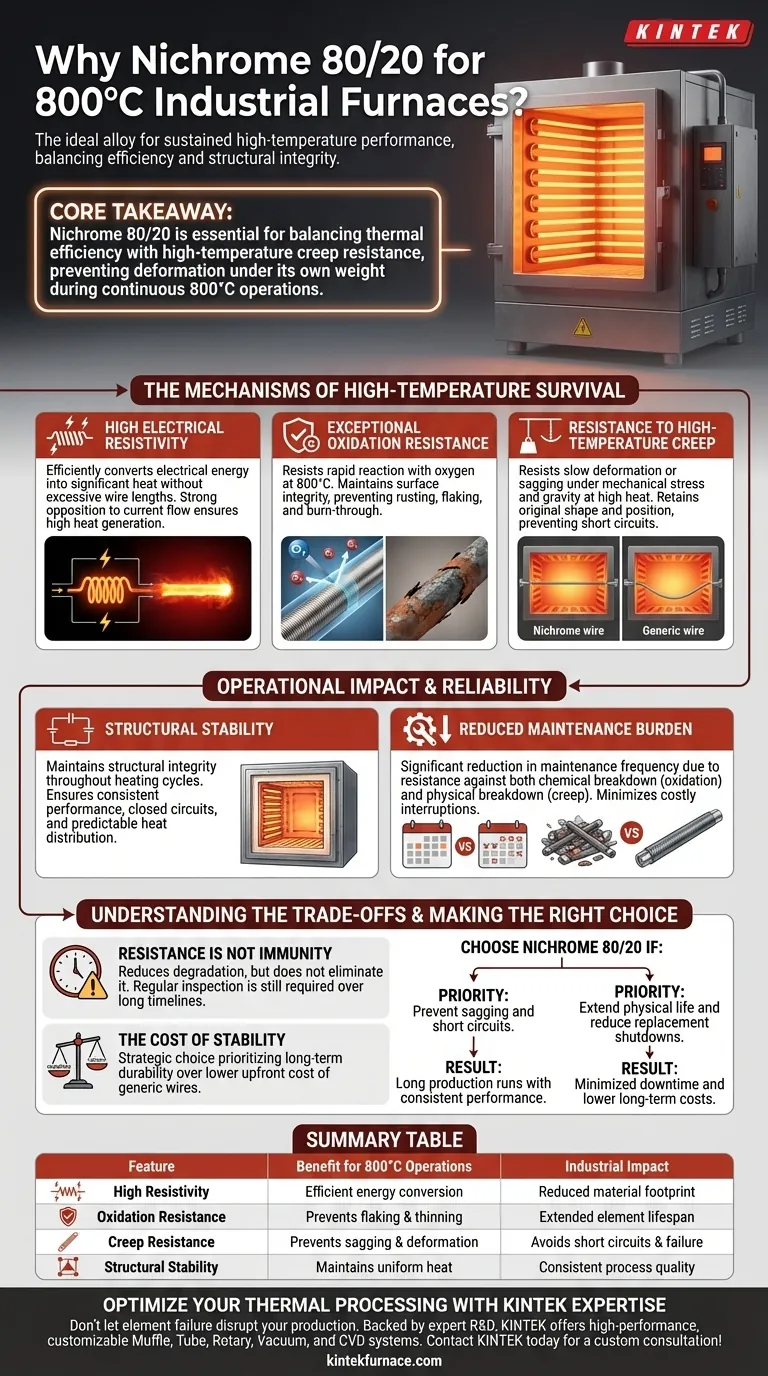
Nichrome 80/20 is the ideal alloy for industrial heating elements primarily due to its unique combination of high electrical resistivity and exceptional resistance to physical and chemical degradation at high temperatures. It allows furnaces to operate continuously at 800°C by efficiently converting electricity into heat while maintaining structural integrity against oxidation and creep.
Core Takeaway While many metals can generate heat, few can survive the process. Nichrome 80/20 is essential for industrial furnaces because it balances thermal efficiency with "high-temperature creep" resistance, preventing the element from deforming or failing under its own weight during sustained 800°C operations.
The Mechanisms of High-Temperature Survival
To understand why Nichrome 80/20 is specified for these environments, we must look at how it handles the three main stressors of industrial heating: electrical resistance, chemical attack, and mechanical stress.
High Electrical Resistivity
The primary function of a heating element is to convert electrical energy into thermal energy.
Nichrome 80/20 possesses high electrical resistivity. This property ensures that the material strongly opposes the flow of electricity, generating significant heat in the process without requiring excessive lengths of wire.
Exceptional Oxidation Resistance
At 800°C, most standard metals react rapidly with oxygen, causing them to rust, flake, and eventually burn through.
Nichrome 80/20 is specifically engineered to resist this oxidation. It maintains its surface integrity even when exposed to air at high temperatures, preventing the material degradation that leads to element failure.
Resistance to High-Temperature Creep
One of the most critical, yet overlooked, factors in furnace design is "creep"—the tendency of a solid material to slowly deform or sag under mechanical stress when heated.
At 800°C, gravity can cause inferior wires to stretch or sag, leading to short circuits or physical breakage. Nichrome 80/20 offers exceptional resistance to this phenomenon, ensuring the heating coil retains its original shape and position over time.
Operational Impact and Reliability
Beyond the material physics, using Nichrome 80/20 has direct implications for the operational efficiency of the furnace.
Structural Stability
Industrial furnaces often run continuously. Stability is not just about staying intact; it is about consistent performance.
This alloy maintains structural stability throughout the heating cycle. This ensures the electrical circuit remains closed and the heat distribution remains predictable.
Reduced Maintenance Burden
Material degradation is the primary cause of downtime in electric furnaces.
Because Nichrome 80/20 resists both chemical breakdown (oxidation) and physical breakdown (creep), it significantly reduces the frequency of maintenance. This durability minimizes the need for costly interruptions to replace worn-out elements.
Understanding the Trade-offs
While Nichrome 80/20 is highly effective, it is important to understand the limits of its "resistance" to ensure realistic expectations.
Resistance is Not Immunity
The primary reference notes that this alloy reduces the need for maintenance caused by degradation, but it does not eliminate it entirely.
Over long enough timelines, even Nichrome 80/20 will eventually succumb to the harsh environment of an 800°C furnace. Regular inspection is still required, though at much longer intervals than with lesser alloys.
The Cost of Stability
The engineering behind this alloy focuses on stability and longevity.
Using a specialized alloy like Nichrome 80/20 is a strategic choice to prioritize long-term durability over the lower upfront cost of generic conductive wires, which would fail rapidly in this temperature range.
Making the Right Choice for Your Goal
When selecting heating elements for an 800°C application, your priorities will dictate your material choice.
- If your primary focus is Operational Continuity: Choose Nichrome 80/20 for its ability to resist creep, ensuring the element does not sag and short out during long production runs.
- If your primary focus is Maintenance Reduction: Rely on this alloy to withstand oxidation, which extends the physical life of the wire and reduces the frequency of replacement shutdowns.
In summary, Nichrome 80/20 is the definitive choice for 800°C operations because it solves the dual problem of generating efficient heat while physically surviving the environment it creates.
Summary Table:
| Feature | Benefit for 800°C Operations | Industrial Impact |
|---|---|---|
| High Resistivity | Efficient electrical-to-thermal energy conversion | Reduced material footprint |
| Oxidation Resistance | Prevents surface flaking and material thinning | Extended element lifespan |
| Creep Resistance | Prevents sagging or deformation under heat | Avoids short circuits & failure |
| Structural Stability | Maintains uniform heat distribution | Consistent process quality |
Optimize Your Thermal Processing with KINTEK Expertise
Don't let element failure disrupt your production. Backed by expert R&D and manufacturing, KINTEK offers high-performance Muffle, Tube, Rotary, Vacuum, and CVD systems—all customizable for your unique high-temperature needs. Whether you require standard solutions or bespoke furnace designs, our team ensures your lab or industrial facility achieves maximum reliability and efficiency.
Ready to upgrade your high-temp equipment? Contact KINTEK today for a custom consultation!
Visual Guide
References
- Gustavo Ribeiro Zanini, LUIS CARLOS GERON. PROJETO DE UM FORNO ELÉTRICO INDUSTRIAL PARA TRATAMENTO TÉRMICO TUBOS DE AÇO SA-178 GR A. DOI: 10.52138/citec.v17i01.437
This article is also based on technical information from Kintek Furnace Knowledge Base .
Related Products
- Silicon Carbide SiC Thermal Heating Elements for Electric Furnace
- Molybdenum Disilicide MoSi2 Thermal Heating Elements for Electric Furnace
People Also Ask
- What are the temperature capabilities and mounting options for silicon carbide heating elements? Unlock High-Temp Flexibility and Durability
- How do the different types of silicon carbide heating elements compare in terms of applications? Find the Best Fit for Your High-Temp Needs
- What is the recommended surface load for silicon carbide heating elements at different furnace temperatures? Maximize Lifespan & Performance
- How do silicon carbide heating elements enhance the heat treatment of alloys? Achieve Superior Temperature Control
- What are the advantages of silicon carbide heating elements? Superior High-Temp Performance & Durability

