
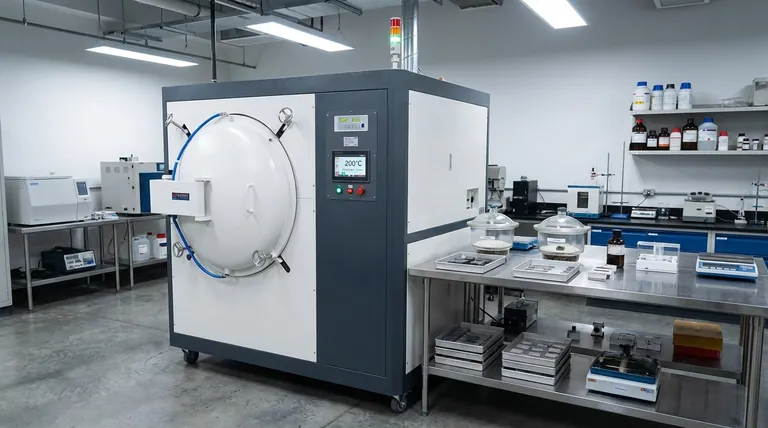
To prepare MXene-ZrB2 green bodies for sintering, you must execute a specific thermal treatment within a vacuum drying oven. The required protocol necessitates maintaining a temperature of 200°C for a duration of 12 to 18 hours. This rigorous process is designed to remove not just surface moisture, but water molecules deeply trapped between the MXene nanosheets.
Deep drying is a critical quality control step, not just a preliminary phase. By thoroughly eliminating interlayer water, you actively suppress pore formation and oxidation, which are the primary causes of reduced density in the final sintered composite.
The Critical Parameters of Deep Drying
To achieve high-density ceramics, the drying phase must be treated with the same precision as the sintering phase itself.
The Temperature Standard
You must set the vacuum oven to 200°C.
This temperature is specific. It provides sufficient thermal energy to mobilize and evacuate water molecules that are physically or chemically bound within the composite structure without degrading the composite components prior to sintering.
The Time Duration
The process requires a sustained hold time of 12 to 18 hours.
Quick drying is insufficient for this material. The water molecules are trapped between MXene nanosheets, creating a complex pathway for moisture release. A duration of less than 12 hours risks leaving residual moisture in the center of the green body.
The Physical and Chemical Implications
Understanding why this specific regime is necessary helps prioritize adherence to the protocol.
Targeting Interlayer Water
Standard drying often leaves "interlayer" water behind.
In MXene-based composites, water molecules can become trapped in the microscopic spaces between nanosheets. The 200°C vacuum treatment is specifically targeted to drive this stubborn moisture out of the nanostructure.
Preventing Pore Formation
If this water remains during the high-temperature sintering phase, it will rapidly expand.
This expansion creates pressure pockets that result in pores or voids within the material. These defects significantly lower the mechanical strength and density of the final product.
Suppressing Impurity Oxides
Water is a reactive agent at sintering temperatures.
Residual moisture can react chemically with the ceramic matrix. This reaction leads to the formation of impurity oxides, effectively contaminating the material and altering its intended properties.
Common Pitfalls to Avoid
Neglecting the strict parameters of the drying phase usually results in structural failure during sintering.
The Risk of Rushing
Attempting to shorten the 12-18 hour window is a primary source of error.
Even if the surface appears dry, internal moisture often remains. This hidden moisture is catastrophic once the material enters the sintering furnace.
The Density Trade-off
There is a direct correlation between drying thoroughness and final density.
Incomplete drying guarantees a lower final sintering density. If maximizing density is your goal, the drying parameters cannot be compromised.
Making the Right Choice for Your Goal
To ensure your MXene-ZrB2 composite meets performance standards, apply these guidelines to your preparation workflow:
- If your primary focus is Structural Integrity: Adhere strictly to the minimum 12-hour duration to eliminate the water expansion that causes porosity and micro-cracking.
- If your primary focus is Material Purity: Ensure the temperature holds at 200°C to fully evacuate the water necessary to trigger impurity oxide reactions.
Strict adherence to this 200°C vacuum drying cycle is the fundamental prerequisite for achieving a dense, high-quality ceramic composite.
Summary Table:
| Parameter | Requirement | Purpose |
|---|---|---|
| Equipment | Vacuum Drying Oven | To remove moisture in a controlled, low-oxygen environment. |
| Temperature | 200°C | Mobilizes water molecules trapped between MXene nanosheets. |
| Duration | 12 - 18 Hours | Ensures deep evacuation of water from the center of green bodies. |
| Target | Interlayer Water | Prevents pressure pockets, pores, and impurity oxide formation. |
Maximize Your Material Performance with KINTEK
Precision in drying is the foundation of successful sintering. At KINTEK, we understand that high-performance ceramics like MXene-ZrB2 demand exact thermal control. Backed by expert R&D and manufacturing, we offer high-precision Vacuum, Muffle, Tube, and CVD systems—all customizable to meet your unique lab requirements.
Don't let residual moisture compromise your sintering density. Contact us today to find the perfect thermal solution for your research and see how our advanced heating technology can enhance your lab's efficiency and material purity.
Visual Guide

References
- Srinivasa Kartik Nemani, Babak Anasori. Ti <sub>3</sub> C <sub>2</sub> T <i> <sub>x</sub> </i> MXene‐Zirconium Diboride Based Ultra‐High Temperature Ceramics. DOI: 10.1002/advs.202500487
This article is also based on technical information from Kintek Furnace Knowledge Base .
Related Products
- Vacuum Heat Treat Sintering and Brazing Furnace
- Vacuum Heat Treat Sintering Furnace Molybdenum Wire Vacuum Sintering Furnace
- Dental Porcelain Zirconia Sintering Ceramic Vacuum Press Furnace
- Molybdenum Vacuum Heat Treat Furnace
- Vacuum Hot Press Furnace Machine Heated Vacuum Press
People Also Ask
- What is one of the most important uses of vacuum heat treating furnaces in aerospace? Achieve Superior Strength in Aircraft Alloys
- How does vacuum heat treating affect the grain structure of metal alloys? Achieve Precise Microstructure Control
- What are the benefits of using vacuum heat treating furnaces for metal alloys? Achieve Superior Metal Properties and Performance
- What is the temperature of a vacuum furnace brazing? Optimize Your Joint Strength and Cleanliness
- What are the steps involved in a typical vacuum brazing treatment? Master the Process for Strong, Clean Joints












