
A high-stability heating stage is paired directly with a fluorescence spectrometer to create a controlled thermal environment ranging from 298K to 498K. By physically heating the phosphor sample while simultaneously recording its emission spectrum, this setup allows for the real-time monitoring of light intensity changes. This precise coordination is the standard method for quantifying how Tb3+/Ce3+ phosphors perform under the thermal stress typical of operating lighting devices.
By simulating the elevated temperatures found in high-power LEDs, this experimental setup captures thermal quenching phenomena to provide a quantitative evaluation of the phosphor’s luminescence maintenance rate and internal quantum efficiency.
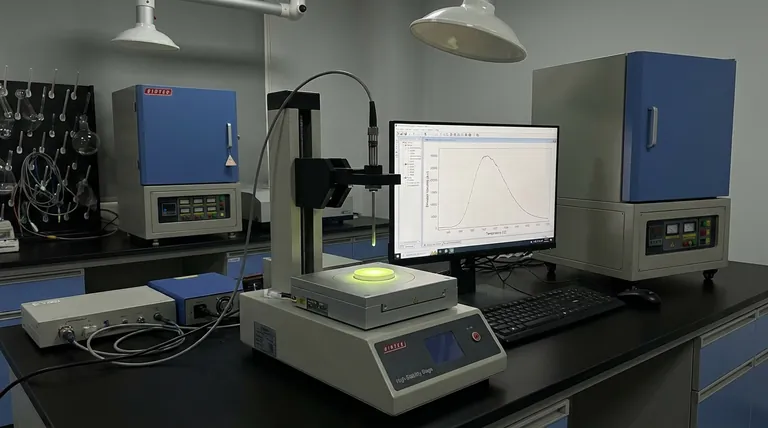
Simulating Real-World Conditions
precise Temperature Regulation
The heating stage functions as a miniature environmental chamber. It allows researchers to set and maintain specific temperatures between 298K and 498K with high accuracy.
Replicating LED Environments
This specific temperature range is chosen to mimic the conditions inside an operating LED package. High-power LEDs generate significant heat, which can degrade phosphor performance.
Real-Time Data Collection
The fluorescence spectrometer does not just take a single snapshot. It monitors the emission intensity continuously as the heating stage ramps up the temperature.
Quantifying Thermal Stability
Detecting Thermal Quenching
The primary phenomenon being studied is thermal quenching. This is the reduction in light output caused by increased lattice vibration and non-radiative relaxation pathways at higher temperatures.
Measuring Luminescence Maintenance
The setup produces data regarding the luminescence maintenance rate. This metric tells researchers exactly how much brightness is lost at 400K or 498K compared to room temperature.
Evaluating Internal Quantum Efficiency (IQE)
Beyond simple brightness, the system evaluates the stability of the phosphor's internal quantum efficiency. A stable IQE indicates that the material can convert absorbed energy into light efficiently, even under thermal stress.
Understanding the Trade-offs
Thermal Contact Limitations
The accuracy of the data depends heavily on the physical contact between the phosphor sample and the heating stage. Poor thermal contact can lead to a discrepancy between the set temperature and the actual sample temperature.
Isolated Variable Testing
This setup isolates temperature as the primary variable. It does not account for other degradation factors present in a real LED, such as moisture ingress or high photon flux degradation, unless specifically modified.
How to Apply This to Your Project
To maximize the utility of your thermal stability data, align your analysis with your specific engineering goals:
- If your primary focus is thermal management: Correlate the onset of thermal quenching with the maximum operating temperature of your target LED heat sink design.
- If your primary focus is material longevity: Prioritize phosphors that maintain high Internal Quantum Efficiency (IQE) at the upper limit (498K) to ensure consistent color performance.
Accurate thermal profiling is the difference between a theoretical phosphor and a commercially viable LED component.
Summary Table:
| Feature | Function in Phosphor Research |
|---|---|
| Temperature Range | 298K to 498K (Simulating LED environments) |
| Key Metric 1 | Thermal Quenching (Reduction in light output) |
| Key Metric 2 | Luminescence Maintenance Rate (Brightness loss) |
| Key Metric 3 | Internal Quantum Efficiency (IQE) Stability |
| Data Type | Real-time continuous emission monitoring |
Optimize Your Materials with KINTEK’s Precision Thermal Solutions
Ensure the commercial viability of your phosphors with accurate thermal profiling. Backed by expert R&D and manufacturing, KINTEK offers high-performance Muffle, Tube, Rotary, Vacuum, and CVD systems, alongside customizable lab high-temp furnaces designed to meet your unique research needs.
Ready to achieve superior thermal stability data? Contact our specialists today to find the perfect heating solution for your lab!
References
- YU Xin-hong, Wei Feng. Anti-thermal-quenching and colour-tuneable Tb3+/Ce3+-doped phosphor from natural wollastonite. DOI: 10.2298/pac2404395y
This article is also based on technical information from Kintek Furnace Knowledge Base .
Related Products
People Also Ask
- What is the function of a multi-zone tube furnace in CVD synthesis? Master 2D In2Se3 Nanosheet Precision
- Why are multi zone tube furnaces particularly useful for nanomaterial research? Unlock Precise Thermal Control for Advanced Synthesis
- What temperature-related capabilities make multi zone tube furnaces valuable for research? Unlock Precision Thermal Control
- What environmental protection applications utilize multi zone tube furnaces? Unlock Precision in Waste Treatment and Green Tech
- What role do multi zone tube furnaces play in new energy research? Unlock Precise Thermal Control for Innovation
