
Multi-station continuous vacuum hot pressing sintering equipment transforms production from a linear, stop-and-start process into a synchronized, high-speed pipeline. By utilizing a rotating table design, this technology allows simultaneous execution of critical steps—loading, heating, pressing, and cooling—rather than performing them sequentially for one batch at a time. This approach drastically reduces individual cycle times and enables annual yields in the tens of thousands.
The core advantage of this technology is the shift from "batch" to "pipeline" processing. By synchronizing every stage of sintering on a rotating platform, manufacturers can achieve massive throughput increases while maintaining the strict atmospheric control necessary for high-quality diamond tools.
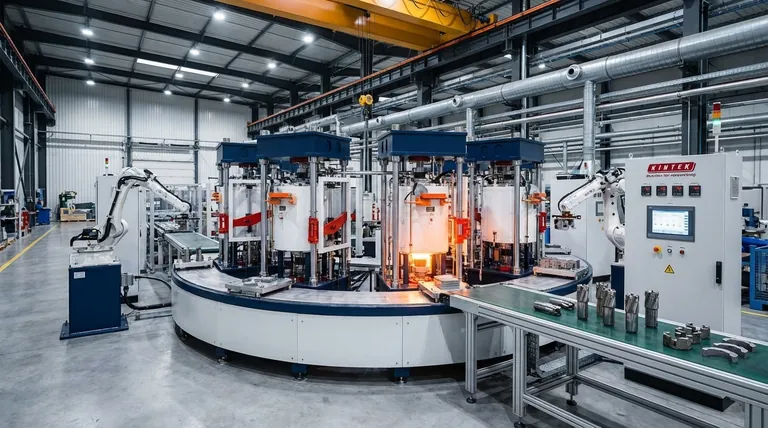
The Mechanics of High-Throughput Sintering
The Power of the Rotating Table
The central engine of efficiency in this equipment is the rotating table design.
Rather than using a single static chamber that must heat up and cool down for every load, the table physically moves the molds through dedicated stations. This movement allows the machine to operate continuously without pausing for thermal cycling.
Simultaneous Processing Steps
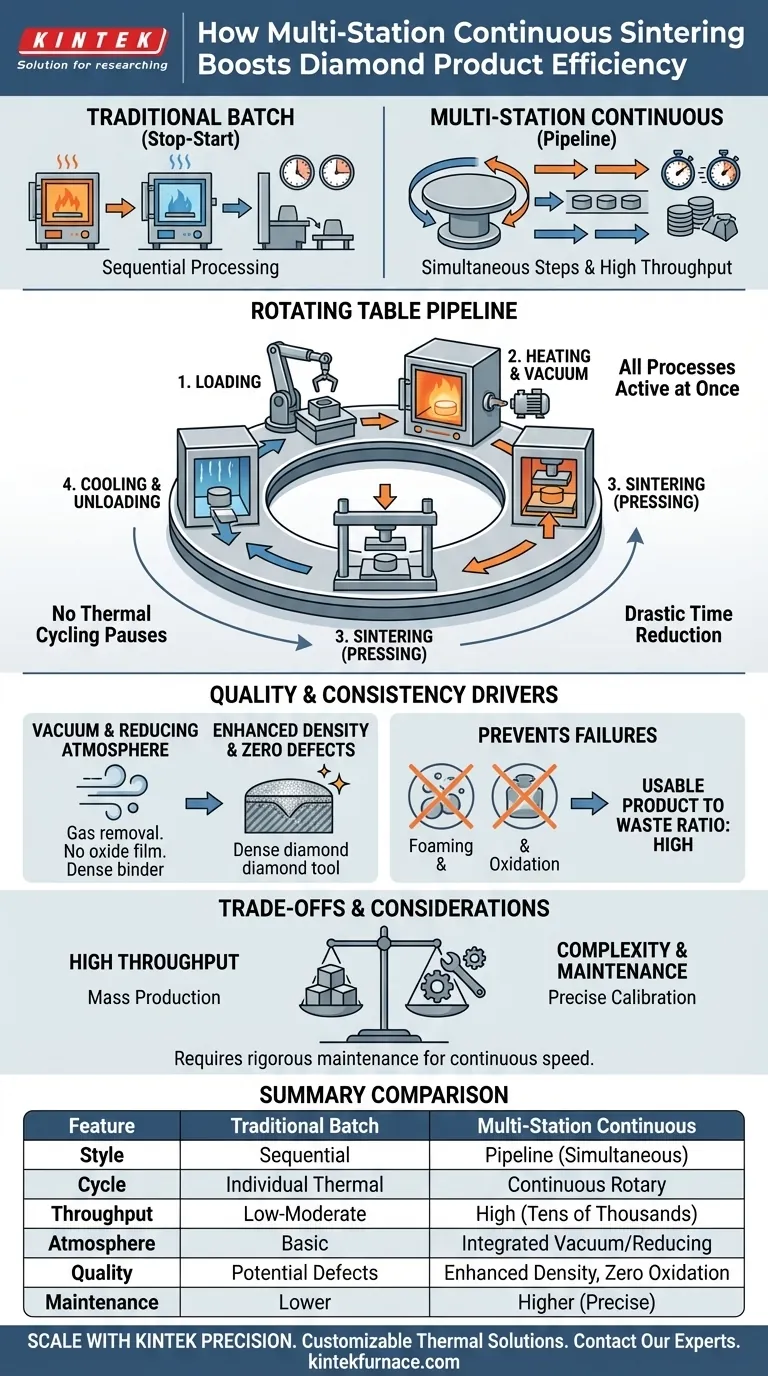
In a standard system, steps occur one after another. In a multi-station continuous system, all processes occur at the same time.
While one station is loading raw material, another is actively heating, a third is applying pressure (sintering), and a fourth is cooling. This parallel processing creates a drastic reduction in the total time required per unit.
Creating a Pipeline Operation
This synchronization creates a true pipeline operation.
As soon as a finished product is unloaded, a new mold is loaded into the cycle immediately. This eliminates the "dead time" usually associated with waiting for furnaces to reach temperature or cool down, enabling the production of tens of thousands of units annually.
Quality Consistency as an Efficiency Driver
Preventing Production Defects
Efficiency is not just about speed; it is about the ratio of usable product to waste.
This equipment integrates vacuum degassing and reducing atmosphere functions. Unlike standard atmospheric equipment, this actively removes adsorbed gases from the powder surface before sintering begins.
Enhancing Material Density
The vacuum environment allows for the effective removal of oxide films on metal particles.
This results in a significantly improved density of the metal binder. A denser binder creates a stronger retention force on the diamond particles, ensuring the final tool performs as intended.
Eliminating Common Failures
By controlling the atmosphere rigorously, the equipment prevents common quality killers such as product foaming and oxidation.
Eliminating these defects ensures that the high-speed output does not result in high-volume scrap. You achieve speed without sacrificing the structural integrity of the diamond product.
Understanding the Trade-offs
Operational Complexity
Transitioning to continuous multi-station equipment introduces higher mechanical complexity compared to static batch furnaces.
The synchronization of the rotating table with vacuum seals and hydraulic presses requires precise calibration. Misalignment in the pipeline can halt the entire production line, rather than just a single batch.
Maintenance Demands
High-throughput machinery experiences more wear and tear on moving components.
To maintain the "pipeline" efficiency, rigorous maintenance schedules for vacuum pumps and rotating mechanisms are essential. Neglecting this can lead to unplanned downtime that negates the speed advantages.
Making the Right Choice for Your Goal
To determine if this equipment aligns with your manufacturing strategy, consider your specific targets:
- If your primary focus is Mass Production: Leverage the rotating table and pipeline design to achieve high-volume yields (tens of thousands annually) with drastically shortened cycle times.
- If your primary focus is Product Consistency: Rely on the integrated vacuum and reducing atmosphere capabilities to eliminate oxidation and foaming, ensuring uniform density across large batches.
For manufacturers aiming to scale, this technology offers the only viable path to combine high-velocity output with the metallurgical precision required for professional diamond tools.
Summary Table:
| Feature | Traditional Batch Sintering | Multi-Station Continuous Sintering |
|---|---|---|
| Processing Style | Sequential (Stop-and-Start) | Pipeline (Simultaneous Steps) |
| Cycle Management | Individual thermal cycling per batch | Continuous movement via rotating table |
| Product Throughput | Low to Moderate | High (Tens of thousands annually) |
| Atmosphere Control | Basic/Standard | Integrated Vacuum & Reducing Atmosphere |
| Quality Output | Potential for oxidation/foaming | Enhanced density & zero oxidation |
| Maintenance | Lower complexity | Higher (requires precise calibration) |
Scale Your Diamond Tool Production with KINTEK Precision
Transitioning from batch processing to a continuous pipeline is the key to achieving massive throughput without compromising on material density or quality. At KINTEK, we specialize in the engineering and manufacturing of advanced thermal solutions, including Muffle, Tube, Rotary, Vacuum, and CVD systems.
Our multi-station vacuum hot pressing equipment is fully customizable to meet your specific high-temperature sintering needs, ensuring you eliminate defects like foaming and oxidation while maximizing your annual yield.
Ready to optimize your production efficiency? Contact our expert R&D team today to discuss your custom solution." Form)."
Visual Guide
Related Products
- 600T Vacuum Induction Hot Press Vacuum Heat Treat and Sintering Furnace
- Vacuum Hot Press Furnace Machine Heated Vacuum Press Tube Furnace
- Vacuum Heat Treat Sintering Furnace with Pressure for Vacuum Sintering
- Vacuum Hot Press Furnace Machine Heated Vacuum Press
- 9MPa Air Pressure Vacuum Heat Treat and Sintering Furnace
People Also Ask
- Why use Vacuum Hot Press (VHP) for ZnS Ceramics? Achieve Superior IR Transparency and Mechanical Strength
- How does a vacuum hot press sintering furnace mitigate copper sintering swelling? Solve Fe-Cu Expansion Issues
- How does the vacuum environment in a vacuum hot press sintering furnace protect chromium-containing ceramics? Find out.
- What are the benefits of using a vacuum hot press sintering furnace for the preparation of SiCw/2024 aluminum matrix composites? Achieve High-Performance Aerospace Materials
- What is the core function of a vacuum hot press sintering furnace in the preparation of high-density RuTi alloys? Achieve Maximum Density and Purity



















