
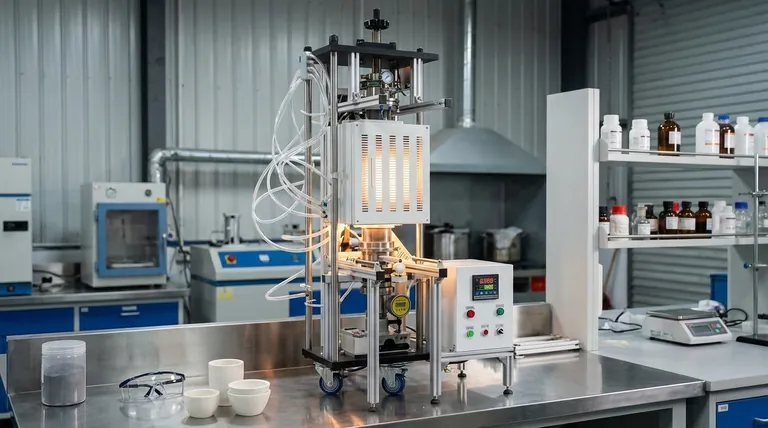
Hot-press sintering serves as the definitive manufacturing technique for producing high-density Tantalum-Aluminum-Carbon (Ta-Al-C) ceramics. By applying uniaxial mechanical pressure, typically around 30 MPa, simultaneously with high-temperature heating, this process forces loose powders to consolidate and accelerates densification far beyond what standard thermal methods can achieve.
Core Takeaway Conventional sintering often leaves microscopic voids that weaken ceramic materials. Hot-press sintering solves this by mechanically forcing particles together under heat to eliminate internal pores, resulting in bulk MAX phase ceramics with superior structural integrity and near-theoretical density.
The Mechanics of Densification
Simultaneous Heat and Pressure
The defining characteristic of this process is the concurrent application of thermal and mechanical energy. While the material is heated to high temperatures (often around 1350°C), uniaxial pressure is applied directly to the powder.
Accelerating Consolidation
This dual approach significantly accelerates the densification process. The external pressure works in tandem with thermal energy to overcome the natural resistance of the material to consolidate.
The Role of Vacuum Environments
To further enhance the process, this operation is frequently conducted in a vacuum (e.g., 10^-1 Pa). This environment prevents oxidation and facilitates the removal of trapped gases, ensuring a purer final product.
Overcoming Internal Porosity
Eliminating Microscopic Voids
One of the primary challenges in manufacturing ceramics like Ta4AlC3 or Ta2AlC is internal porosity. Hot-press sintering effectively eliminates these internal pores by mechanically compressing the material while it is in a malleable state.
Enhancing Particle Interaction
The applied pressure promotes particle rearrangement and plastic flow. This forces the ceramic grains to slide past one another and fill voids that simple diffusion sintering would likely miss.
Achieving High Relative Density
Through these mechanisms, the process allows difficult-to-sinter MAX phase ceramics to achieve extremely high densities. It is common to reach a relative density exceeding 95.5%, which is considered near-theoretical density.
Understanding the Trade-offs
Equipment Complexity
Achieving these results requires specialized vacuum hot press furnaces capable of maintaining strict atmospheric and pressure controls. This is inherently more complex than pressureless sintering methods.
Uniaxial Limitations
The pressure applied is uniaxial (from one direction). While excellent for creating dense plates or discs, this method may require careful process control to ensure density is uniform throughout complex shapes.
Making the Right Choice for Your Goal
To determine if hot-press sintering is the correct approach for your Ta-Al-C application, consider your specific performance requirements:
- If your primary focus is Maximum Density: Rely on hot-press sintering to achieve >95% relative density and eliminate internal porosity that weakens the structure.
- If your primary focus is Mechanical Strength: Choose this method to produce bulk ceramics with the superior mechanical properties required for high-stress applications.
By leveraging the combined power of heat and pressure, you transform loose powder into a robust, high-performance MAX phase ceramic.
Summary Table:
| Parameter | Process Detail | Impact on Ta-Al-C Ceramics |
|---|---|---|
| Pressure Type | Uniaxial Mechanical (~30 MPa) | Forces particle rearrangement and eliminates microscopic voids. |
| Temperature | High-Temp (approx. 1350°C) | Increases material malleability for faster densification. |
| Atmosphere | Vacuum (e.g., 10^-1 Pa) | Prevents oxidation and ensures high purity of MAX phases. |
| Resulting Density | >95.5% Relative Density | Achieves near-theoretical density with superior structural integrity. |
Elevate Your Material Performance with KINTEK
Unlock the full potential of your high-performance materials with KINTEK’s precision vacuum hot-pressing technology. Whether you are developing Ta-Al-C MAX phases or other advanced ceramics, our expert-led R&D and manufacturing provide the control you need to achieve near-theoretical density and exceptional mechanical strength.
Why Choose KINTEK?
- Customizable Systems: From Muffle and Tube furnaces to specialized Vacuum and CVD systems, tailored to your unique specs.
- Expert Engineering: Backed by years of high-temp furnace innovation.
- Targeted Solutions: Designed specifically for lab researchers and industrial manufacturers seeking superior heat treatment.
Ready to transform your loose powders into high-density bulk ceramics? Contact KINTEK today to discuss your project requirements!
Visual Guide

References
- Mingfeng Li, Yanan Ma. Recent Advances in Tantalum Carbide MXenes: Synthesis, Structure, Properties, and Novel Applications. DOI: 10.3390/cryst15060558
This article is also based on technical information from Kintek Furnace Knowledge Base .
Related Products
- Vacuum Heat Treat Sintering Furnace with Pressure for Vacuum Sintering
- 600T Vacuum Induction Hot Press Vacuum Heat Treat and Sintering Furnace
- Dental Porcelain Zirconia Sintering Ceramic Vacuum Press Furnace
- 9MPa Air Pressure Vacuum Heat Treat and Sintering Furnace
- Chairside Dental Porcelain Zirconia Sintering Furnace with Transformer for Ceramic Restorations
People Also Ask
- What is one of the most important uses of vacuum heat treating furnaces in aerospace? Achieve Superior Strength in Aircraft Alloys
- What are the benefits of using vacuum heat treating furnaces for metal alloys? Achieve Superior Metal Properties and Performance
- How does vacuum heat treating affect the grain structure of metal alloys? Achieve Precise Microstructure Control
- What are the key components of a vacuum sintering furnace? Essential Parts for Precision Material Processing
- What is the purpose of setting a mid-temperature dwell stage? Eliminate Defects in Vacuum Sintering



















