
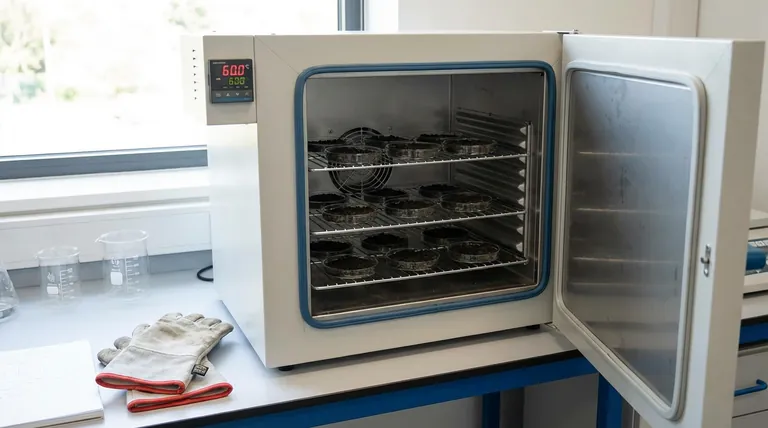
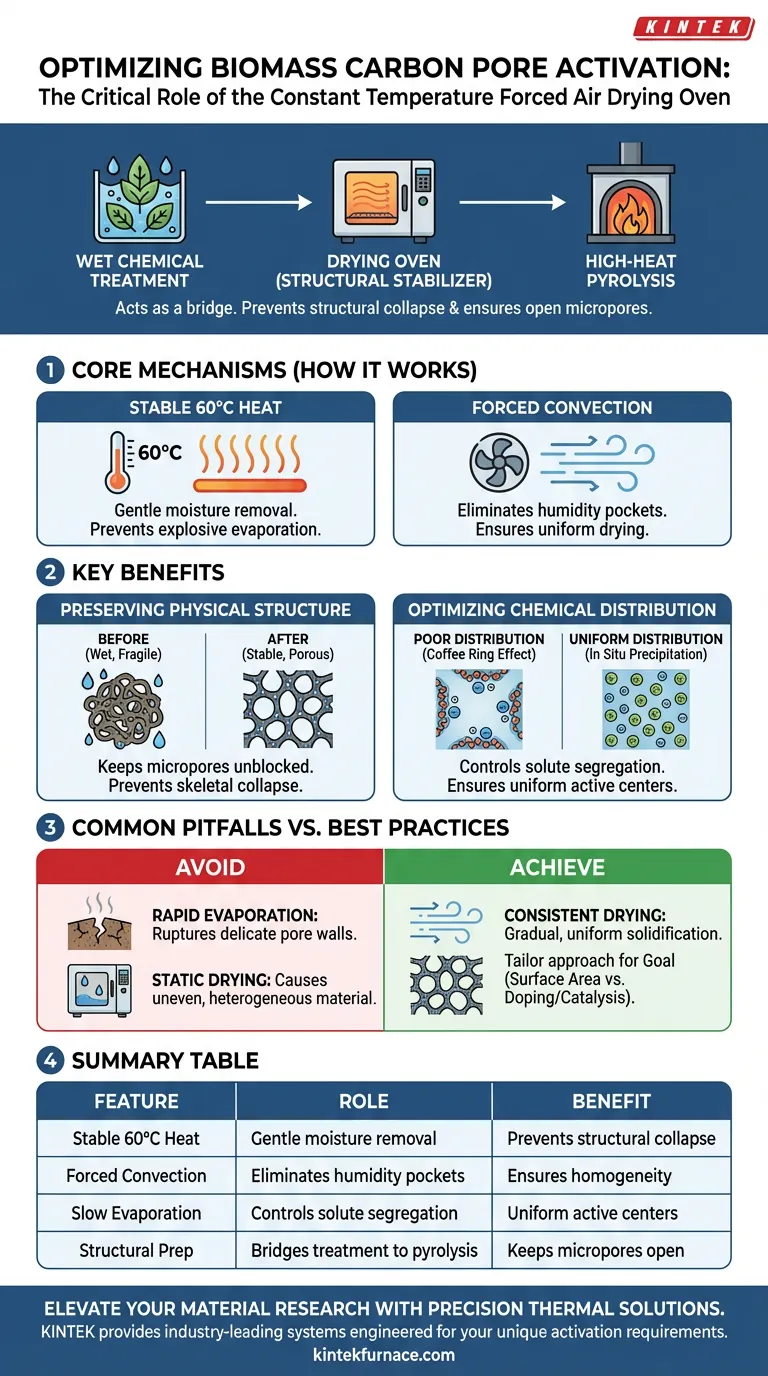
A constant temperature forced air drying oven serves as a critical stabilization step in the synthesis of biomass carbon. By maintaining a stable thermal environment—typically around 60 °C—and utilizing forced convection, it efficiently removes excess moisture from treated biomass without damaging its internal framework. This controlled drying process prevents structural collapse and ensures micropores remain unblocked, avoiding defects that would otherwise occur due to rapid water evaporation during subsequent high-temperature carbonization.
The oven acts as a structural stabilizer. It bridges the gap between wet chemical treatment and high-heat pyrolysis, ensuring that the evaporation of moisture does not destroy the material's internal porosity or disrupt the distribution of chemical precursors.
Preserving Physical Structure
Preventing Micropore Blockage
The primary function of the oven is to remove water that occupies the internal voids of the biomass. If this moisture remains during high-temperature carbonization, it evaporates explosively, potentially sealing off or destroying micropores.
By removing moisture gently at 60 °C, the oven keeps these pathways open. This preparation is essential for materials that have undergone alkali treatment and washing, ensuring the pore network is accessible for activation.
Avoiding Structural Collapse
Wet biomass is mechanically fragile. Subjecting it immediately to pyrolysis temperatures can cause the material's skeleton to collapse under the stress of rapid phase changes.
The forced air convection provides a consistent drying rate. This solidifies the carbon precursor's structure gradually, allowing it to withstand the rigorous conditions of the activation furnace later on.
Optimizing Chemical Distribution
Controlling Solute Segregation
When biomass is soaked in precursor solutions (such as metal ions for doping), the drying rate dictates where those chemicals end up.
A constant temperature oven facilitates slow moisture removal. This prevents the "coffee ring effect," where dissolved solids migrate to the outer surface, ensuring the chemicals precipitate in situ within the pores rather than crusting on the exterior.
Ensuring Uniform Active Centers
For high-performance applications, the distribution of active sites (like iron centers) must be uniform.
The stable circulation of hot air guides the uniform precipitation of these ions throughout the biomass matrix. This high dispersion is crucial for maximizing the catalytic activity of the final carbon material.
Common Pitfalls to Avoid
The Risk of Rapid Evaporation
While "forced air" implies speed, the goal is consistency, not haste.
If the temperature is set too high in an attempt to rush the process, moisture creates internal pressure. This can rupture the delicate pore walls you are trying to preserve, reducing the final surface area.
The Necessity of Circulation
Simply heating the biomass without air circulation (static drying) often leads to humidity pockets.
These pockets cause uneven drying, resulting in a heterogeneous material where some sections are structurally sound and others are collapsed or warped. The forced air mechanism eliminates this variable.
Making the Right Choice for Your Goal
To maximize the effectiveness of the drying stage, tailor your approach to your specific material objectives:
- If your primary focus is Surface Area: Prioritize the low-temperature stability (approx. 60 °C) to prevent pore blockage and mechanical collapse during the transition to carbonization.
- If your primary focus is Doping/Catalysis: Focus on the duration and uniformity of the drying cycle to ensure metal precursors precipitate evenly inside the pores rather than migrating to the surface.
The drying oven is not merely a dehydration tool; it is the gatekeeper that determines whether your biomass retains its engineered structure or degrades before activation begins.
Summary Table:
| Feature | Role in Biomass Activation | Benefit to Final Carbon Product |
|---|---|---|
| Stable 60°C Heat | Gentle moisture removal | Prevents structural collapse & pore wall rupture |
| Forced Convection | Eliminates humidity pockets | Ensures uniform drying and material homogeneity |
| Slow Evaporation | Controls solute segregation | Prevents chemical migration; ensures uniform active centers |
| Structural Prep | Bridges wet-treatment to pyrolysis | Keeps micropores open for high-temperature activation |
Elevate Your Material Research with KINTEK
Precision at the drying stage is the foundation of high-performance biomass carbon. KINTEK provides industry-leading thermal solutions, including Muffle, Tube, Rotary, and Vacuum systems, all engineered to ensure the structural integrity of your precursors.
Backed by expert R&D and manufacturing, our high-temp lab furnaces are fully customizable to meet your unique activation and carbonization requirements. Don't let inconsistent drying compromise your surface area or catalytic activity.
Contact our experts today to find the perfect furnace for your lab and see how our precision engineering can optimize your synthesis process.
Visual Guide
References
- Porous Biomass Carbon Composites Derived from Canadian Goldenrod and Their Excellent Microwave Absorption. DOI: 10.3390/app15179474
This article is also based on technical information from Kintek Furnace Knowledge Base .
Related Products
- 1700℃ High Temperature Muffle Oven Furnace for Laboratory
- 1800℃ High Temperature Muffle Oven Furnace for Laboratory
- 1400℃ Muffle Oven Furnace for Laboratory
- 1200℃ Muffle Oven Furnace for Laboratory
- High Temperature Muffle Oven Furnace for Laboratory Debinding and Pre Sintering
People Also Ask
- What is the primary function of a high-temperature laboratory muffle furnace in chemical synthesis? Achieve Precision.
- How does a high-temperature laboratory muffle furnace affect material properties? Transform Anodic Oxide Films Fast
- What role does a muffle furnace play in BCZY712 electrolyte powder production? Achieve Perfect Phase Purity
- What role does a muffle furnace play in sintering photocathodes? Enhance Electrode Conductivity & Catalytic Activity
- How does a muffle furnace impact Ni/MgAl2O4 catalysts? Optimize Stability and Catalytic Performance





