
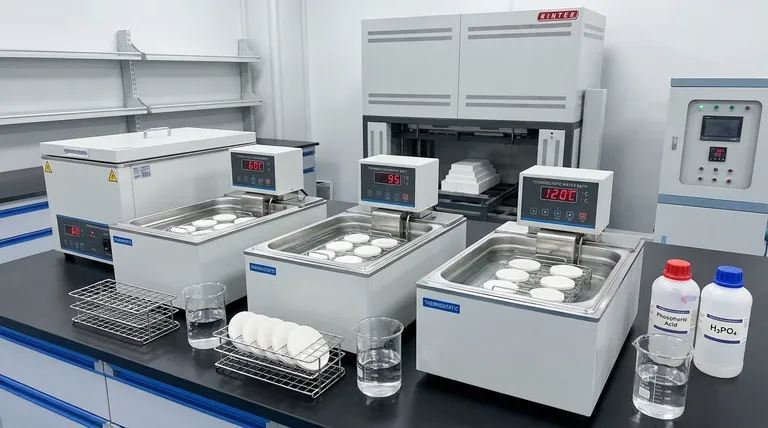
Laboratory thermostatic baths and heating devices act as the critical control mechanism for the surface modification of 3Y-TZP ceramics. By rigidly maintaining phosphoric acid solutions at specific target temperatures—such as 60°C, 95°C, or 120°C—these devices ensure the precise thermal energy supply required to drive the chemical reaction between the acid and the zirconia surface.
Temperature is the primary variable that governs the reaction kinetics between phosphoric acid and zirconia. Thermostatic devices provide the necessary thermal stability to accelerate the bonding of hydroxyl groups, which is the fundamental mechanism for optimizing the material's biological performance.
The Role of Thermal Energy in Surface Modification
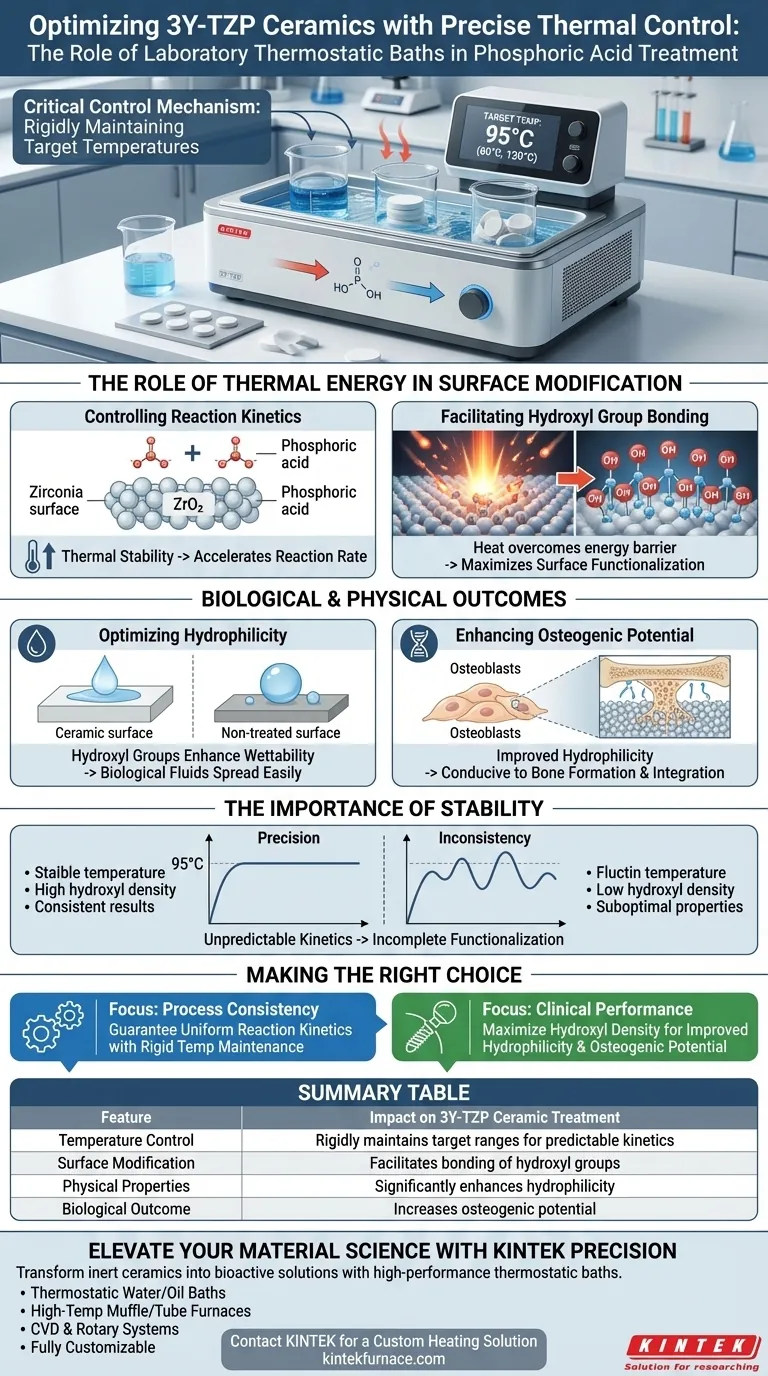
Controlling Reaction Kinetics
The interaction between phosphoric acid and 3Y-TZP ceramics is highly dependent on reaction kinetics. Temperature does not merely sustain the solution; it acts as a catalyst for the chemical process.
Thermostatic devices ensure that the thermal energy supply is constant. This stability is required to accelerate the reaction rate to a predictable and effective level.
Facilitating Hydroxyl Group Bonding
The primary goal of the thermal treatment is to alter the surface chemistry of the ceramic. The heat supplied by the device facilitates the bonding of hydroxyl functional groups to the zirconia surface.
Without precise heating, the energy barrier for this bonding process might not be overcome efficiently. The device ensures the environment is energetic enough to maximize this surface functionalization.
Biological and Physical Outcomes
Optimizing Hydrophilicity
The presence of hydroxyl groups directly influences the physical properties of the ceramic. Specifically, these groups significantly enhance the hydrophilicity (wettability) of the surface.
A hydrophilic surface allows biological fluids to spread more easily across the implant material. This is a direct result of the chemical changes driven by the heated acid treatment.
Enhancing Osteogenic Potential
The ultimate downstream benefit of this process is biological. By optimizing hydrophilicity through controlled heating, the osteogenic potential of the 3Y-TZP ceramic is improved.
This means the material becomes more conducive to bone formation and integration. The thermostatic device, therefore, plays a vital role in determining the clinical success of the ceramic implant.
The Importance of Stability
Precision vs. Inconsistency
The effectiveness of phosphoric acid treatment relies on the stability of the temperature.
If the temperature fluctuates or fails to reach the targets (e.g., 60, 95, or 120°C), the reaction kinetics become unpredictable. This can lead to incomplete surface functionalization and suboptimal biological properties.
Making the Right Choice for Your Goal
To ensure the successful treatment of 3Y-TZP ceramics, consider the following regarding your thermal equipment:
- If your primary focus is Process Consistency: Ensure your device can rigidly maintain the specific target temperatures (60°C, 95°C, or 120°C) without fluctuation to guarantee uniform reaction kinetics.
- If your primary focus is Clinical Performance: Prioritize thermal precision to maximize the density of hydroxyl groups, as this directly correlates to improved hydrophilicity and osteogenic potential.
Precise thermal control is not just a procedural requirement; it is the enabling factor that transforms an inert ceramic into a bioactive material.
Summary Table:
| Feature | Impact on 3Y-TZP Ceramic Treatment |
|---|---|
| Temperature Control | Rigidly maintains target ranges (60°C, 95°C, 120°C) for predictable kinetics |
| Surface Modification | Facilitates bonding of hydroxyl groups to the zirconia surface |
| Physical Properties | Significantly enhances hydrophilicity and surface wettability |
| Biological Outcome | Increases osteogenic potential for better bone formation and integration |
Elevate Your Material Science with KINTEK Precision
Precise thermal energy is the key to transforming inert ceramics into bioactive medical solutions. KINTEK provides high-performance laboratory heating systems and thermostatic baths designed to deliver the rigid temperature stability required for critical 3Y-TZP surface modifications.
Backed by expert R&D and manufacturing, KINTEK offers a comprehensive range of equipment, including:
- Thermostatic Water/Oil Baths for precise acid treatment
- High-Temp Muffle, Tube, and Vacuum Furnaces
- CVD & Rotary Systems for advanced surface engineering
All our systems are fully customizable to meet your unique research or manufacturing needs. Ensure consistent reaction kinetics and superior clinical outcomes for your ceramic implants today.
Contact KINTEK for a Custom Heating Solution
Visual Guide
References
- Satoshi KOBAYASHI, Takumi Sekine. Effect of bioactivation treatment using phosphoric acid on mechanical properties and osteogenesis for 3Y-TZP. DOI: 10.1299/mej.24-00376
This article is also based on technical information from Kintek Furnace Knowledge Base .
Related Products
- 1400℃ High Temperature Laboratory Tube Furnace with Alumina Tube
- 1700℃ High Temperature Laboratory Tube Furnace with Alumina Tube
- 1800℃ High Temperature Muffle Oven Furnace for Laboratory
- Vertical Laboratory Quartz Tube Furnace Tubular Furnace
- Laboratory Muffle Oven Furnace with Bottom Lifting
People Also Ask
- How does zone-melting in tube furnaces synthesize bismuth micro-wires? Master Single-Crystal Thermoelectric Growth
- How do high-temperature laboratory tube furnaces ensure environmental stability? Precision Thermal Reduction Tips
- How are high-temperature laboratory tube furnaces applied in long-term vacuum homogenization heat treatments for intermetallic samples?
- How are high-temp tube furnaces used to measure diffusion coefficients per Fick's law? Master Precision Annealing
- How are high-temperature tube furnaces applied in testing ceramic-supported alloy membranes? Insights







