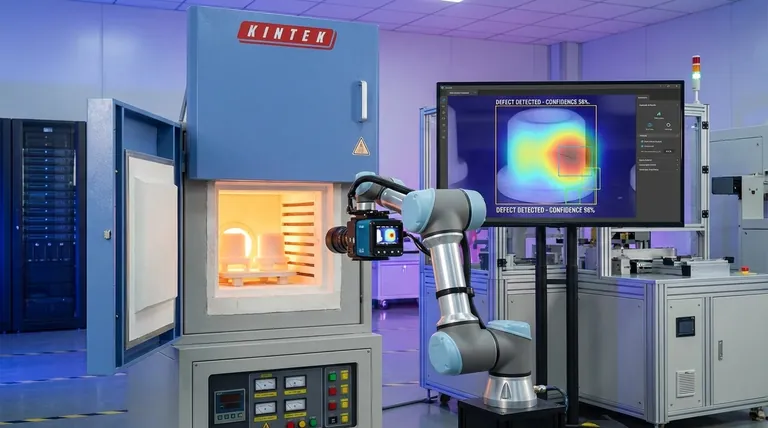
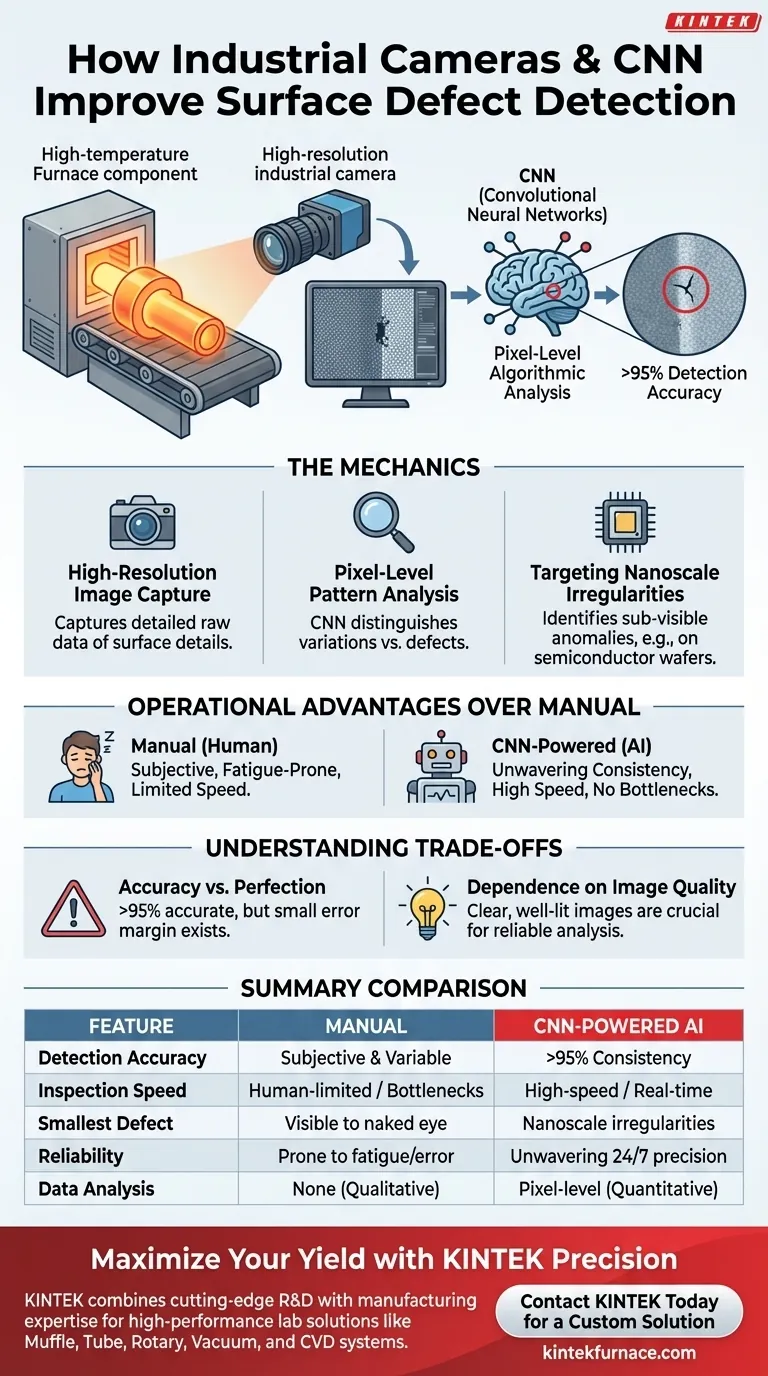
Industrial cameras paired with Convolutional Neural Networks (CNNs) revolutionize defect detection by combining high-resolution imaging with pixel-level algorithmic analysis to achieve detection accuracy exceeding 95%. This integration allows for the rapid identification of surface anomalies and nanoscale irregularities that are often invisible to the naked eye, ensuring a level of consistency and speed that manual inspection cannot match.
Automated inspection systems mitigate human error by utilizing deep learning algorithms to analyze components at a pixel level. This approach fundamentally shifts quality control from a subjective, labor-intensive process to a data-driven operation that significantly reduces scrap rates and missed defects.
The Mechanics of Automated Inspection
High-Resolution Image Capture
The foundation of this system lies in industrial cameras capable of capturing high-resolution images of furnace components.
These cameras provide the raw data necessary for detailed analysis, ensuring that even the most minute surface details are recorded for processing.
Pixel-Level Pattern Analysis
Once images are captured, CNN algorithms process the visual data.
Unlike simple threshold-based sensors, these algorithms perform pixel-level pattern analysis. This allows the system to distinguish between acceptable variations and actual defects with high precision.
Targeting Nanoscale Irregularities
The technology is particularly adept at handling complex components, such as semiconductor wafers or electronic parts often processed in high-temperature environments.
It can identify nanoscale irregularities and subtle surface anomalies that would typically evade standard inspection tools.
Operational Advantages Over Manual Methods
Eliminating Subjectivity
Manual inspection is prone to fatigue and inconsistency.
CNN-driven systems offer unwavering consistency, applying the exact same criteria to every single component, regardless of volume or time of day.
Speed and Throughput
The automated nature of CNN processing allows for detection speeds that far exceed human capabilities.
This enables manufacturers to maintain high production throughput without creating bottlenecks at the quality control stage.
Understanding the Trade-offs
Accuracy vs. Perfection
While these systems achieve an impressive detection accuracy of over 95%, it is important to recognize that they are not infallible.
There remains a small margin of error, which means critical applications may still require a secondary review process for edge cases.
Dependence on Image Quality
The efficacy of the CNN is entirely dependent on the quality of the input data.
If the industrial cameras fail to capture clear, well-lit images due to environmental factors in the manufacturing floor, the pixel-level analysis will yield unreliable results.
Optimizing Quality Control Strategies
To maximize the benefits of this technology for your production line, consider your specific inspection goals:
- If your primary focus is Precision: Leverage CNNs for their ability to detect nanoscale irregularities in high-value components like semiconductor wafers.
- If your primary focus is Efficiency: Implement this system to replace manual bottlenecks, utilizing its superior speed to lower scrap rates and missed defects.
By integrating industrial cameras with deep learning algorithms, manufacturers secure a scalable, high-accuracy solution that protects both product quality and the bottom line.
Summary Table:
| Feature | Manual Inspection | CNN-Powered AI Inspection |
|---|---|---|
| Detection Accuracy | Subjective & Variable | Over 95% Consistency |
| Inspection Speed | Human-limited / Bottlenecks | High-speed / Real-time |
| Smallest Defect | Visible to naked eye | Nanoscale irregularities |
| Reliability | Prone to fatigue/error | Unwavering 24/7 precision |
| Data Analysis | None (Qualitative) | Pixel-level (Quantitative) |
Maximize Your Yield with KINTEK Precision
Don't let manual inspection bottlenecks and scrap rates compromise your production excellence. KINTEK combines cutting-edge R&D with manufacturing expertise to provide high-performance lab solutions, including Muffle, Tube, Rotary, Vacuum, and CVD systems.
Whether you are processing semiconductor wafers or advanced ceramics, our customizable high-temperature furnaces are designed to meet your most rigorous quality standards. Partner with us to achieve the precision and consistency your facility demands.
Contact KINTEK Today for a Custom Solution
Visual Guide
Related Products
- 1400℃ High Temperature Laboratory Tube Furnace with Alumina Tube
- 1700℃ High Temperature Laboratory Tube Furnace with Alumina Tube
- 1700℃ High Temperature Muffle Oven Furnace for Laboratory
- 1800℃ High Temperature Muffle Oven Furnace for Laboratory
- High Temperature Muffle Oven Furnace for Laboratory Debinding and Pre Sintering
People Also Ask
- How does zone-melting in tube furnaces synthesize bismuth micro-wires? Master Single-Crystal Thermoelectric Growth
- How do high-temperature laboratory tube furnaces ensure environmental stability? Precision Thermal Reduction Tips
- How are high-temp tube furnaces used to measure diffusion coefficients per Fick's law? Master Precision Annealing
- How are high-temperature laboratory tube furnaces applied in long-term vacuum homogenization heat treatments for intermetallic samples?
- How are high-temperature tube furnaces applied in testing ceramic-supported alloy membranes? Insights