
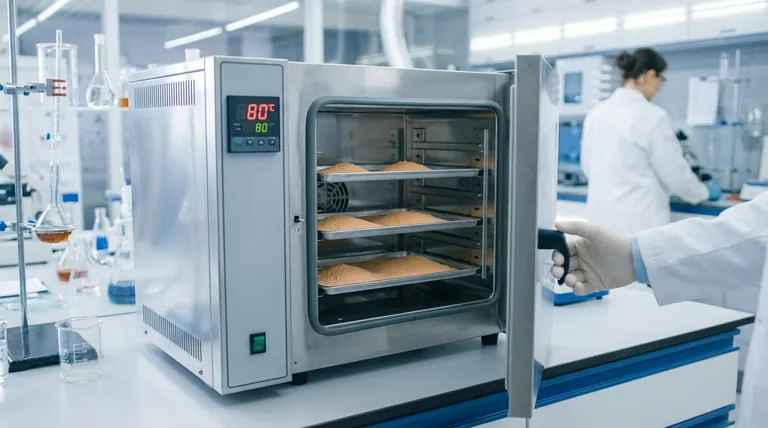
The laboratory blast drying oven serves as a critical stabilization tool in the synthesis of Ti-doped Mn3O4 precursors. It functions by maintaining a constant temperature of 80°C utilizing forced hot air circulation to efficiently remove residual moisture and physically adsorbed water from co-precipitated particles.
Core Takeaway Beyond simple dehydration, the blast drying process fixes the microscopic morphology of the precursor particles. By ensuring uniform drying, it prevents uneven agglomeration, yielding a high-quality, fluid raw material essential for successful high-temperature solid-state reactions.
The Mechanics of Precursor Stabilization
efficient Removal of Adsorbed Water
The primary function of the oven is the removal of moisture at a controlled temperature of 80°C.
This specific thermal environment targets physically adsorbed water and residual moisture remaining on the precipitates.
By using continuous hot air circulation, the oven ensures that heat is distributed evenly, eliminating water without subjecting the material to extreme thermal shock.
Fixing Microscopic Morphology
Drying is not merely a subtractive process; it is a structural one.
The blast drying phase effectively "freezes" or fixes the microscopic morphology of the particles established during co-precipitation.
This step locks in the structural characteristics of the precursor before it undergoes further processing.
Prevention of Uneven Agglomeration
A critical risk during the drying of chemical precipitates is the formation of hard, uneven clumps.
The forced air circulation promotes uniform evaporation rates across the sample batch.
This uniformity prevents the particles from binding together irregularly, ensuring the material does not suffer from uneven agglomeration that would hinder subsequent mixing.
Preparing for Solid-State Reactions
Ensuring Material Fluidity
The output of this drying process is not just a dry cake, but a manageable raw material.
By preventing severe agglomeration, the oven ensures the precursor remains in a state that facilitates easy mixing.
This physical consistency is vital for creating a homogenous blend required for the next stage of synthesis.
facilitating High-Temperature Processing
The ultimate goal of this drying stage is to prepare the precursor for a high-temperature solid-state reaction.
Any residual moisture left in the material could interfere with the reaction kinetics or cause structural defects during calcination.
The blast drying oven eliminates these variables, providing a consistent baseline for the thermal reaction.
Understanding the Trade-offs
Air Circulation vs. Oxidation
While blast drying is excellent for moisture removal and uniformity, it operates with circulating air (oxygen).
If a precursor is highly sensitive to oxidation at 80°C, a vacuum drying oven would be the preferred alternative to exclude oxygen.
However, for Ti-doped Mn3O4 precursors, the blast drying method is accepted and effective, suggesting oxidation at this specific stage and temperature is not a primary detrimental factor.
Temperature Sensitivity
The specific setting of 80°C is a calculated balance.
Temperatures that are too low may leave residual moisture, leading to defects during high-temperature firing.
Conversely, excessively high temperatures during the drying phase could induce premature particle sintering or hard agglomeration, making the material difficult to grind or mix.
Making the Right Choice for Your Goal
To ensure the success of your Ti-doped Mn3O4 synthesis, apply the drying process with the following objectives in mind:
- If your primary focus is Chemical Purity: Ensure the oven maintains a strict 80°C to fully remove physically adsorbed water without degrading the material.
- If your primary focus is Physical Consistency: Rely on the forced hot air circulation to prevent uneven clumping, ensuring the powder mixes uniformly for the solid-state reaction.
Summary: The laboratory blast drying oven transforms a wet precipitate into a morphologically stable, uniformly dried precursor, acting as the essential bridge between wet chemistry and solid-state physics.
Summary Table:
| Function | Process Detail | Impact on Precursor |
|---|---|---|
| Dehydration | 80°C Forced Air Circulation | Removes residual moisture and adsorbed water |
| Morphology Fixation | Controlled Thermal Environment | Preserves microscopic particle structure |
| Agglomeration Control | Uniform Evaporation | Prevents hard clumping; ensures material fluidity |
| Reaction Prep | Pre-calcination Drying | Prepares material for high-temp solid-state reactions |
Elevate Your Material Synthesis with KINTEK Precision
Achieve uncompromising consistency in your chemical precursors with KINTEK’s advanced laboratory solutions. Backed by expert R&D and world-class manufacturing, KINTEK offers a comprehensive range of Muffle, Tube, Rotary, Vacuum, and CVD systems, alongside specialized lab high-temp furnaces and drying ovens—all fully customizable to meet your unique research requirements.
Whether you are preparing Ti-doped Mn3O4 or developing next-generation ceramics, our equipment ensures the precise thermal control and atmospheric stability your process demands. Don't let inconsistent drying compromise your results.
Contact KINTEK Today to Consult Our Experts" Form)"
References
- Kexin Zheng, Lu Ju. Effects of Ti4+ Doping on the Structural Stability and Electrochemical Performance of Layered P2-Na0.7MnO2.05 Cathodes for Sodium-Ion Batteries. DOI: 10.3390/nano14241989
This article is also based on technical information from Kintek Furnace Knowledge Base .
Related Products
- Laboratory Muffle Oven Furnace with Bottom Lifting
- 1800℃ High Temperature Muffle Oven Furnace for Laboratory
- 1200℃ Muffle Oven Furnace for Laboratory
- High Temperature Muffle Oven Furnace for Laboratory Debinding and Pre Sintering
- 1700℃ High Temperature Muffle Oven Furnace for Laboratory
People Also Ask
- Why is a high-temperature muffle furnace required for FeOx-MOx/TiO2? Engineering High-Performance Nanocomposites
- What is the importance of the calcination process? Master High-Purity Calcium Phosphate Nanopowder Production
- Why is a high-temperature laboratory muffle furnace essential for the alkali fusion process in zeolite synthesis?
- What function does a muffle furnace perform in Ba0.75Ca0.25TiO3 calcination? Ensure Phase Purity & Synthesis
- What are the primary functions of a high-temperature laboratory muffle furnace in the preparation of biosorbent materials?






