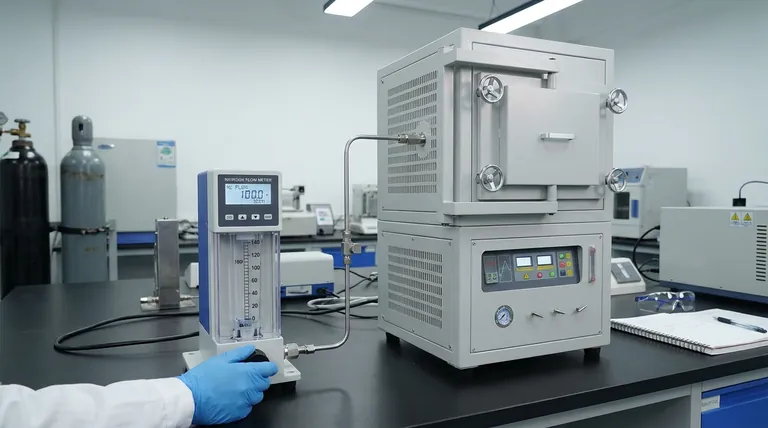
High-precision nitrogen flow meters act as the critical control mechanism for establishing a stable, inert environment during pyrolysis. By regulating the nitrogen purge rate with exactitude, these devices ensure oxygen is effectively excluded from the reactor, preventing the raw material from burning rather than charring.
Precision in nitrogen flow is not just about safety; it is the defining factor in creating char with a consistent chemical structure and specific pore characteristics required for accurate gasification analysis.
Establishing the Reaction Environment
Maintaining an Inert Atmosphere
Pyrolysis is defined as thermal decomposition in the absence of oxygen. High-precision flow meters ensure that nitrogen continuously displaces oxygen within the reactor. Without this displacement, the process shifts from pyrolysis to combustion, fundamentally changing the reaction.
Preventing Oxidative Combustion
If the nitrogen flow fluctuates or drops below a critical threshold, oxygen ingress can occur. This leads to unintended oxidative combustion, where the raw material burns to ash rather than converting into carbon-rich char. Precise metering guarantees that the purging rate remains sufficient to block oxidation throughout the heating cycle.
Impact on Material Properties
Preserving Chemical Structure
For gasification analysis to be valid, the starting char must have a predictable and uniform chemical makeup. Fluctuations in the inert atmosphere can introduce variable levels of oxidation, altering the char's elemental composition. Consistent flow control ensures the chemical structure is determined solely by thermal decomposition, not by random reactions with oxygen.
Defining Pore Characteristics
The reactivity of char during gasification is heavily influenced by its physical surface area and pore structure. Uncontrolled oxidation can destroy these delicate pore networks or enlarge them unpredictably. By strictly excluding oxygen, high-precision flow meters allow the char to develop specific pore characteristics representative of the raw material's true thermal properties.
Risks of Improper Flow Control
The Cost of Variability
Using low-precision equipment introduces a variable into the experiment that is difficult to isolate later. If the flow rate drifts, the degree of "inertness" changes, leading to batches of char that appear similar but react differently. This lack of uniformity renders subsequent gasification data unreliable.
False Baselines
If the pretreatment phase is compromised by poor flow control, the resulting char is flawed. Any analysis performed on this char will reflect the artifacts of the preparation process, not the intrinsic properties of the material. High precision is the only way to establish a true scientific baseline.
Ensuring Experimental Validity
To maximize the reliability of your gasification studies, consider the following regarding your instrumentation:
- If your primary focus is Fundamental Research: Prioritize flow meters with high turndown ratios to maintain stability across precise temperature ramps, ensuring identical chemical structures across trials.
- If your primary focus is Process Optimization: Ensure flow meters provide real-time feedback to detect any deviation in the purge rate immediately, protecting the pore characteristics of the sample.
Precise nitrogen control is the prerequisite for reproducible, scientifically valid char preparation.
Summary Table:
| Feature | Impact on Pyrolysis | Result of Poor Control |
|---|---|---|
| Inert Atmosphere | Displaces oxygen to enable pure thermal decomposition | Material burns to ash via oxidative combustion |
| Chemical Integrity | Maintains predictable, uniform elemental composition | Variable oxidation alters chemical makeup |
| Pore Structure | Protects surface area and delicate pore networks | Destruction or unpredictable enlargement of pores |
| Data Reliability | Establishes a true scientific baseline for gasification | Unreliable results due to experimental variability |
Elevate Your Gasification Research with KINTEK
Precise control is the foundation of scientific validity. KINTEK provides high-performance laboratory solutions—including Muffle, Tube, Rotary, Vacuum, and CVD systems—specifically designed to meet the rigorous demands of pyrolysis and material pretreatment.
Backed by expert R&D and manufacturing, our systems are fully customizable to ensure your char preparation maintains the exact chemical structure and pore characteristics your analysis requires.
Ready to eliminate variability in your experiments? Contact KINTEK today to discuss your unique laboratory needs and discover the value of precision engineering.
References
- Despina Vamvuka, Konstantina Zacheila. Gasification Performance of Barley Straw Waste Blended with Lignite for Syngas Production under Steam or Carbon Dioxide Atmosphere. DOI: 10.3390/app14020665
This article is also based on technical information from Kintek Furnace Knowledge Base .
Related Products
People Also Ask
- Why is a high-precision vacuum sealing system necessary for CrSb? Ensure Pure Crystal Growth & Prevent Oxidation
- Why is an Ultra-High Vacuum (UHV) System Required for In2Se3? Achieving Atomic-Level Ferroelectric Clarity
- What is the function of quartz vacuum encapsulation in RhSeCl CVT? Mastering Pure Crystal Growth
- Why is vacuum sealing technology essential for K2In2As3 synthesis? Master High-Purity Solid-State Reactions
- What role do vacuum-sealed high-purity silica ampoules play in phase equilibrium experiments? Enhance Sample Integrity