
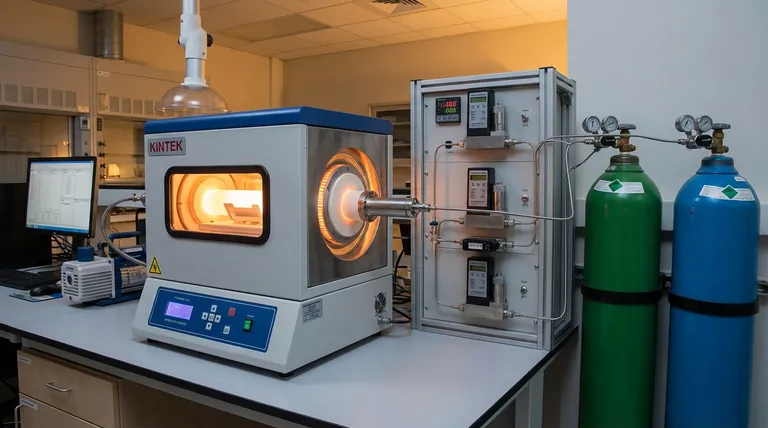
A precision gas flow control system is mandatory because it establishes the strictly inert atmosphere required for successful synthesis. By introducing a consistent stream of high-purity nitrogen (N2) or argon (Ar), the system prevents oxygen from entering the reaction zone during high-temperature pyrolysis (400 °C to 800 °C).
The core purpose of gas flow control is to create a specific chemical environment that prevents the combustion of the carbon support while enabling the precise reduction of tungsten species into high-performance single-atom or carbide forms.
Preserving the Carbon Support
Preventing Oxidation and Loss
The structural integrity of tungsten-based nanocomposites relies heavily on a carbon carrier. However, at pyrolysis temperatures between 400 °C and 800 °C, carbon is highly susceptible to oxidation.
The Role of Inert Gas
If oxygen is present, the carbon carrier will react to form carbon dioxide and essentially burn away.
A precision flow system ensures that high-purity nitrogen or argon continuously flushes the tube. This creates a protective barrier that preserves the carbon matrix, ensuring the nanocomposite retains its intended structure and surface area.
Controlling Tungsten Chemistry
Facilitating Reduction
Beyond protection, the gas atmosphere dictates the chemical transformation of the tungsten itself. The goal is often to convert tungsten from an initial oxide state into more active forms.
Achieving Specific Phases
The reference highlights that the target forms are typically single-atom or carbide forms.
To achieve these specific states, the environment must be reductive or neutral, rather than oxidative. Precision gas flow maintains the conditions necessary to drive this reduction, preventing the tungsten from reverting to or remaining as a bulky oxide.
Common Pitfalls to Avoid
The Risk of Flow Fluctuations
Inconsistent gas flow can lead to "dead zones" or varying partial pressures within the tube. This results in heterogeneous samples where some tungsten is reduced to carbides while other areas remain as oxides.
Gas Purity Issues
Even with a perfect flow rate, the quality of the nanocomposite is compromised if the gas source is not high-purity. Impurities in the gas stream can introduce unwanted dopants or initiate side reactions that degrade the performance of the final material.
Making the Right Choice for Your Goal
To ensure the successful synthesis of your tungsten-based nanocomposites, align your gas control strategy with your specific chemical objectives:
- If your primary focus is Structural Integrity: Ensure your flow rate is sufficient to maintain positive pressure, fully excluding oxygen to prevent the loss of your carbon carrier.
- If your primary focus is Chemical Specificity: Prioritize the use of high-purity inert gases to strictly control the reduction pathway of tungsten into single-atom or carbide forms.
Precision in gas control is not just a safety measure; it is a synthesis parameter that dictates material quality.
Summary Table:
| Key Requirement | Role in Pyrolysis | Benefit to Nanocomposite |
|---|---|---|
| Inert Atmosphere | Excludes O2 at 400°C - 800°C | Prevents carbon support combustion |
| High-Purity N2/Ar | Maintains neutral environment | Enables single-atom or carbide formation |
| Precision Flow | Prevents "dead zones" | Ensures sample homogeneity and quality |
| Positive Pressure | Blocks atmospheric leakage | Preserves structural integrity and surface area |
Optimize Your Nanomaterial Synthesis with KINTEK
Precision in gas control is a critical synthesis parameter that dictates the quality of your tungsten-based materials. Backed by expert R&D and manufacturing, KINTEK offers high-performance Tube, Muffle, Rotary, Vacuum, and CVD systems—all fully customizable to include precision gas flow controllers tailored to your unique research needs.
Ensure perfect chemical reduction and structural integrity for your samples today. Contact our technical specialists now to design your ideal high-temperature furnace solution.
References
- Wanqing Song, Wenbin Hu. Optimizing potassium polysulfides for high performance potassium-sulfur batteries. DOI: 10.1038/s41467-024-45405-w
This article is also based on technical information from Kintek Furnace Knowledge Base .
Related Products
- Small Vacuum Heat Treat and Tungsten Wire Sintering Furnace
- 2200 ℃ Tungsten Vacuum Heat Treat and Sintering Furnace
- Vertical Laboratory Quartz Tube Furnace Tubular Furnace
- Multi Zone Laboratory Quartz Tube Furnace Tubular Furnace
- Magnesium Extraction and Purification Condensing Tube Furnace
People Also Ask
- How does vacuum sintering improve dimensional tolerances? Achieve Uniform Shrinkage and Precision
- What is the purpose of setting a mid-temperature dwell stage? Eliminate Defects in Vacuum Sintering
- What are the key components of a vacuum sintering furnace? Essential Parts for Precision Material Processing
- What are the main structural components of a vacuum sintering furnace? Unlock Precision in High-Temperature Processing
- What are the main types of sintering furnaces? Find the Perfect Match for Your Materials



















