
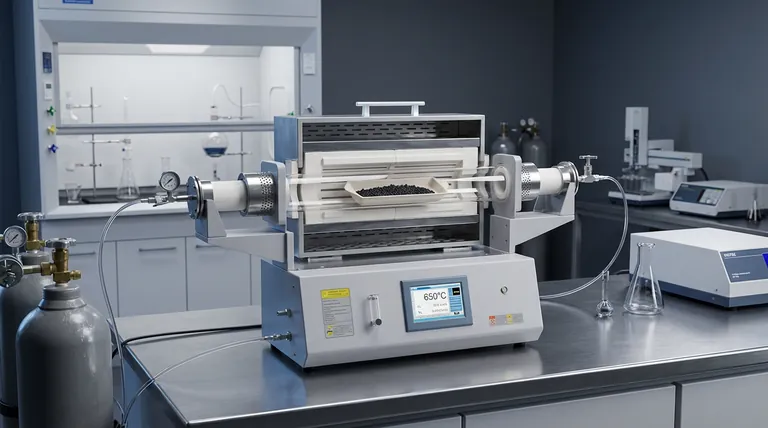
To convert polymer-based precursors into MXene/MWCNTs@C–Co composites, a laboratory tube furnace provides a strictly controlled high-temperature thermal environment (typically 600–700°C) under a nitrogen-protected inert or reducing atmosphere. This specialized setting facilitates the simultaneous gasification of polymer templates to create hollow centers and the in-situ pyrolysis of shell layers, effectively transforming organic ligands into conductive carbon networks and reducing metal ions into magnetic nanoparticles.
The tube furnace acts as a chemical reactor that uses precise thermal programming to drive the simultaneous decomposition of polymer structures and the catalytic reduction of metal ions into a complex, electromagnetic-shielding heterostructure.
The Role of Controlled Thermal Environments
Precision Temperature Regulation
The furnace maintains a stable temperature range, often between 600°C and 700°C, which is the critical window for transforming organic precursors without destroying the MXene or CNT frameworks.
By utilizing a precise heating ramp (such as 1°C per minute), the furnace prevents rapid gas expansion that could rupture the delicate hollow structures of the composite.
High-Stability Heat Conduction
Consistent heat distribution ensures that the pyrolysis of the shell layer occurs uniformly across the entire sample, leading to a homogenous material.
This stability is vital for maintaining the dimensional accuracy and low shrinkage of the carbon-based structures during their transition from polymers to conductive networks.
Atmospheric Control and Chemical Transformation
Anaerobic and Reducing Atmospheres
The use of nitrogen protection creates an anaerobic environment that prevents the oxidation of the carbon nanotubes (CNTs) and the metallic cobalt nanoparticles.
This controlled atmosphere allows for the gasification of polymer cores (like polystyrene), leaving behind hollow cavities that are essential for multiple electromagnetic reflections.
In-situ Pyrolysis and Catalytic Reduction
The furnace environment drives the cleavage of chemical bonds in the polymer backbone, converting them into a structured, conductive carbon matrix.
Simultaneously, the thermal energy catalyzes the reduction of cobalt ions, dispersing magnetic cobalt nanoparticles throughout the carbon shell to enhance magnetic loss mechanisms.
Understanding the Trade-offs
Temperature Sensitivity vs. Structural Integrity
While higher temperatures (above 800°C) can increase carbon crystallinity and conductivity, they also risk the aggregation of metal nanoparticles or the degradation of the MXene phases.
Finding the "sweet spot" is a balance between achieving maximum electromagnetic loss and preserving the hollow core-shell heterostructure defined by the original polymer template.
Atmospheric Purity Risks
Any fluctuation in the inert gas flow or a leak in the tube seals can introduce oxygen, leading to the combustion of the carbon network rather than carbonization.
Furthermore, if the heating rate is too aggressive, the internal pressure from gasified polymers can cause the shell to collapse, ruining the multiple loss mechanisms required for the final composite.
How to Apply This to Your Project
Optimization Strategies for Composite Synthesis
The success of the synthesis depends on aligning the furnace parameters with the specific thermal degradation profile of your polymer precursor.
- If your primary focus is maximizing conductivity: Increase the carbonization temperature slightly and extend the dwell time to enhance the graphitization of the carbon shell.
- If your primary focus is maintaining a hollow structure: Use a very slow heating ramp (0.5–1°C/min) to allow polymer decomposition gases to escape without damaging the shell.
- If your primary focus is magnetic performance: Ensure a strictly reducing atmosphere to facilitate the complete conversion of cobalt ions into high-purity magnetic nanoparticles.
By meticulously controlling the thermal and atmospheric conditions of the tube furnace, you can engineer the precise electromagnetic properties required for advanced MXene-based shielding materials.
Summary Table:
| Technical Condition | Specific Parameter | Primary Function in Synthesis |
|---|---|---|
| Temperature Range | 600°C – 700°C | Facilitates pyrolysis while preserving MXene/CNT frameworks |
| Atmosphere Control | Nitrogen-protected (Inert) | Prevents oxidation and enables polymer core gasification |
| Heating Ramp | Precise (e.g., 1°C/min) | Prevents structural rupture from rapid gas expansion |
| Heat Distribution | High-stability conduction | Ensures uniform carbonization and dimensional accuracy |
| Chemical Environment | Reducing atmosphere | Catalyzes metal ion reduction into magnetic nanoparticles |
Elevate Your Composite Synthesis with KINTEK Precision
Achieving the delicate balance of temperature and atmospheric purity is critical for high-performance MXene/MWCNTs@C–Co composites.
Backed by expert R&D and world-class manufacturing, KINTEK provides the advanced thermal solutions you need. We offer a comprehensive range of Muffle, Tube, Rotary, Vacuum, and CVD systems, all fully customizable to meet the unique requirements of your material science research.
Ready to optimize your laboratory's thermal processing?
Contact KINTEK Today to Consult with our Experts
References
- Ze Wu, Lei Liu. MXene Hollow Spheres Supported by a C–Co Exoskeleton Grow MWCNTs for Efficient Microwave Absorption. DOI: 10.1007/s40820-024-01326-3
This article is also based on technical information from Kintek Furnace Knowledge Base .
Related Products
- Vacuum Sealed Continuous Working Rotary Tube Furnace Rotating Tube Furnace
- 1400℃ High Temperature Laboratory Tube Furnace with Alumina Tube
- 1700℃ High Temperature Laboratory Tube Furnace with Alumina Tube
- Magnesium Extraction and Purification Condensing Tube Furnace
- High Pressure Laboratory Vacuum Tube Furnace
People Also Ask
- What is the purpose of rotary tube furnaces? Achieve Uniform Heat Treatment for Powders and Granules
- What are the key advantages of using a rotary tube furnace? Achieve Dynamic, Uniform Heating for Powders
- How does the amount of material processed vary between batch and continuous rotary tube furnaces? Scale Your Production Efficiently
- What are the advantages of rotary tube furnaces in fuel compatibility? Boost Efficiency and Cut Costs
- What is the temperature range of some rotary tube furnaces? Achieve Uniform Heating Up to 1200°C



















