
Vacuum hot press sintering is the superior manufacturing choice for high-performance IZO targets because it simultaneously applies mechanical pressure, high temperature, and a vacuum environment to the raw material. This combination forces particle rearrangement and plastic flow, accelerating densification to achieve near-perfect density at lower temperatures than pressureless methods, which is critical for preventing sputtering defects.
The Core Takeaway Pressureless sintering relies solely on heat, often leaving microscopic voids. Vacuum hot press sintering adds physical force to close these voids and a vacuum to extract impurities, resulting in a dense, defect-free target essential for stable, high-quality thin-film deposition.
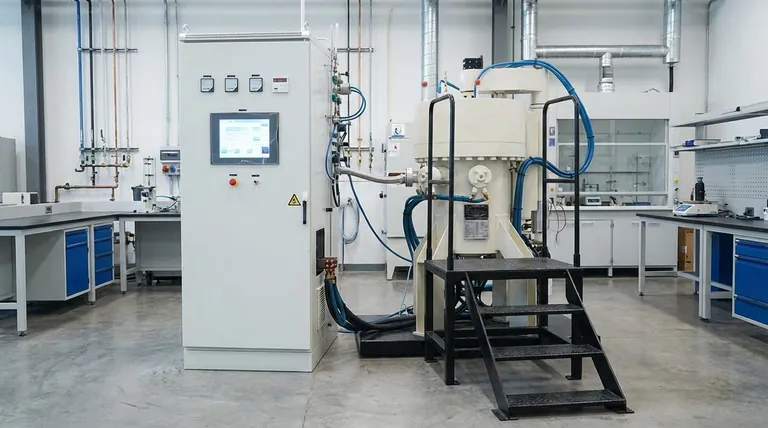
The Mechanics of Superior Densification
Accelerating Particle Rearrangement
In pressureless sintering, particles bond slowly through thermal diffusion. Vacuum hot pressing introduces mechanical pressure (typically 5–30 MPa) as an additional driving force.
This external force promotes immediate contact and plastic flow among the powder particles. It physically forces grains together, significantly accelerating the elimination of pores that thermal energy alone might not close.
Achieving Density at Lower Temperatures
Because mechanical pressure aids the diffusion process, the material reaches full densification at significantly lower temperatures compared to pressureless methods.
This reduction in thermal load is crucial. It minimizes the risk of altering the chemical composition of the IZO material while ensuring the structural integrity of the final ceramic body.
Critical Advantages for IZO Performance
Eliminating Sputtering Defects
The primary enemy of a high-performance target is porosity. Internal pores in a target lead to sputtering arcing (electrical discharges) and the generation of unwanted particles during the coating process.
By achieving relative densities exceeding 95%–99%, vacuum hot pressing effectively removes these internal voids. This ensures a smooth, consistent deposition process essential for semiconductor and display applications.
Controlling Grain Growth
The rapid densification provided by hot pressing requires shorter holding times at peak temperatures. This effectively inhibits excessive grain growth.
Maintaining a fine, uniform grain structure significantly improves the mechanical properties of the target. For optical ceramics, this microstructure also enhances optical transmittance.
Enhancing Purity Through Vacuum
The process operates in a high-vacuum environment. This facilitates the removal of occluded gases and promotes the volatilization of low-melting-point metal impurities.
The result is a target with strictly controlled gas (<850 ppm) and carbon content (<100 ppm). High purity is non-negotiable for IZO targets, as impurities directly degrade the electrical performance of the sputtered film.
Managing Process Complexity and Risks
The Challenge of Gas Discharge
While pressure is beneficial, applying it too quickly can trap gases inside the powder compact.
To prevent blockages caused by poor gas discharge, programmable pressure functions are required. Pressure must be applied slowly during the heating phase to allow volatiles to escape before the outer shell seals completely.
Mitigating Thermal Stress
Large ceramic targets are brittle and prone to cracking under thermal stress.
Vacuum hot press furnaces mitigate this through precise depressurization. Slow depressurization during the cooling phase is essential to prevent the target from cracking due to rapid release of thermal and mechanical stress.
Making the Right Choice for Your Goal
When selecting a manufacturing method for IZO targets, prioritize vacuum hot pressing based on your specific performance requirements.
- If your primary focus is Sputtering Stability: Choose this method to maximize density and eliminate internal pores, which directly prevents arcing and particle contamination.
- If your primary focus is Film Purity: Rely on the vacuum environment to remove volatile impurities and occluded gases that would otherwise degrade electrical conductivity.
- If your primary focus is Structural Integrity: Utilize the programmable pressure capabilities to produce large-sized, crack-free targets with uniform grain structures.
Vacuum hot press sintering transforms the production of IZO targets from a simple heating process into a precision engineering operation, delivering the density and purity required for high-tech applications.
Summary Table:
| Feature | Pressureless Sintering | Vacuum Hot Press Sintering |
|---|---|---|
| Driving Force | Thermal energy only | Thermal energy + Mechanical pressure |
| Densification | Slow, prone to voids | Rapid, near-theoretical density |
| Sputtering Stability | Risk of arcing/particles | Stable, low-arcing performance |
| Impurity Control | Atmospheric contamination risk | High-vacuum removal of gases/metals |
| Grain Structure | Risk of excessive growth | Fine, uniform grain control |
Maximize Your IZO Target Performance with KINTEK
Don't settle for porous ceramic targets that lead to sputtering defects. KINTEK’s high-precision vacuum hot press systems deliver the mechanical pressure and thermal control necessary to achieve >99% relative density and superior chemical purity.
Backed by expert R&D and manufacturing, KINTEK offers Muffle, Tube, Rotary, Vacuum, and CVD systems, all customizable for your unique lab and industrial needs. Whether you are producing advanced semiconductors or optical coatings, our technology ensures your materials meet the highest standards of structural integrity.
Ready to elevate your material science? Contact our technical experts today for a custom solution!
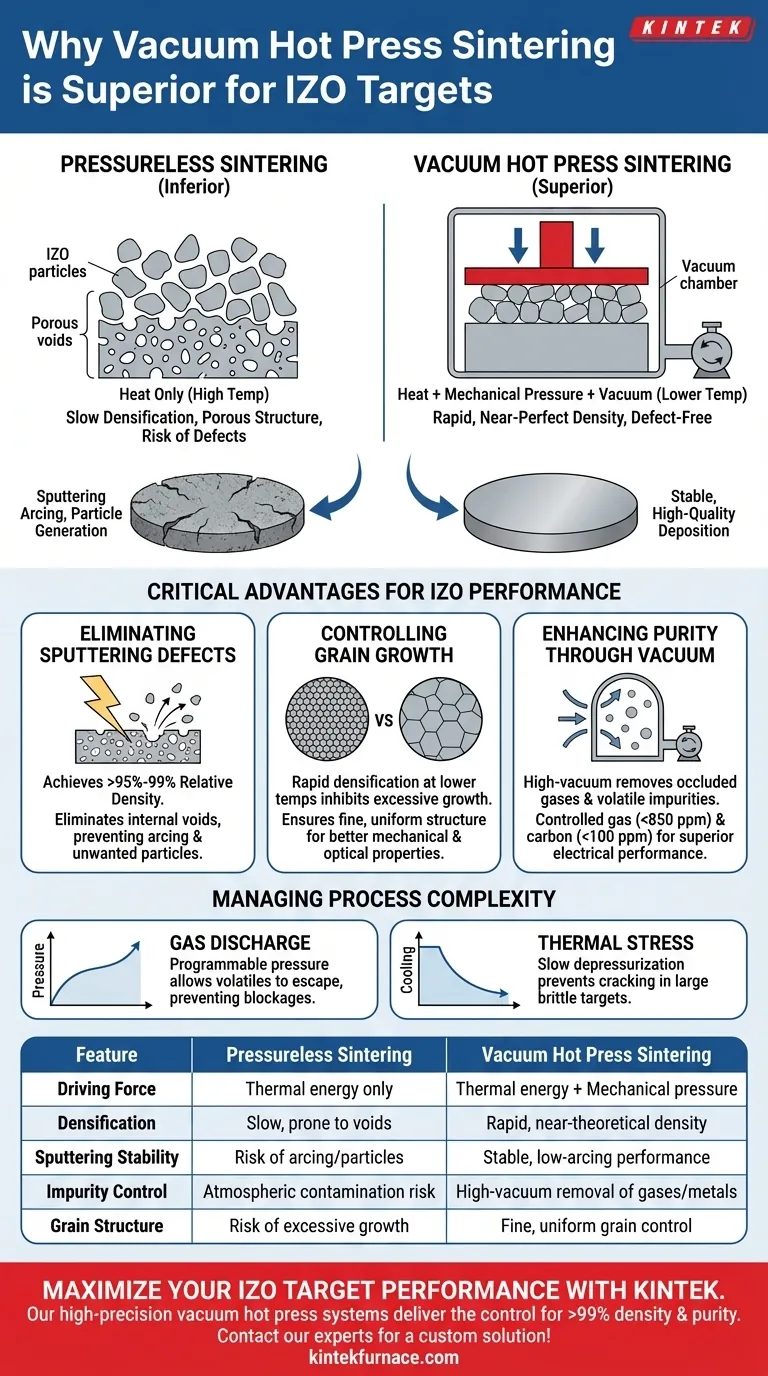
Visual Guide
Related Products
- 600T Vacuum Induction Hot Press Vacuum Heat Treat and Sintering Furnace
- 9MPa Air Pressure Vacuum Heat Treat and Sintering Furnace
- Vacuum Hot Press Furnace Machine Heated Vacuum Press Tube Furnace
- Vacuum Heat Treat Sintering Furnace with Pressure for Vacuum Sintering
- 2200 ℃ Tungsten Vacuum Heat Treat and Sintering Furnace
People Also Ask
- Why use Vacuum Hot Press (VHP) for ZnS Ceramics? Achieve Superior IR Transparency and Mechanical Strength
- How does a vacuum hot press sintering furnace mitigate copper sintering swelling? Solve Fe-Cu Expansion Issues
- How does the vacuum environment in a vacuum hot press sintering furnace protect chromium-containing ceramics? Find out.
- What are the benefits of using a vacuum hot press sintering furnace for the preparation of SiCw/2024 aluminum matrix composites? Achieve High-Performance Aerospace Materials
- What are the key advantages of vacuum hot press sintering furnaces? Achieve Superior Density and Purity in Materials



















