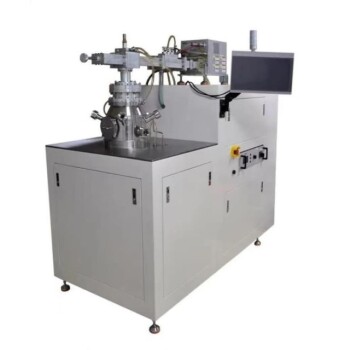
Achieving a pristine growth environment is the single most important factor in synthesizing high-quality Gallium Sulfide (GaS) crystals. The use of a high-performance vacuum system equipped with a diffusion pump is critical because it allows the quartz tube to reach an ultra-high vacuum level of 10^-6 Torr. This extreme evacuation is the only reliable method to physically remove microscopic environmental contaminants before the sealing process begins.
Core Insight: By utilizing a diffusion pump to achieve a vacuum of 10^-6 Torr, you effectively eliminate oxygen and water vapor interference. This prevents the oxidation of raw materials during high-temperature melting, ensuring the final Gallium Sulfide crystal maintains its correct stoichiometric ratio and structural purity.
The Physics of Contamination Control
Reaching Ultra-High Vacuum
Standard mechanical pumps are often insufficient for high-purity crystal growth. To synthesize semiconductor-grade materials like Gallium Sulfide, you must achieve an ultra-high vacuum (UHV) of approximately 10^-6 Torr.
This level of pressure reduction requires a diffusion pump working in tandem with a backing pump. The diffusion pump is specifically designed to capture and remove gas molecules that standard pumps leave behind.
Eliminating Gaseous Impurities
The primary adversaries in crystal growth are oxygen and water vapor found in ambient air. At the molecular level, these gases adhere to the walls of the quartz tube and the surface of the raw materials.
A high-performance vacuum system ensures these gaseous impurities are fully evacuated. This creates a "clean slate" environment inside the tube before the high-temperature processing begins.
Ensuring Chemical Integrity
Preventing Material Oxidation
Gallium and Sulfur precursors are highly reactive at the elevated temperatures required for melting. If residual oxygen or moisture remains in the tube, the raw materials will oxidize rather than react with each other.
This oxidation leads to the formation of unwanted byproducts, such as oxides, which contaminate the melt. The high vacuum acts as a protective barrier, preventing these chemical side reactions from occurring.
Maintaining Stoichiometry
For a Gallium Sulfide crystal to function correctly, it must have a precise atomic ratio (stoichiometry) of Gallium to Sulfur. The introduction of gaseous impurities disrupts this delicate balance.
By eliminating interference from foreign gases, the vacuum system ensures that the chemical reaction is driven solely by the intended raw materials. This guarantees that the resulting single crystal possesses the correct stoichiometric composition.
Common Pitfalls and Trade-offs
The Risk of "Good Enough" Vacuum
A common error is relying solely on a mechanical roughing pump, which typically creates a vacuum in the range of 10^-2 or 10^-3 Torr. While this removes the bulk of the air, it leaves behind enough oxygen to compromise the crystal's surface quality.
Equipment Complexity vs. Purity
Using a diffusion pump adds complexity and maintenance requirements to the setup compared to a simple rotary pump. However, this is a necessary trade-off.
Attempting to bypass the diffusion pump to save time or resources inevitably results in lower purity crystals. In the context of Gallium Sulfide, where stoichiometry is paramount, the cost of equipment complexity is far lower than the cost of failed synthesis batches.
Making the Right Choice for Your Goal
To ensure your crystal growth process yields usable semiconductor materials, consider the following recommendations:
- If your primary focus is High Purity: Ensure your vacuum system includes a diffusion pump capable of consistently holding 10^-6 Torr to eliminate all traces of water vapor.
- If your primary focus is Stoichiometric Accuracy: Prioritize leak-checking your quartz sealing station, as even microscopic leaks will introduce oxygen that skews the Gallium-Sulfur ratio.
The vacuum system is not merely a preparatory tool; it is the fundamental gatekeeper of your crystal's chemical identity.
Summary Table:
| Feature | Standard Mechanical Pump | High-Performance Diffusion Pump |
|---|---|---|
| Vacuum Level | 10^-2 to 10^-3 Torr | 10^-6 Torr (Ultra-High Vacuum) |
| Contaminant Removal | Bulk air removal only | Removes microscopic O2 & water vapor |
| Oxidation Risk | High; potential for byproduct formation | Minimal; ensures chemical integrity |
| Resulting Purity | Industrial grade/low purity | Semiconductor grade/high purity |
| Stoichiometry | Often compromised by impurities | Precisely maintained |
Maximize Your Crystal Growth Success with KINTEK
Don't let residual oxygen compromise your research. KINTEK provides industry-leading high-temperature lab furnaces and vacuum systems tailored for the most demanding synthesis requirements. Backed by expert R&D and manufacturing, we offer Muffle, Tube, Rotary, Vacuum, and CVD systems—all fully customizable to achieve the ultra-high vacuum levels your Gallium Sulfide crystals require.
Ready to elevate your lab's precision? Contact us today to discuss your unique needs with our technical specialists.
References
- Danil Bukhvalov, Antonio Politano. Self‐Assembled Gallium Sulfide (GaS) Heterostructures Enabling Efficient Water Splitting and Selective Ammonia Sensing. DOI: 10.1002/adfm.202507388
This article is also based on technical information from Kintek Furnace Knowledge Base .
Related Products
- Cylindrical Resonator MPCVD Machine System for Lab Diamond Growth
- MPCVD Machine System Reactor Bell-jar Resonator for Lab and Diamond Growth
People Also Ask
- How does MPCVD achieve stable temperature control during diamond growth? Master Precise Thermal Management
- What are the essential components of an MPCVD reactor system? Build a Pristine Environment for High-Purity Materials
- How do carbon-containing groups contribute to diamond growth in the MPCVD method? Unlock High-Quality Diamond Synthesis
- How does pressure affect the MPCVD growth process? Master Plasma Control for Superior Film Quality
- What factors influence the quality of diamond deposition in the MPCVD method? Master the Critical Parameters for High-Quality Diamond Growth