
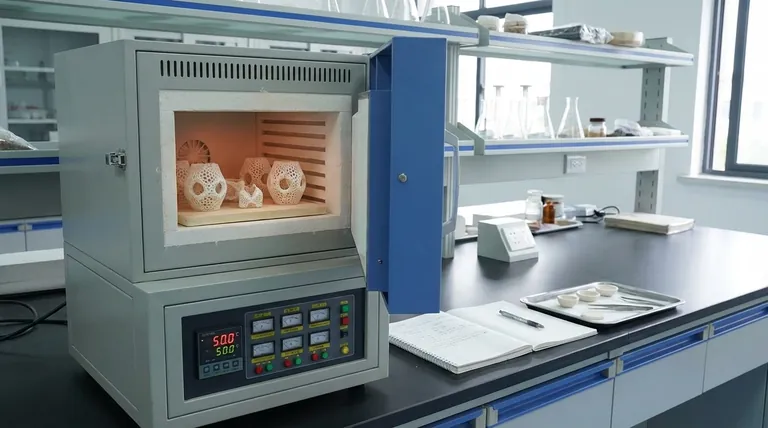
Precision drying is the specific safeguard against structural failure in ceramic processing. It is necessary to facilitate the slow, uniform removal of moisture from the slurry-coated green body. By utilizing equipment like constant temperature ovens at 50 °C, you prevent rapid evaporation that would otherwise destroy the delicate porous architecture.
The use of precision drying equipment ensures moisture is removed slowly and evenly, preventing uneven capillary pressure. This is the single most effective method for avoiding micro-cracks and deformation, guaranteeing the integrity of the complex porous skeleton.
The Mechanics of Moisture Removal
Controlling Evaporation Rates
The drying process involves treating the coated green body at a constant temperature of 50 °C. This phase can last for up to 12 hours.
This extended duration at a moderate temperature is intentional. It forces the moisture to exit the slurry at a gradual, controlled pace rather than flashing off quickly.
Ensuring Uniformity
Precision equipment, such as a drying cabinet, eliminates environmental fluctuations. It maintains a steady thermal environment around the entire geometry of the part.
This uniformity ensures that one section of the skeleton does not dry—and consequently shrink—faster than another.
The Science of Defect Prevention
Managing Capillary Pressure
The root cause of failure during drying is uneven capillary pressure. When moisture evaporates too quickly, significant pressure differentials build up within the pores of the material.
Precision drying neutralizes this threat. By keeping the evaporation slow, capillary forces remain balanced throughout the structure.
Eliminating Micro-Cracks and Deformation
If capillary pressure is not managed, the stress manifests physically as micro-cracks or warping. These defects compromise the structural integrity of the skeleton.
Proper drying ensures the green body remains physically stable. This stability is a prerequisite for the ceramic to survive subsequent processing steps without falling apart.
Understanding the Trade-offs
The Cost of Patience
The primary "downside" of this method is time. Dedicating up to 12 hours for drying at a low temperature of 50 °C can create a bottleneck in high-speed production lines.
The Risk of Acceleration
Attempting to speed up this process is the most common cause of component loss. Increasing the temperature above the recommended range to save time triggers rapid evaporation.
This inevitably leads to the very deformation and cracking the equipment is designed to prevent. There is no shortcut that preserves the structural integrity of the porous skeleton.
Making the Right Choice for Your Goal
To ensure high yields and consistent quality in porous mullite ceramics, adhere to the following:
- If your primary focus is Structural Integrity: Strictly maintain the 50 °C temperature limit to prevent uneven capillary pressure.
- If your primary focus is Process Efficiency: Optimize your batch scheduling to accommodate the 12-hour cycle rather than increasing heat to shorten it.
Precision in drying is not an optional refinement; it is the fundamental requirement for a crack-free green body.
Summary Table:
| Parameter | Standard Requirement | Role in Process |
|---|---|---|
| Drying Temperature | 50 °C (Constant) | Prevents rapid evaporation & flash-off |
| Process Duration | Up to 12 Hours | Ensures gradual moisture removal |
| Key Mechanism | Capillary Pressure Control | Neutralizes internal stress & pressure differentials |
| Critical Outcome | Structural Integrity | Eliminates warping and micro-crack formation |
Elevate Your Material Integrity with KINTEK
Don't let structural failure compromise your research or production. KINTEK provides high-precision thermal solutions tailored for the delicate drying and sintering stages of advanced ceramics. Backed by expert R&D and manufacturing, we offer Muffle, Tube, Rotary, Vacuum, and CVD systems, all customizable to maintain the exact 50 °C environment or high-temp profiles your unique porous skeletons require.
Ready to eliminate micro-cracks and maximize your yield?
Contact our laboratory experts today to find the perfect precision equipment for your workflow.
References
- Chunxia Xu, Wenbin Han. Research on preparation and related properties of macro–micro porous mullite ceramic skeletons <i>via</i> twice pore-forming technology. DOI: 10.1039/d4ra01277a
This article is also based on technical information from Kintek Furnace Knowledge Base .
Related Products
People Also Ask
- What is Hot-filament Chemical Vapor Deposition (HFCVD)? Achieve High-Quality Thin Films with Precision Control
- What are the equipment for chemical vapor deposition? A Guide to the 5 Essential Components
- What is the significance of the vacuum pressure control system in the CVD coating process for powders?
- What is the function of high-purity Argon (Ar) gas during CVD? Optimize Your Thin Film Uniformity and Purity
- What are the advantages of using Chemical Vapor Deposition (CVD) for coating turbine blades? Enhance Life & Performance
