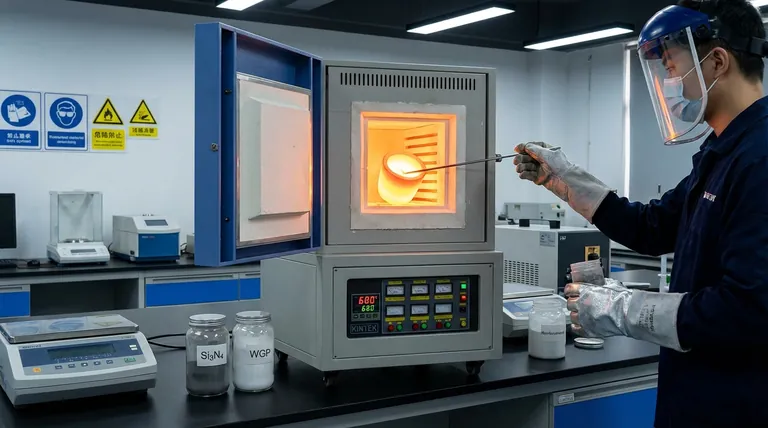
Precise temperature control is the critical variable that determines the structural integrity and performance of AZ91D/Si3N4/WGP composites. In an electric melting furnace, maintaining the base magnesium alloy (AZ91D) at a specific target, typically around 680°C, is essential to ensure the metal matrix achieves the optimal fluidity required to accept and distribute reinforcement particles.
Core Takeaway: producing high-quality metal matrix composites is a balancing act between viscosity and stability. Precise thermal regulation ensures the molten matrix is fluid enough to wet the reinforcement particles uniformly, avoiding the structural weak points caused by clumping or thermal stress.
Optimizing Matrix Fluidity and Distribution
The Role of Viscosity
For the AZ91D magnesium alloy to effectively bond with Si3N4 (silicon nitride) and WGP (waste glass powder) reinforcements, the metal must be fully molten.
At the target temperature of approximately 680°C, the melt achieves optimal fluidity. This state allows the matrix to flow freely around the reinforcement particles.
Ensuring Uniform Dispersion
The primary challenge in composite preparation is achieving a homogeneous mix.
If the temperature fluctuates or drops below the optimal range, the viscosity of the melt increases. This resistance prevents the stirring process from distributing the reinforcement phases evenly, leading to an inconsistent material structure.
Preventing Structural Defects
Avoiding Particle Agglomeration
When temperature control is imprecise, reinforcement particles tend to cluster together rather than disperse.
These clusters, known as agglomerations, create brittle spots and stress concentrators within the composite. Precise heating ensures the melt remains fluid enough to separate these particles during mechanical stirring.
Mitigating Thermal Stress
Inconsistent heating creates temperature gradients within the furnace chamber.
Large differences in temperature across the material can introduce thermal stress defects. By maintaining a strict temperature profile, you ensure the entire volume of material expands and processes at the same rate, preventing internal cracking.
Understanding the Trade-offs: The Risks of Deviation
While the primary reference focuses on AZ91D, evidence from broader composite manufacturing highlights the universal dangers of missing the temperature window.
The Risk of Overheating
Exceeding the target temperature does not simply make the material "more molten"; it can trigger detrimental chemical reactions.
In similar composite processes (such as C/Al or Ti-Al3Ti), excessive heat leads to the formation of brittle phases or combustion reactions that introduce porosity. In the context of AZ91D, overheating risks degrading the material properties and increasing oxidation.
The Risk of Underheating
Conversely, failing to reach the target temperature results in insufficient densification.
If the matrix is too cool, it lacks the fluidity to infiltrate the reinforcement bundles or powders. This leads to voids and a lack of bonding at the interface, rendering the final composite mechanically weak.
The Importance of Heating Rate
It is not just about the final temperature, but how you get there.
Rapid, uncontrolled heating can cause thermal shock. A precise, controlled ramp-up (e.g., in vacuum furnace applications) allows the microstructure to evolve uniformly, minimizing internal defects.
Making the Right Choice for Your Goal
To maximize the quality of your AZ91D/Si3N4/WGP composites, you must prioritize thermal precision as heavily as you prioritize material selection.
- If your primary focus is Mechanical Strength: Prioritize temperature stability around 680°C to ensure uniform particle distribution, as clusters act as failure points.
- If your primary focus is Material Longevity: Focus on controlling heating rates and gradients to eliminate thermal stress defects that shorten the component's fatigue life.
- If your primary focus is Process Efficiency: Automate temperature regulation to prevent the formation of waste product caused by porosity or insufficient infiltration.
True process mastery lies in the ability to lock the thermal reaction window, ensuring the physics of the melt work for you, not against you.
Summary Table:
| Factor | Optimal Temperature (~680°C) | Deviation Risks (Low/High) |
|---|---|---|
| Matrix State | Ideal Fluidity & Low Viscosity | Increased Viscosity / Brittle Phase Formation |
| Reinforcement | Uniform Particle Dispersion | Agglomeration & Stress Concentrators |
| Structural Integrity | Homogeneous Microstructure | Porosity, Internal Cracking & Voids |
| Material Bonding | Strong Interface Wetting | Infiltration Failure & Thermal Shock |
Elevate Your Composite Manufacturing Precision
High-performance materials like AZ91D/Si3N4/WGP require the absolute thermal stability that only expert engineering can provide. At KINTEK, we specialize in the R&D and manufacturing of advanced high-temperature systems designed for researchers and industrial manufacturers who cannot afford to compromise on quality.
Whether you need Muffle, Tube, Rotary, Vacuum, or CVD systems, our furnaces offer the precise temperature regulation and customizable profiles necessary to eliminate structural defects and optimize material properties. Let our experts help you achieve perfect matrix fluidity and uniform dispersion for your unique applications.
Ready to refine your thermal process? Contact KINTEK Today to Find Your Custom Solution
References
- Shubham Sharma, Emad A. A. Ismail. Enhancing tribo-mechanical, microstructural morphology, and corrosion performance of AZ91D-magnesium composites through the synergistic reinforcements of silicon nitride and waste glass powder. DOI: 10.1038/s41598-024-52804-y
This article is also based on technical information from Kintek Furnace Knowledge Base .
Related Products
- Vacuum Induction Melting Furnace
- Silicon Carbide SiC Thermal Heating Elements for Electric Furnace
- Electric Rotary Kiln Pyrolysis Furnace Plant Machine Small Rotary Kiln Calciner
- Electric Rotary Kiln Continuous Working Small Rotary Furnace Kiln for Pyrolysis Plant Heating
- Spark Plasma Sintering SPS Furnace
People Also Ask
- What are the core functions of the High Vacuum Induction Melting (VIM) furnace? Optimize DD5 Superalloy Purification
- What are the technical advantages of using a Vacuum Induction Melting furnace in the development of advanced packaging steel?
- What role does a Vacuum Induction Melting furnace play in the production of high-aluminum nickel-based superalloys?
- What are the advantages of using a VIM furnace to control residual oxygen pressure? Achieve Superior Metal Uniformity
- What is the role of VIM and directional solidification in aero-engine blade substrates? Engineering Extreme Durability