
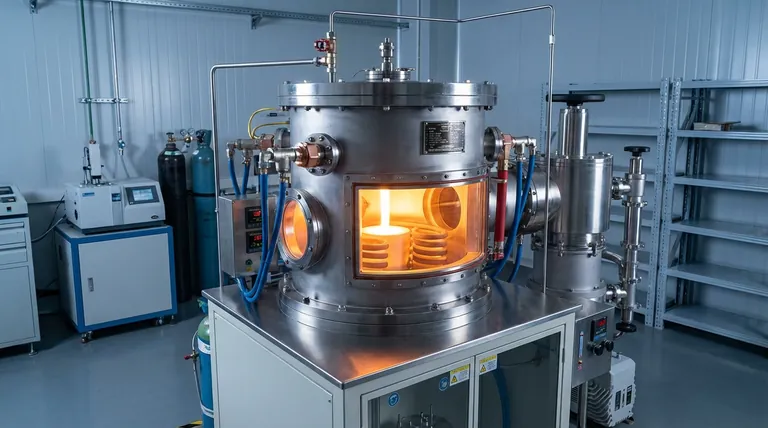
A vacuum induction furnace acts as the critical control system for both chemical purity and physical uniformity in the smelting of AlCoCrFeNi2.1.
By establishing a high-vacuum environment, the furnace prevents the oxidative loss of reactive elements like aluminum and chromium. Simultaneously, it utilizes electromagnetic induction to actively stir the molten metal, forcing the five distinct elements to mix thoroughly into a precise, homogeneous alloy.
The core function of the vacuum induction furnace is to eliminate atmospheric contamination while mechanically homogenizing the melt, ensuring the strict chemical ratios required to achieve the eutectic microstructure of AlCoCrFeNi2.1 are preserved.
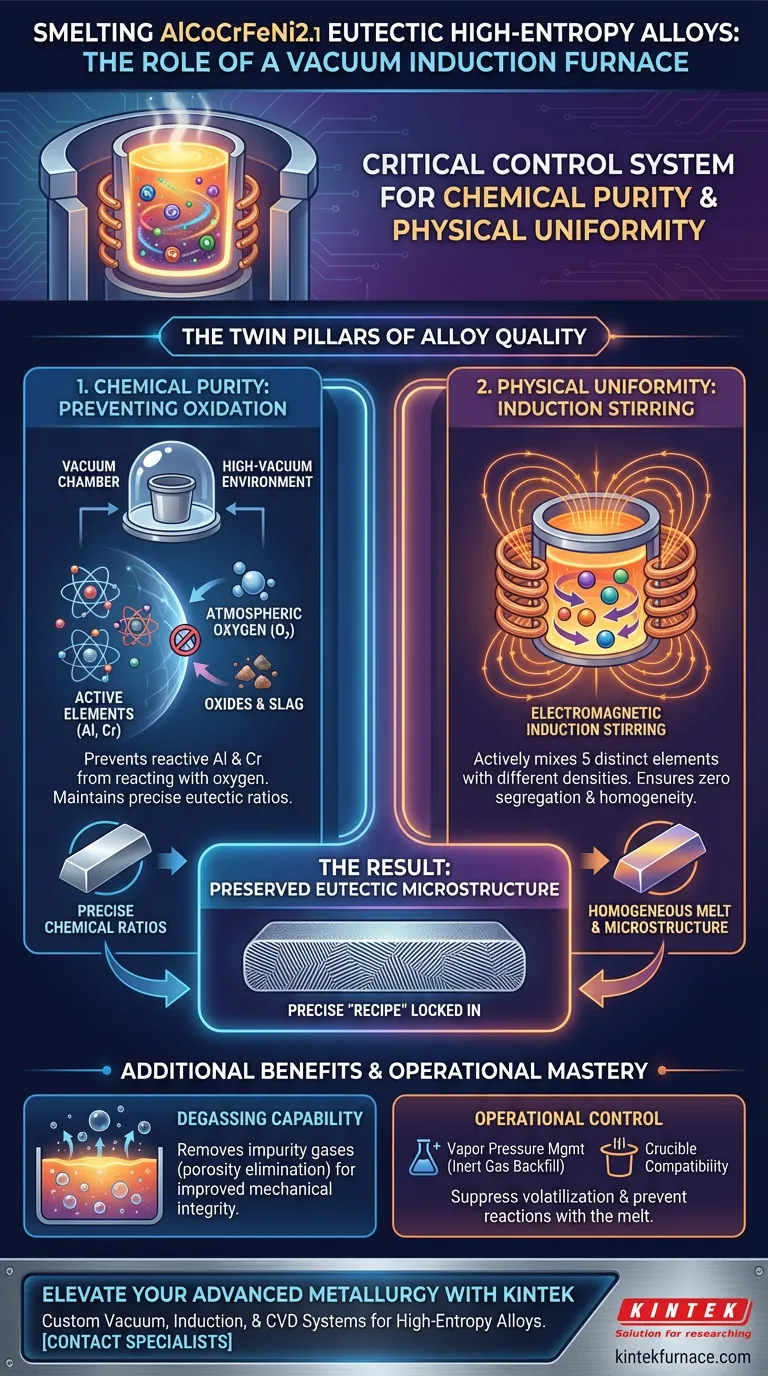
The Twin Pillars of Alloy Quality
The preparation of high-entropy alloys (HEAs) requires overcoming two main challenges: oxidation of active metals and segregation of elements with different densities. The vacuum induction furnace addresses these through two distinct mechanisms.
Preventing Oxidative Loss
The primary reference indicates that the furnace operates under a high-vacuum environment. This is essential for AlCoCrFeNi2.1 because elements like Aluminum (Al) and Chromium (Cr) are "active," meaning they react aggressively with oxygen at high temperatures.
If these elements were to oxidize, they would form slag rather than integrating into the alloy matrix. This would shift the chemical composition away from the target ratio, potentially destroying the specific eutectic properties of the material.
Ensuring Homogeneity via Induction Stirring
AlCoCrFeNi2.1 consists of five distinct metallic elements, each with its own density and melting point. Without active intervention, these elements might stratify or mix unevenly.
The furnace generates an induction stirring effect within the liquid phase. This electromagnetic force creates a natural convection current in the crucible, continuously circulating the melt. This ensures that heavy and light elements are thoroughly blended, resulting in ingots with uniform chemical distribution from top to bottom.
The Significance for Eutectic Microstructures
Precision is Non-Negotiable
Unlike standard alloys, a "eutectic" alloy forms a specific lamellar microstructure only at a very precise chemical composition ratio.
The vacuum induction furnace ensures that the final ingot retains the exact "recipe" calculated by the metallurgist. By preventing the loss of volatile or active elements to the atmosphere, the furnace guarantees that the liquid metal solidifies into the intended AlCoCrFeNi2.1 phase structure.
Elimination of Impurity Gases
Beyond preventing solid oxides, the vacuum environment facilitates degassing. It removes dissolved gases that could lead to porosity or brittleness in the final casting, ensuring the mechanical integrity of the alloy.
Operational Considerations and Trade-offs
While the vacuum induction furnace is the superior choice for this application, operators must be aware of specific process dynamics to maximize results.
Managing Vapor Pressure
While a high vacuum prevents oxidation, it can theoretically lead to the evaporation of elements with high vapor pressures if not monitored.
To mitigate this, the process often involves backfilling the chamber with an inert gas like argon (as noted in supplementary contexts regarding VIM processes). This creates a "controlled atmosphere" that suppresses volatilization while still blocking oxygen.
Crucible Compatibility
The induction process generates intense localized heat. It is vital to ensure the crucible material does not react with the high-entropy melt, as this would introduce new impurities that the vacuum cannot remove.
Making the Right Choice for Your Goal
To achieve the best results with AlCoCrFeNi2.1, align your furnace operation with your specific metallurgical objectives.
- If your primary focus is Chemical Precision: Prioritize the vacuum level to ensure zero oxidative loss of Aluminum, which is the most vulnerable element in this matrix.
- If your primary focus is Microstructural Uniformity: Maximize the induction frequency and power to enhance the stirring effect, ensuring the five elements are physically indistinguishable in the liquid phase.
The vacuum induction furnace is not just a heat source; it is a precision tool that locks in the chemistry required for high-performance eutectic alloys.
Summary Table:
| Feature | Role in AlCoCrFeNi2.1 Smelting | Key Benefit |
|---|---|---|
| High Vacuum Environment | Prevents Al and Cr from reacting with oxygen | Maintains precise eutectic chemical ratios |
| Induction Stirring | Electromagnetic circulation of five distinct elements | Ensures physical homogeneity and zero segregation |
| Degassing Capability | Removes dissolved gases from the melt | Eliminates porosity and improves mechanical integrity |
| Atmosphere Control | Inert gas backfilling options | Suppresses element volatilization and vapor loss |
Elevate Your Advanced Metallurgy with KINTEK
Precision in AlCoCrFeNi2.1 production demands equipment that guarantees zero atmospheric contamination and perfect elemental mixing. KINTEK provides state-of-the-art Vacuum, Induction, and CVD systems designed specifically for the rigorous requirements of high-entropy alloy research.
Backed by expert R&D and world-class manufacturing, our lab high-temp furnaces are fully customizable to your unique smelting protocols. Don't settle for inconsistent alloy quality—trust KINTEK to deliver the control you need.
Contact Our Technical Specialists Today to discuss your custom furnace requirements!
Visual Guide
References
- Effect of Heat Treatment on Corrosion of an AlCoCrFeNi2.1 Eutectic High-Entropy Alloy in 3.5 wt% NaCl Solution. DOI: 10.3390/met15060681
This article is also based on technical information from Kintek Furnace Knowledge Base .
Related Products
- 600T Vacuum Induction Hot Press Vacuum Heat Treat and Sintering Furnace
- Vacuum Induction Melting Furnace
- Vacuum Hot Press Furnace Machine Heated Vacuum Press Tube Furnace
- Vacuum Heat Treat Sintering and Brazing Furnace
- Vacuum Hot Press Furnace Machine Heated Vacuum Press
People Also Ask
- Why use Vacuum Hot Press (VHP) for ZnS Ceramics? Achieve Superior IR Transparency and Mechanical Strength
- How does a vacuum hot press sintering furnace mitigate copper sintering swelling? Solve Fe-Cu Expansion Issues
- How does the vacuum environment in a vacuum hot press sintering furnace protect chromium-containing ceramics? Find out.
- What are the key advantages of vacuum hot press sintering furnaces? Achieve Superior Density and Purity in Materials
- What is the core function of a vacuum hot press sintering furnace in the preparation of high-density RuTi alloys? Achieve Maximum Density and Purity



















