
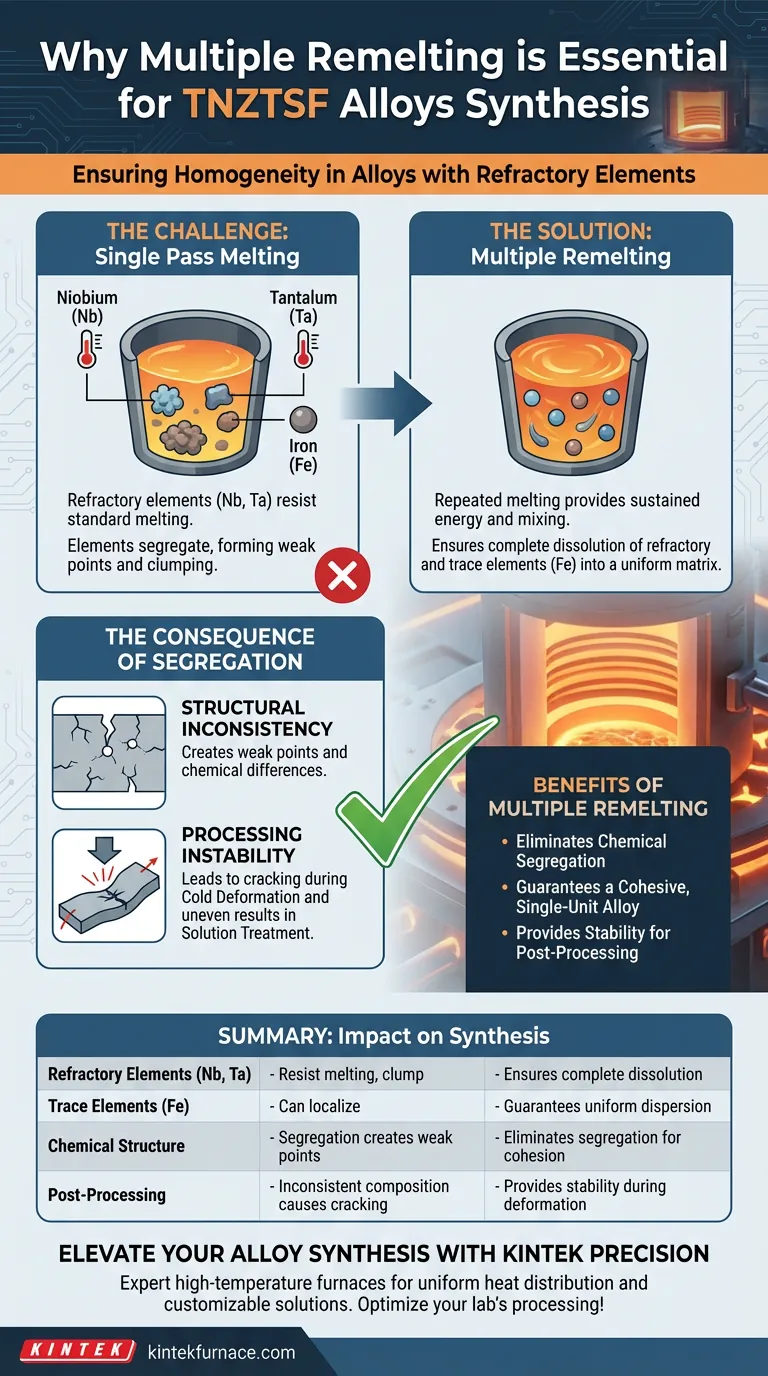
Multiple remelting cycles are essential to achieve the necessary chemical homogeneity within TNZTSF alloys. Because these alloys contain refractory elements with high melting points, specifically Niobium (Nb) and Tantalum (Ta), a single melting pass is insufficient to distribute them evenly. Repeated melting ensures these heavy components, along with trace elements like Iron (Fe), are thoroughly mixed to eliminate chemical segregation.
Refractory elements resist standard melting; without multiple cycles, they clump together and compromise the alloy's integrity. Remelting is the primary mechanism for ensuring a uniform chemical structure that remains stable during later processing.
The Challenge of Refractory Elements
Overcoming High Melting Points
Niobium (Nb) and Tantalum (Ta) are refractory metals known for their exceptional resistance to heat.
Because they have significantly higher melting points than other alloy constituents, they do not dissolve easily.
Multiple remelting provides the sustained energy and mixing required to fully integrate these stubborn elements into the alloy matrix.
Distributing Trace Elements
The synthesis process must also account for trace elements such as Iron (Fe).
While less resistant than refractory metals, these elements still risk becoming localized within the material.
Remelting ensures these trace components are dispersed uniformly rather than concentrating in specific pockets.
The Consequence of Segregation
Preventing Structural Inconsistency
Chemical segregation occurs when elements separate or clump rather than forming a solid solution.
In TNZTSF alloys, segregation creates weak points where the chemical composition differs from the rest of the material.
Eliminating this segregation through remelting is the only way to guarantee the alloy acts as a single, cohesive unit.
Ensuring Processing Stability
The benefits of homogeneity extend beyond the initial synthesis.
A uniform chemical structure is a prerequisite for stable performance during subsequent manufacturing steps.
Specifically, it ensures the material behaves predictably during cold deformation and solution treatment phases.
Understanding the Risks
Impact on Cold Deformation
If chemical segregation is present, the alloy will not deform continuously under stress.
Inconsistent areas caused by undissolved Niobium or Tantalum can lead to stress concentrations.
This often results in unexpected failure or cracking during the cold deformation process.
Issues with Solution Treatment
Solution treatment relies on a uniform starting microstructure to be effective.
If the elements are not evenly distributed, the heat treatment will produce uneven results across the alloy.
This lack of uniformity compromises the final mechanical properties of the material.
Ensuring Material Integrity
To achieve a high-performance TNZTSF alloy, the initial synthesis must prioritize total chemical integration.
- If your primary focus is structural durability: Prioritize multiple remelting cycles to eliminate weak points caused by the segregation of Niobium and Tantalum.
- If your primary focus is manufacturing efficiency: Ensure the alloy is fully homogenized to prevent material failure during cold deformation and heat treatment.
A rigorous approach to initial melting creates the foundation for a reliable, defect-free material.
Summary Table:
| Factor | Impact on TNZTSF Synthesis | Benefit of Multiple Remelting |
|---|---|---|
| Refractory Elements | Nb and Ta resist melting and tend to clump | Ensures complete dissolution into the alloy matrix |
| Trace Elements | Iron (Fe) can localize in specific pockets | Guarantees uniform dispersion throughout the material |
| Chemical Structure | Segregation creates structural weak points | Eliminates segregation for a cohesive, single-unit alloy |
| Post-Processing | Inconsistent composition causes cracking | Provides stability during cold deformation and heat treatment |
Elevate Your Alloy Synthesis with KINTEK Precision
Don't let chemical segregation compromise your material integrity. Achieving the perfect homogeneity in TNZTSF alloys requires the right high-temperature environment. Backed by expert R&D and world-class manufacturing, KINTEK offers a comprehensive range of Vacuum, CVD, Muffle, and customizable lab high-temperature furnaces designed to handle the rigorous demands of refractory elements like Niobium and Tantalum.
Our value to you:
- Uniform Heat Distribution: Critical for eliminating weak points in complex alloys.
- Customizable Solutions: Tailored systems to meet your specific melting and synthesis requirements.
- Expert Engineering: High-performance equipment that ensures stability during subsequent cold deformation.
Contact KINTEK today to optimize your lab's high-temperature processing!
Visual Guide
References
- Vasile Dănuț Cojocaru, Bogdan Mihai Gălbinaşu. The Effect of Solution Treatment Duration on the Microstructural and Mechanical Properties of a Cold-Deformed-by-Rolling Ti-Nb-Zr-Ta-Sn-Fe Alloy. DOI: 10.3390/ma17040864
This article is also based on technical information from Kintek Furnace Knowledge Base .
Related Products
- 2200 ℃ Tungsten Vacuum Heat Treat and Sintering Furnace
- Small Vacuum Heat Treat and Tungsten Wire Sintering Furnace
- Vacuum Induction Melting Furnace
- 1200℃ Controlled Inert Nitrogen Atmosphere Furnace
- 1700℃ Controlled Inert Nitrogen Atmosphere Furnace
People Also Ask
- How does a tungsten-heated vacuum sintering furnace prepare (TbxY1-x)2O3 ceramics? Achieve 99%+ Density & Purity
- What wear-resistance enhancements are achieved by powder coating? The Role of Vacuum Sintering Furnaces
- How do compaction pressure and vacuum sintering optimize porous ceramics? Maximize Density & Toughness
- What role does a high-temperature vacuum sintering furnace play in the densification of WC-10(Ni, Ni/Co) alloys?
- What core role does a high-temperature vacuum sintering furnace play in Sm:YAG ceramics? Mastering Optical Clarity












