
Pre-melting pure titanium particles acts as a crucial purification step known as "gettering." By melting titanium first, you leverage its high chemical reactivity to capture residual oxygen remaining in the furnace chamber. This process significantly improves the vacuum quality before the sensitive CoCrFeNiZr0.3 alloy is introduced to heat.
Even in a high-quality vacuum, trace amounts of oxygen can compromise an alloy's integrity. Pre-melting titanium neutralizes these impurities, creating a pristine environment that ensures the structural and chemical purity of the final CoCrFeNiZr0.3 alloy.
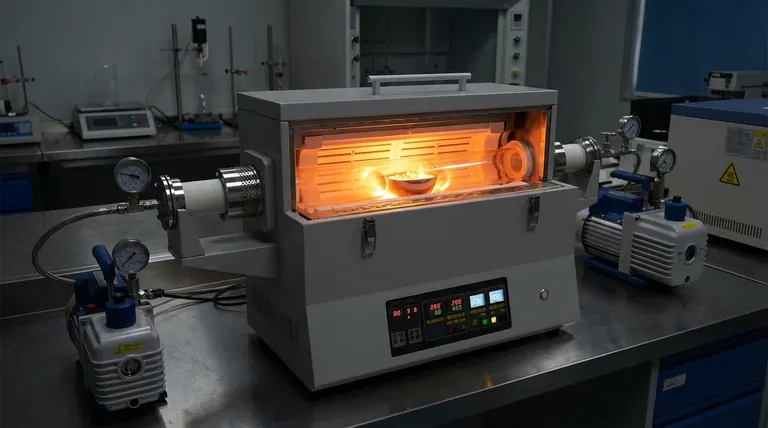
The Mechanism of Purification
Titanium as a Chemical Trap
Titanium is selected for this process due to its extreme chemical activity at high temperatures.
It acts as a sacrificial material, functioning as a "getter."
Its role is to attract and bond with impurities that mechanical pumps cannot remove.
Scavenging Residual Oxygen
Vacuum chambers are rarely perfect voids; trace oxygen often remains floating or adsorbed on chamber walls.
When titanium particles are melted, they react aggressively with this residual oxygen.
This reaction locks the oxygen away into solid titanium oxides, effectively scrubbing the atmosphere clean.
Protecting the CoCrFeNiZr0.3 Alloy
Preventing Impurity Contamination
The CoCrFeNiZr0.3 alloy is chemically complex and sensitive to its environment.
If oxygen is present during the main melt, it can react with the alloy's components, particularly Zirconium (Zr).
This contamination can lead to unwanted oxide inclusions, which compromise the mechanical properties of the final material.
Elevating Vacuum Quality
The pre-melt step bridges the gap between a standard mechanical vacuum and a high-purity metallurgical environment.
It ensures that the atmosphere surrounding the alloy is chemically inert.
This allows the CoCrFeNiZr0.3 to melt and homogenize without fighting against atmospheric interference.
Understanding the Trade-offs
Process Time and Consumables
Implementing a titanium pre-melt adds a distinct step to the manufacturing cycle.
It increases the total time required for each batch, impacting throughput.
Additionally, it requires the consumption of pure titanium, which adds a recurring material cost to the operation.
Chamber Maintenance
The gettering process creates reaction byproducts, specifically titanium oxides.
These byproducts deposit on the interior surfaces of the furnace or the crucible.
Regular maintenance is required to clean these deposits to prevent buildup that could eventually contaminate future melts.
Optimizing Your Melting Protocol
To get the most out of this purification step, align your approach with your specific metallurgical goals:
- If your primary focus is mechanical performance: Prioritize a thorough pre-melt cycle to ensure the absolute minimum oxygen content, as this prevents brittleness in the final alloy.
- If your primary focus is process consistency: Standardize the mass of the titanium getter used in every run to ensure the vacuum quality remains identical across different batches.
Treating the vacuum atmosphere as a critical variable is just as important as the alloy ingredients themselves.
Summary Table:
| Aspect | Function / Impact |
|---|---|
| Primary Role | Acts as a "getter" to capture residual oxygen |
| Mechanism | High chemical reactivity creates stable titanium oxides |
| Alloy Protection | Prevents Zirconium (Zr) oxidation and inclusions |
| Atmosphere | Elevates vacuum quality beyond mechanical pumping |
| Trade-offs | Increased cycle time and regular chamber maintenance |
Secure High-Purity Results with KINTEK
Don't let residual impurities compromise your complex alloys. Backed by expert R&D and manufacturing, KINTEK offers high-performance Muffle, Tube, Rotary, Vacuum, and CVD systems—all fully customizable to support advanced protocols like titanium gettering. Whether you are melting sensitive CoCrFeNiZr0.3 alloys or developing new materials, our precision lab furnaces provide the stable, high-vacuum environment your research demands.
Ready to elevate your metallurgical precision? Contact us today to discuss your unique furnace needs!
References
- Peng Lyu, Xinlin Liu. Hot Deformation Characteristics and Microstructure Evolution of CoCrFeNiZr0.3 Hypoeutectic High-Entropy Alloy. DOI: 10.3390/met14060632
This article is also based on technical information from Kintek Furnace Knowledge Base .
Related Products
- High Temperature Muffle Oven Furnace for Laboratory Debinding and Pre Sintering
- Vacuum Induction Melting Furnace
- Magnesium Extraction and Purification Condensing Tube Furnace
- 2200 ℃ Tungsten Vacuum Heat Treat and Sintering Furnace
- Small Vacuum Heat Treat and Tungsten Wire Sintering Furnace
People Also Ask
- What thermal phenomena occur during polymer binder burnout in ceramic green bodies? Lab Furnace Guide
- Why is controlled heat treatment in a muffle furnace necessary for calcined clay? Achieve Optimal Pozzolanic Activity
- What role does a high-temperature muffle furnace play in STFO synthesis? Achieve Pure Perovskite Results
- How does a high-temperature muffle furnace facilitate the formation of LaNbxAl1−xO3+δ perovskite structures? Key Roles
- What role does a high-temperature muffle furnace play in the multi-stage synthesis of Li0.5MnFe1.5O4? Key to Pure Spinel








