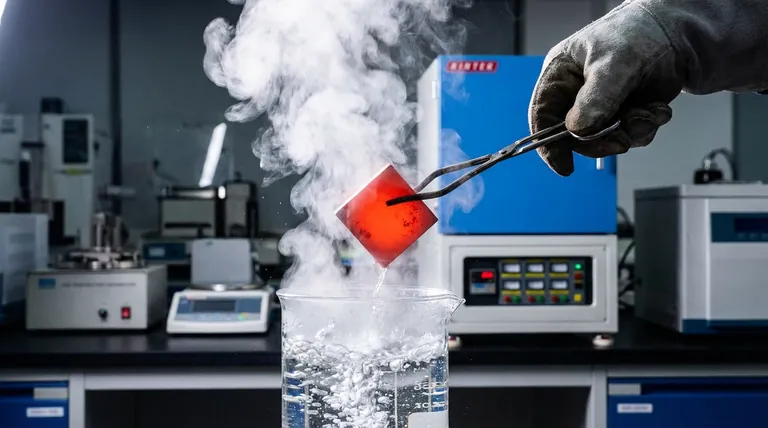
Immediate water-quenching is the critical stop-mechanism required to preserve the integrity of thermal simulation experiments. For (CoCrNi)94Al3Ti3 alloy specimens, this rapid cooling is essential to instantly "freeze" the internal structure of the metal as it exists at high temperatures, preventing natural thermal evolution that occurs the moment deformation stops.
Core Takeaway When an alloy is deformed at high heat, its internal structure is in a dynamic, transient state. Immediate water-quenching halts all thermal activity to preserve the specific Dynamic Recrystallization (DRX) microstructure, ensuring that subsequent analysis reflects the actual test conditions rather than cooling artifacts.
Preserving the Transient Microstructure
Freezing Dynamic Recrystallization (DRX)
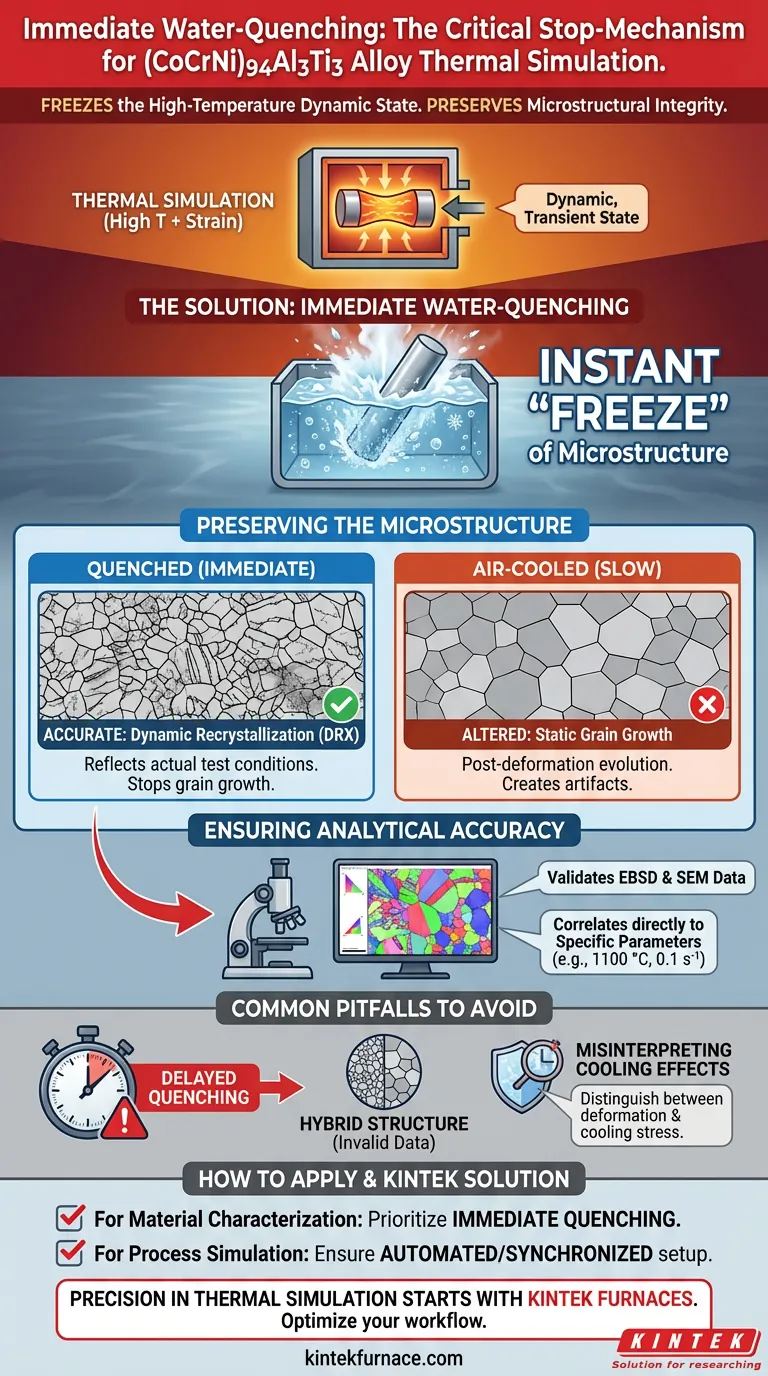
During thermal simulation, the alloy undergoes a process called Dynamic Recrystallization (DRX). This microstructural change is driven by the specific combination of heat and mechanical strain applied during the test. Water-quenching utilizes rapid cooling rates to capture this exact state, locking the microstructure in place before it can relax or change.
Preventing Static Grain Growth
If the specimen is allowed to cool slowly (air cooling), the internal grains will continue to evolve. This post-deformation phenomenon is known as static grain growth. By immediately lowering the temperature, you remove the thermal energy required for this growth, ensuring the grain size remains exactly as it was at the moment deformation ceased.
Ensuring Analytical Accuracy
Validating EBSD and SEM Data
Advanced imaging techniques, such as Electron Backscatter Diffraction (EBSD) and Scanning Electron Microscopy (SEM), are used to analyze the alloy's behavior. These tools are extremely sensitive and detect minute details in grain orientation and boundary structure. If the sample is not quenched, the images produced will represent a "relaxed" state, rendering the data factually incorrect regarding the test conditions.
Correlating Data to Specific Parameters
To understand how the alloy behaves under precise conditions, the final microstructure must map directly to the input parameters. For example, when testing at 1100 °C with a strain rate of 0.1 s⁻¹, the resulting structure is unique to those variables. Quenching guarantees that the observed physical properties are the direct result of those specific inputs, not a byproduct of uncontrolled cooling.
Common Pitfalls to Avoid
The Risk of Delayed Quenching
The most critical error in this process is a delay between the cessation of strain and the introduction of water. Even a delay of a few seconds allows the material to retain enough heat for the microstructure to alter. This leads to a hybrid structure—partially dynamic, partially static—which compromises the validity of the entire simulation.
Misinterpreting Cooling Effects
It is vital to distinguish between effects caused by the deformation and effects caused by the cooling method. While quenching is necessary to freeze the structure, one must ensure the analysis focuses on the high-temperature features preserved by the quench, rather than thermal stresses introduced by the rapid temperature drop itself.
How to Apply This to Your Project
To ensure your thermal simulation data is defensible and accurate, consider the following regarding your cooling strategy:
- If your primary focus is material characterization: Prioritize immediate quenching to ensure EBSD/SEM imagery reflects the true high-temperature state of the alloy.
- If your primary focus is process simulation: Ensure your quenching setup is automated or tightly synchronized to eliminate any delay after deformation.
By treating the cooling phase as a critical variable rather than an afterthought, you ensure your data remains a true window into the alloy's high-temperature behavior.
Summary Table:
| Feature | Impact of Immediate Quenching | Impact of Slow Air Cooling |
|---|---|---|
| Microstructure | Preserves Dynamic Recrystallization (DRX) | Suffers Static Grain Growth |
| Thermal State | "Freezes" transient high-temp state | Allows for natural thermal evolution |
| Data Integrity | High: Maps directly to test parameters | Low: Includes cooling artifacts |
| Analytical Value | Validates EBSD and SEM accuracy | Resulting images reflect a "relaxed" state |
| Risk Factor | Minimal structural change | High risk of hybrid, invalid structures |
Precision in thermal simulation requires precision in heating and cooling control. Backed by expert R&D and manufacturing, KINTEK offers high-performance Muffle, Tube, Vacuum, and CVD systems—all fully customizable to meet the rigorous demands of alloy research and materials science. Ensure your (CoCrNi)94Al3Ti3 specimens yield defensible data with our lab high-temp furnaces. Contact KINTEK today to optimize your thermal simulation workflow!
Visual Guide
References
- Optimized Control of Hot-Working Parameters in Hot-Forged (CoCrNi)94Al3Ti3 Medium-Entropy Alloy. DOI: 10.3390/coatings15060706
This article is also based on technical information from Kintek Furnace Knowledge Base .
Related Products
- HFCVD Machine System Equipment for Drawing Die Nano Diamond Coating
- High Performance Vacuum Bellows for Efficient Connection and Stable Vacuum in Systems
- Custom Made Versatile CVD Tube Furnace Chemical Vapor Deposition CVD Equipment Machine
People Also Ask
- What is Hot-filament Chemical Vapor Deposition (HFCVD)? Achieve High-Quality Thin Films with Precision Control
- What are the equipment for chemical vapor deposition? A Guide to the 5 Essential Components
- What is the significance of the vacuum pressure control system in the CVD coating process for powders?
- What is the function of high-purity Argon (Ar) gas during CVD? Optimize Your Thin Film Uniformity and Purity
- What are the advantages of using Chemical Vapor Deposition (CVD) for coating turbine blades? Enhance Life & Performance