
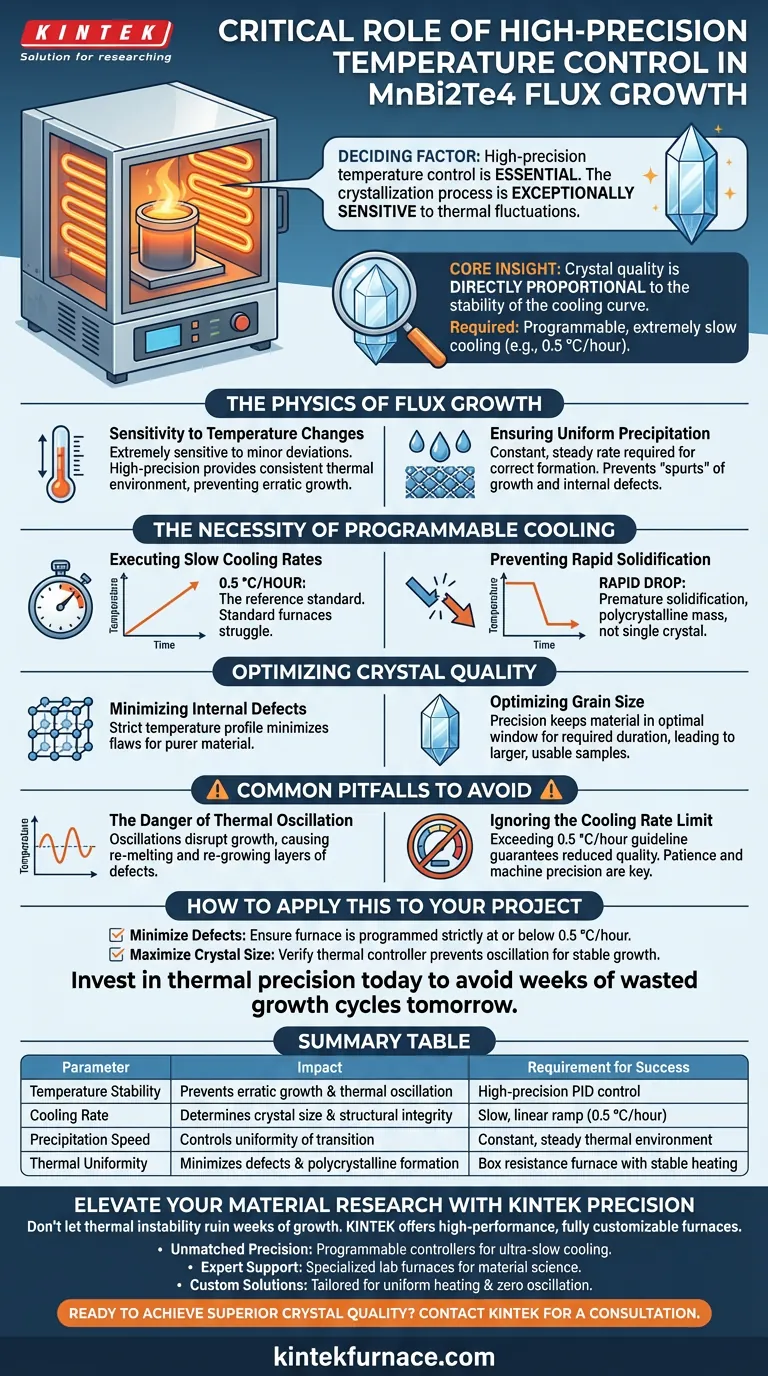
High-precision temperature control is the deciding factor in successfully growing MnBi2Te4 crystals because the material’s crystallization process is exceptionally sensitive to thermal fluctuations. To achieve high-quality growth via the flux method, the furnace must maintain a stable environment that allows the material to precipitate slowly and uniformly from the molten state.
Core Insight: The quality of MnBi2Te4 single crystals is directly proportional to the stability of the cooling curve. Without a furnace capable of executing extremely slow, programmable temperature drops (e.g., 0.5 °C/hour), the process will likely yield crystals plagued by internal defects and poor grain size.
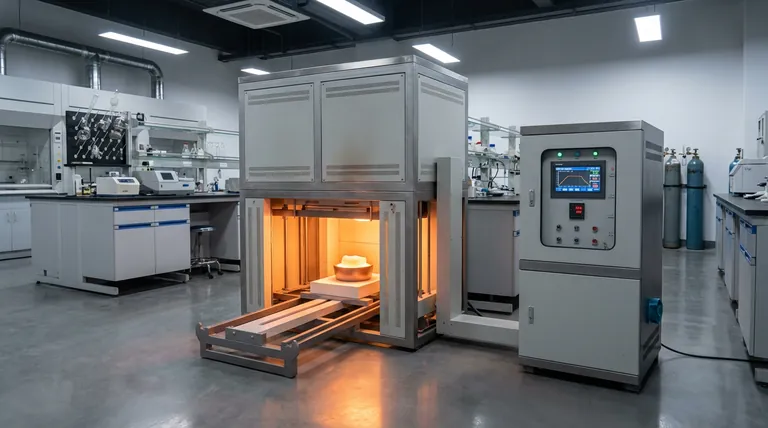
The Physics of Flux Growth
Sensitivity to Temperature Changes
The crystallization of MnBi2Te4 is not a robust process that can withstand thermal instability. It is extremely sensitive to even minor deviations in temperature.
A high-precision box resistance furnace mitigates this by providing a consistent thermal environment. This stability prevents the erratic growth behaviors that occur when temperatures drift unexpectedly.
Ensuring Uniform Precipitation
For a single crystal to form correctly, it must precipitate from the molten flux at a constant, steady rate.
High-precision control ensures that the transition from liquid to solid happens uniformly. This prevents "spurts" of growth that can ruin the crystal's internal structure.
The Necessity of Programmable Cooling
Executing Slow Cooling Rates
The primary requirement for this material is the ability to execute specific, programmable cooling curves.
The reference standard for this process is a cooling rate of 0.5 °C per hour. This is an incredibly slow pace that standard, low-precision furnaces often struggle to maintain linearly.
Preventing Rapid Solidification
If the furnace cannot maintain this slow ramp and drops temperature too quickly, the flux will solidify prematurely.
Rapid solidification prevents the orderly arrangement of atoms required for single-crystal growth. Instead of a single large crystal, you may end up with a polycrystalline mass.
Optimizing Crystal Quality
Minimizing Internal Defects
Thermal control is the primary defense against structural flaws.
By maintaining a strict temperature profile, the furnace minimizes internal defects within the crystal lattice. This results in a purer material with better physical properties.
Optimizing Grain Size
The size of the final crystal—its grain size—is heavily dependent on how long it stays in the optimal growth window.
Precision control keeps the material in this window for the exact duration required. This optimizes the resulting grain size, leading to larger, more usable samples.
Common Pitfalls to Avoid
The Danger of Thermal Oscillation
A furnace may appear to hit a target temperature on average, but if it oscillates (swings up and down) around that setpoint, it will disrupt growth.
For MnBi2Te4, these oscillations can cause the crystal to partially re-melt and re-grow repeatedly. This creates layers of defects that ruin the sample.
Ignoring the Cooling Rate Limit
Attempting to accelerate the process by exceeding the 0.5 °C/hour guideline is a common error.
While faster cooling saves time, it almost strictly guarantees a reduction in crystal quality. The flux method requires patience and machine precision to work effectively.
How to Apply This to Your Project
To maximize your success with MnBi2Te4 growth, match your furnace settings to your specific quality goals:
- If your primary focus is minimizing defects: Ensure your furnace is programmed for a cooling rate strictly at or below 0.5 °C/hour to prevent internal flaws.
- If your primary focus is maximizing crystal size: Verify that your furnace's thermal controller prevents oscillation, as stability is required to grow large, singular grains.
Invest in thermal precision today to avoid weeks of wasted growth cycles tomorrow.
Summary Table:
| Parameter | Impact on MnBi2Te4 Growth | Requirement for Success |
|---|---|---|
| Temperature Stability | Prevents erratic growth & thermal oscillation | High-precision PID control |
| Cooling Rate | Determines crystal size and structural integrity | Slow, linear ramp (0.5 °C/hour) |
| Precipitation Speed | Controls uniformity of the liquid-to-solid transition | Constant, steady thermal environment |
| Thermal Uniformity | Minimizes internal defects and polycrystalline formation | Box resistance furnace with stable heating |
Elevate Your Material Research with KINTEK Precision
Don't let thermal instability ruin weeks of growth cycles. At KINTEK, we understand that growing complex crystals like MnBi2Te4 requires absolute control. Backed by expert R&D and world-class manufacturing, we offer high-performance Muffle, Tube, Rotary, Vacuum, and CVD systems—all fully customizable to meet your specific research needs.
Our value to you:
- Unmatched Precision: programmable controllers capable of the ultra-slow cooling rates essential for flux growth.
- Expert Support: Specialized lab furnaces designed for material science and semiconductor research.
- Custom Solutions: Tailored configurations to ensure uniform heating and zero oscillation.
Ready to achieve superior crystal quality? Contact KINTEK today for a consultation!
Visual Guide
References
- Yaoxin Li, Chang Liu. Fabrication-induced even-odd discrepancy of magnetotransport in few-layer MnBi2Te4. DOI: 10.1038/s41467-024-47779-3
This article is also based on technical information from Kintek Furnace Knowledge Base .
Related Products
- 1700℃ High Temperature Laboratory Tube Furnace with Alumina Tube
- 1400℃ High Temperature Laboratory Tube Furnace with Alumina Tube
- Vertical Laboratory Quartz Tube Furnace Tubular Furnace
- 1700℃ Controlled Inert Nitrogen Atmosphere Furnace
- 1200℃ Split Tube Furnace Laboratory Quartz Tube Furnace with Quartz Tube
People Also Ask
- How are high-temperature laboratory tube furnaces applied in long-term vacuum homogenization heat treatments for intermetallic samples?
- How are high-temp tube furnaces used to measure diffusion coefficients per Fick's law? Master Precision Annealing
- How do high-temperature laboratory tube furnaces ensure environmental stability? Precision Thermal Reduction Tips
- How are high-temperature tube furnaces applied in testing ceramic-supported alloy membranes? Insights
- In what scenarios are laboratory high-temperature tube furnaces or muffle furnaces utilized? Study MgTiO3-CaTiO3 Ceramics



















