
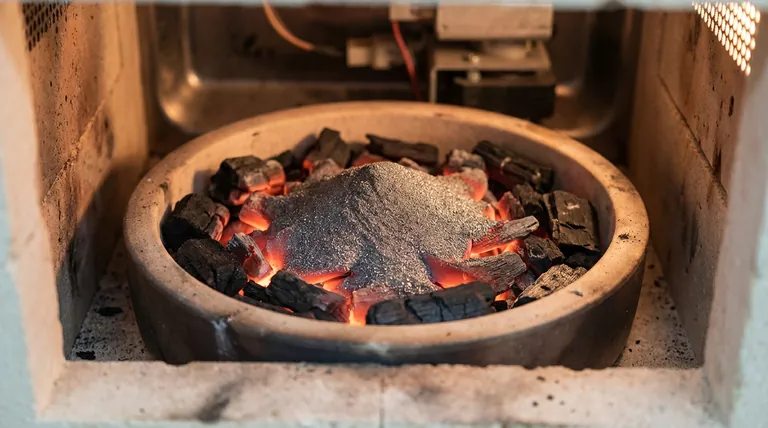
Charcoal is utilized as a susceptor in the Microwave Hybrid Heating (MHH) process primarily to overcome the natural tendency of metal powders to reflect microwave energy at room temperature. By rapidly absorbing microwaves and converting them into heat, charcoal acts as an intermediary thermal source that allows conductive metal powders to reach the critical temperatures necessary for direct microwave absorption.
Core Takeaway Direct microwave heating of metals is inefficient at low temperatures due to high reflection rates. Charcoal acts as a "thermal bridge," absorbing energy to generate heat via conduction, which raises the metal powder's temperature until it can effectively couple with the microwave field on its own.
The Challenge of Direct Microwave Heating
The Problem of Reflection
At room temperature, metallic particles—such as nickel—act as mirrors to microwave radiation. Instead of absorbing the energy and heating up, they reflect the microwaves, making direct heating inefficient or impossible during the initial phase of the process.
The Role of the Susceptor
To solve this, a susceptor material like charcoal is introduced into the heating environment. Unlike metal, charcoal has dielectric properties that allow it to absorb microwave energy rapidly rather than reflecting it.
Immediate Energy Conversion
Upon exposure to the microwave field, the charcoal quickly increases in temperature. It serves as an active heating element within the system, independent of the metal powder's initial response.
The Mechanism of Hybrid Heating
Heat Transfer via Conduction
Once the charcoal heats up, it transfers thermal energy to the adjacent material, such as a Nickel-Boron Nitride (Ni-BN) mixture. This transfer occurs through thermal conduction, effectively bypassing the metal's initial resistance to microwave absorption.
Reaching Critical Temperature
The heat provided by the charcoal raises the temperature of the metal powder. As the metal gets hotter, its physical properties change, reducing its reflectivity.
Achieving Microwave Coupling
Eventually, the metal powder reaches a critical temperature. At this distinct tipping point, the metal begins to effectively couple with the microwaves directly, allowing the process to transition from indirect conduction heating to direct microwave heating.
Understanding the Process Dynamics
Dependence on Proximity
Because this process relies heavily on thermal conduction in the early stages, the efficiency of heat transfer is dictated by the physical arrangement of the materials. The charcoal must be positioned effectively to transfer heat to the target powder.
The Two-Stage Heating Profile
It is important to recognize that MHH is a dual-phase process. It begins with the external heating provided by the charcoal and shifts toward internal heating once the metal creates its own coupling with the electromagnetic field.
How to Apply This to Your Project
When designing a Microwave Hybrid Heating process for metallurgy, consider the following regarding susceptor selection:
- If your primary focus is heating highly reflective metals: Utilize charcoal to bridge the "cold start" gap where materials like nickel reflect rather than absorb energy.
- If your primary focus is process efficiency: Ensure the thermal conduction path between the charcoal and the metal powder is optimized to reach the critical coupling temperature quickly.
Charcoal provides the essential thermal leverage required to initiate heating in materials that otherwise resist microwave interaction.
Summary Table:
| Feature | Direct Microwave Heating | Microwave Hybrid Heating (MHH) with Charcoal |
|---|---|---|
| Initial Interaction | High reflection by metal powders | Rapid absorption by charcoal susceptor |
| Heating Method | Internal (once coupled) | Two-stage: Conduction then Direct Coupling |
| Cold Start Capability | Very low for reflective metals | High; charcoal initiates thermal ramp |
| Efficiency | Poor at room temperature | Optimized via intermediary thermal bridge |
| Key Outcome | Uneven or no heating | Uniform heating to critical temperature |
Elevate Your Material Processing with KINTEK
Are you looking to optimize your Microwave Hybrid Heating (MHH) or high-temperature sintering workflows? Backed by expert R&D and world-class manufacturing, KINTEK provides high-performance Muffle, Tube, Rotary, Vacuum, and CVD systems tailored to your laboratory's unique requirements.
Our customizable furnaces ensure precise thermal control, helping you master susceptor-based processes and achieve superior material properties.
Ready to transform your thermal processing? Contact us today to speak with a specialist about our advanced lab high-temp furnace solutions.
References
- Shashi Prakash Dwivedi, Raghad Ahmed. Revolutionizing Surface Enhancement: Microwave-Assisted Cladding of Ni-Boron Nitride Mixture onto SS-304. DOI: 10.1051/e3sconf/202450701008
This article is also based on technical information from Kintek Furnace Knowledge Base .
Related Products
- Small Vacuum Heat Treat and Tungsten Wire Sintering Furnace
- Electric Rotary Kiln Small Rotary Furnace for Activated Carbon Regeneration
- High Temperature Muffle Oven Furnace for Laboratory Debinding and Pre Sintering
- Spark Plasma Sintering SPS Furnace
- Multi Heating Zones CVD Tube Furnace Machine for Chemical Vapor Deposition Equipment
People Also Ask
- How does vacuum sintering improve dimensional tolerances? Achieve Uniform Shrinkage and Precision
- What is the purpose of setting a mid-temperature dwell stage? Eliminate Defects in Vacuum Sintering
- What are the key components of a vacuum sintering furnace? Essential Parts for Precision Material Processing
- What are the main structural components of a vacuum sintering furnace? Unlock Precision in High-Temperature Processing
- What are the main types of sintering furnaces? Find the Perfect Match for Your Materials



















