
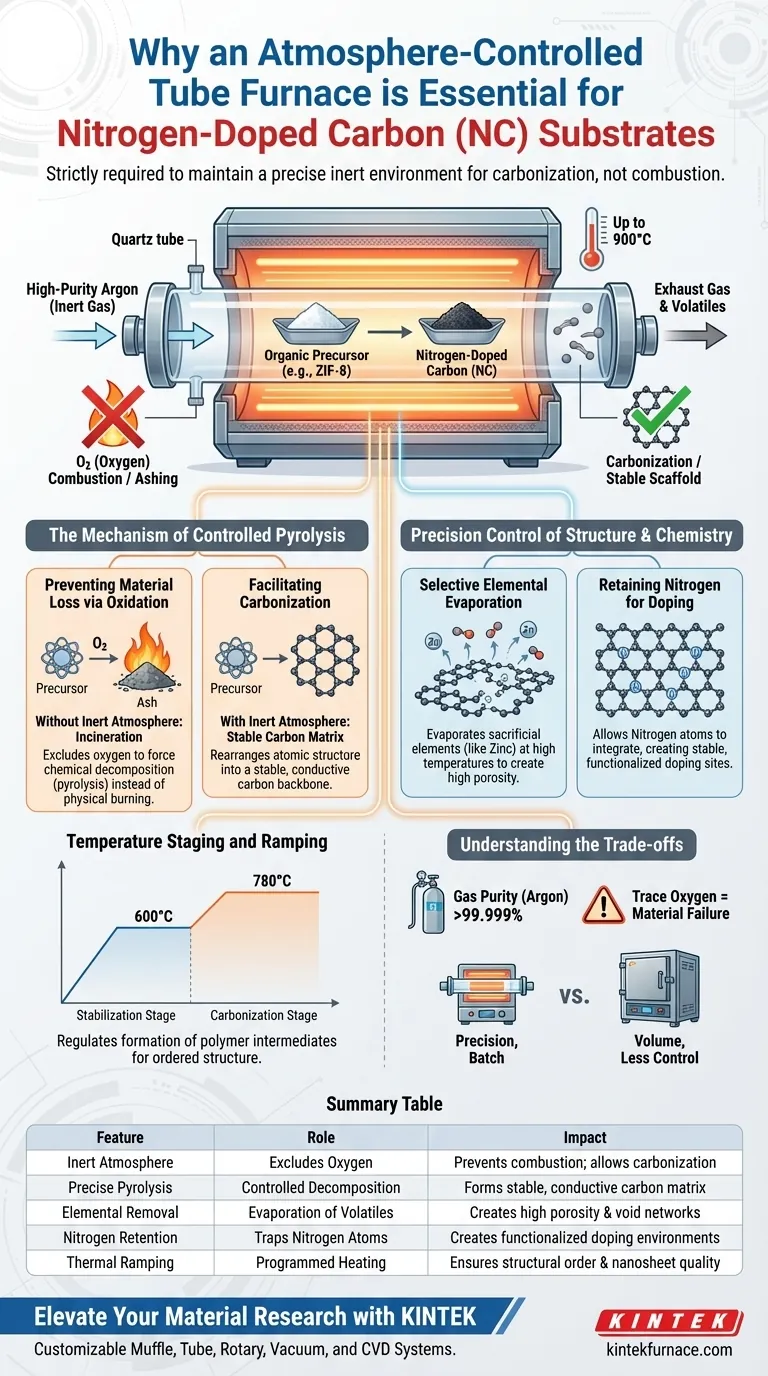
An atmosphere-controlled tube furnace is strictly required because it maintains a precise inert environment, typically high-purity argon, which allows organic precursors to undergo carbonization rather than oxidative combustion. Without this oxygen-free protection during high-temperature treatment (often reaching 900°C), the precursor materials would simply burn away, preventing the formation of the stable, porous carbon scaffold necessary for nitrogen-doped substrates.
The tube furnace functions not just as a heater, but as a selective chemical reactor. It creates the specific thermodynamic conditions needed to evaporate sacrificial elements (like Zinc) while effectively trapping nitrogen atoms within the carbon lattice to create a functionalized, high-porosity material.
The Mechanism of Controlled Pyrolysis
Preventing Material Loss via Oxidation
The fundamental challenge in creating carbon substrates is that organic precursors are highly flammable at elevated temperatures.
If exposed to oxygen at 900°C, the framework would incinerate, leaving behind only ash. The tube furnace excludes oxygen entirely, forcing the material to decompose chemically (pyrolysis) rather than physically burn.
Facilitating Carbonization
Once the atmosphere is secured, the furnace drives the transformation of the organic framework into a rigid carbon structure.
This process, known as carbonization, rearranges the atomic structure. It converts the precursor into a stable, conductive carbon matrix that serves as the physical backbone for the substrate.
Precision Control of Structure and Chemistry
Selective Elemental Evaporation
For precursors like ZIF-8, the furnace facilitates a critical separation process.
At high temperatures, volatile metallic elements such as Zinc are evaporated out of the material. This controlled removal is essential because it leaves behind a network of voids, directly creating the material's high porosity.
Retaining Nitrogen for Doping
While Zinc is expelled, the furnace environment allows Nitrogen atoms to remain.
These nitrogen atoms do not evaporate; instead, they integrate into the carbon scaffold. This creates a stable nitrogen coordination environment, which is the defining characteristic of a "nitrogen-doped" substrate.
Temperature Staging and Ramping
The tube furnace allows for programmed temperature profiles, which is vital for complex precursors.
For example, a two-stage heating strategy (e.g., stabilizing at 600°C before rising to 780°C) allows for the orderly formation of polymer intermediates. This regulation ensures the final nanosheets have the correct chemical structure rather than a chaotic, amorphous arrangement.
Understanding the Trade-offs
Sensitivity to Gas Purity
The success of this process is entirely dependent on the quality of the inert atmosphere.
Even trace amounts of oxygen due to a leak or low-quality argon can compromise the "hard carbon" structure or lead to partial surface oxidation. The system requires rigorous sealing and high-purity gas sources.
Throughput vs. Precision
Tube furnaces are inherently limited in volume compared to industrial box furnaces.
While they offer exceptional control over atmosphere and heating rates—essential for doping sulfur or nitrogen—they are typically batch-process tools. Scaling this process up for mass production requires significant engineering to maintain the same atmospheric uniformity.
Making the Right Choice for Your Goal
To maximize the quality of your nitrogen-doped carbon (NC) substrates, align your furnace parameters with your specific structural targets:
- If your primary focus is High Porosity: Ensure your maximum temperature reaches the evaporation point of your sacrificial element (e.g., 900°C for Zinc removal) to maximize void creation.
- If your primary focus is Specific Surface Area: Consider introducing activating agents like Carbon Dioxide (CO2) at high temperatures (1000°C) to physically etch structural defects into the matrix.
- If your primary focus is Chemical Stability: Utilize a programmed, multi-stage heating ramp to allow carbon polymer intermediates to form bonds slowly before the final high-temperature carbonization.
The tube furnace is the gatekeeper that determines whether your precursor becomes a pile of ash or a highly engineered catalytic substrate.
Summary Table:
| Feature | Role in NC Substrate Preparation | Impact on Material Properties |
|---|---|---|
| Inert Atmosphere | Excludes oxygen using high-purity Argon | Prevents combustion; allows carbonization |
| Precise Pyrolysis | Controlled chemical decomposition | Forms a stable, conductive carbon matrix |
| Elemental Removal | Facilitates evaporation of Zinc/volatile metals | Creates high porosity and void networks |
| Nitrogen Retention | Traps Nitrogen atoms in the carbon lattice | Creates functionalized doping environments |
| Thermal Ramping | Programmed multi-stage heating profiles | Ensures structural order and nanosheet quality |
Elevate Your Material Research with KINTEK
Precision is the difference between a successful nitrogen-doped substrate and material loss. Backed by expert R&D and manufacturing, KINTEK offers a comprehensive range of lab high-temp furnaces, including Muffle, Tube, Rotary, Vacuum, and CVD systems, all fully customizable to your unique research needs.
Our systems provide the rigorous atmospheric sealing and precise temperature staging required to achieve high-porosity, high-quality NC substrates. Contact us today to discover how KINTEK’s advanced furnace technology can optimize your carbonization and doping processes!
Visual Guide
References
- Junjun Pei, Jinming Luo. Non-metallic iodine single-atom catalysts with optimized electronic structures for efficient Fenton-like reactions. DOI: 10.1038/s41467-025-56246-6
This article is also based on technical information from Kintek Furnace Knowledge Base .
Related Products
- 1200℃ Controlled Inert Nitrogen Atmosphere Furnace
- 1700℃ Controlled Inert Nitrogen Atmosphere Furnace
- 1400℃ Controlled Inert Nitrogen Atmosphere Furnace
- Mesh Belt Controlled Atmosphere Furnace Inert Nitrogen Atmosphere Furnace
- Controlled Inert Nitrogen Hydrogen Atmosphere Furnace
People Also Ask
- What controlled-atmosphere furnace conditions are required for sintering powder metallurgy copper alloy compacts? Ideal Setup
- What are the operational considerations for a controlled atmosphere furnace? Master Key Factors for Material Processing
- How Sintering Temp Affects Density & Resistivity of Cu-Oxide Composites
- What are the four main types of controlled atmospheres used in these furnaces? Optimize Your Heat Treatment Processes
- What types of gases are used in controlled atmosphere furnaces? Optimize Material Protection and Transformation



















