
At its core, a split tube furnace is defined by its physical design. Its primary feature is a cylindrical heating chamber that is split lengthwise into two halves, connected by a hinge. This allows the furnace to open like a clamshell, providing direct access to the entire length of the internal process tube. This design is complemented by high-temperature capabilities, precise multi-zone control, and robust safety features.
The most critical feature of a split tube furnace is its hinged, two-part body. This design's sole purpose is to simplify the placement and removal of complex, pre-assembled, or delicate samples that cannot be easily inserted into the end of a standard solid tube furnace.
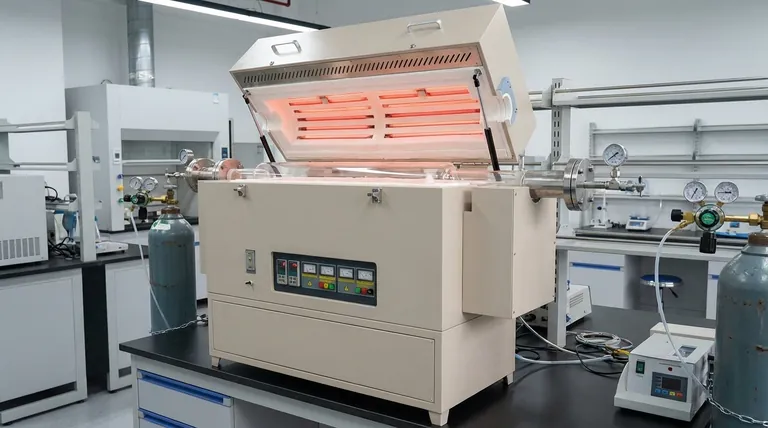
The Defining Feature: The Split-Hinge Design
The fundamental difference between a split tube furnace and a standard tube furnace is mechanical. This single design choice dictates its primary use cases and advantages.
Unparalleled Sample Access
The ability to open the furnace provides top-down access to the process tube. This is essential when working with samples that have multiple connections, such as sensors or gas lines, which are already attached.
It also allows for the careful placement of delicate or irregularly shaped materials that could be damaged if slid through a long, solid tube.
Simplified Tube and Insulation Management
Placing, inspecting, or replacing the ceramic or quartz process tube is significantly easier. You can lift the tube out directly rather than carefully sliding it out from one end. This also simplifies the maintenance of the surrounding insulation.
Enhanced Ergonomics
Many models are equipped with pneumatic dampening struts or spring-loaded mechanisms. These features ensure the top half of the furnace opens and closes smoothly and safely, preventing it from slamming shut and protecting both the operator and the equipment.
Core Performance and Control Features
Beyond its unique mechanical design, a split tube furnace shares many high-performance characteristics with other advanced laboratory furnaces. These features ensure it can execute demanding thermal processes.
Multi-Zone Temperature Control
High-end split tube furnaces often feature multiple independent heating zones (e.g., 3 or 5 zones). This allows for precise programming to create an exceptionally uniform temperature "flat zone" in the center of the furnace, which is critical for consistent material processing.
High-Temperature Capability
These furnaces are designed for high-temperature applications, with maximum operating temperatures typically ranging from 1200°C to 1600°C, and sometimes higher. This capability depends on the heating elements and insulation materials used.
Atmosphere Control
Like other tube furnaces, the split design is ideal for processing materials in a controlled atmosphere. By sealing the ends of the process tube, you can introduce inert gases like nitrogen or argon or create a vacuum to prevent oxidation and contamination.
Robust Construction and Safety
Split tube furnaces feature a dual-layer, air-cooled casing. This design ensures the exterior surface remains at a safe temperature for operators, even when the interior is running at maximum heat. They also include safety interlocks and over-temperature protection.
Understanding the Trade-offs
The specialized design of a split tube furnace introduces specific considerations that you must weigh against its benefits.
Thermal Efficiency and Sealing
The seam where the two halves of the furnace meet can be a source of minor heat loss compared to a solid, single-piece design. For very high-vacuum applications, ensuring a perfect seal along the process tube and its end flanges requires extra attention.
Mechanical Complexity
The hinge, locking clasps, and pneumatic struts add mechanical complexity. While reliable in high-quality units, these components represent more potential points of wear and maintenance over the furnace's lifespan compared to a simpler solid furnace.
Cost Considerations
Due to their more complex construction and specialized purpose, split tube furnaces typically have a higher initial cost than standard solid tube furnaces with equivalent temperature ratings and heated zone dimensions.
Making the Right Choice for Your Application
Choosing between a split tube and a solid tube furnace depends entirely on your specific experimental or process requirements.
- If your primary focus is working with complex sample holders or pre-assembled reactors: The split tube furnace is the superior choice, as its access will save you immense time and prevent damage to your apparatus.
- If your primary focus is rapid cycling of large or delicate samples: The ease of loading and unloading offered by the split design will significantly improve your workflow efficiency.
- If your primary focus is high-volume processing of simple, uniform samples (e.g., rods or powder in crucibles): A standard solid tube furnace is likely more cost-effective and provides all the necessary performance with less mechanical complexity.
Ultimately, the split tube furnace is a specialized tool designed to solve a specific problem of access, making it an invaluable asset for advanced research and development.
Summary Table:
| Feature | Description |
|---|---|
| Split-Hinge Design | Hinged clamshell opening for top-down access to samples and tubes |
| Multi-Zone Control | Independent heating zones for uniform temperature and precise processing |
| High-Temperature Capability | Operates up to 1600°C, ideal for demanding thermal applications |
| Atmosphere Control | Sealed process tube for inert gases or vacuum to prevent contamination |
| Safety Features | Dual-layer air-cooled casing, interlocks, and over-temperature protection |
| Ergonomics | Pneumatic struts for smooth, safe opening and closing |
| Trade-offs | Slightly lower thermal efficiency, higher cost, and mechanical complexity |
Ready to enhance your lab's capabilities with a tailored split tube furnace? At KINTEK, we leverage exceptional R&D and in-house manufacturing to provide advanced high-temperature furnace solutions, including Muffle, Tube, Rotary Furnaces, Vacuum & Atmosphere Furnaces, and CVD/PECVD Systems. Our strong deep customization capability ensures we precisely meet your unique experimental requirements, whether you're handling complex samples or need precise temperature control. Don't let equipment limitations hold back your research—contact us today to discuss how our furnaces can optimize your workflow and deliver reliable performance!
Visual Guide

Related Products
- 1200℃ Split Tube Furnace Laboratory Quartz Tube Furnace with Quartz Tube
- Split Multi Heating Zone Rotary Tube Furnace Rotating Tube Furnace
- Split Chamber CVD Tube Furnace with Vacuum Station CVD Machine
- Vertical Laboratory Quartz Tube Furnace Tubular Furnace
- Vacuum Sealed Continuous Working Rotary Tube Furnace Rotating Tube Furnace
People Also Ask
- What is a split tube furnace? Unlock Easy Access for Complex Lab Experiments
- What are the components of a basic tube furnace design capable of withstanding 1200°C? Essential Parts for High-Temp Labs
- Why is a split tube furnace utilized as the core reaction equipment in coal chemical looping? Simulate Thermal Shock
- What additional features might a split tube furnace have? Boost Your Lab's Precision and Control
- What safety measures should be followed when operating a split tube furnace? Ensure Safe and Efficient Lab Operations



















