Knowledge Why is the control of heating and cooling rates in a tube furnace critical for the thermal reduction of lithium niobate?
Author avatar

Tech Team · Kintek Furnace

Updated 4 hours ago

Why is the control of heating and cooling rates in a tube furnace critical for the thermal reduction of lithium niobate?


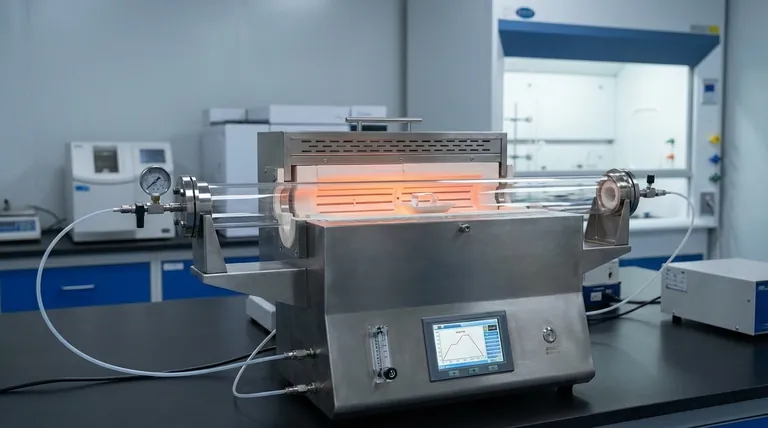
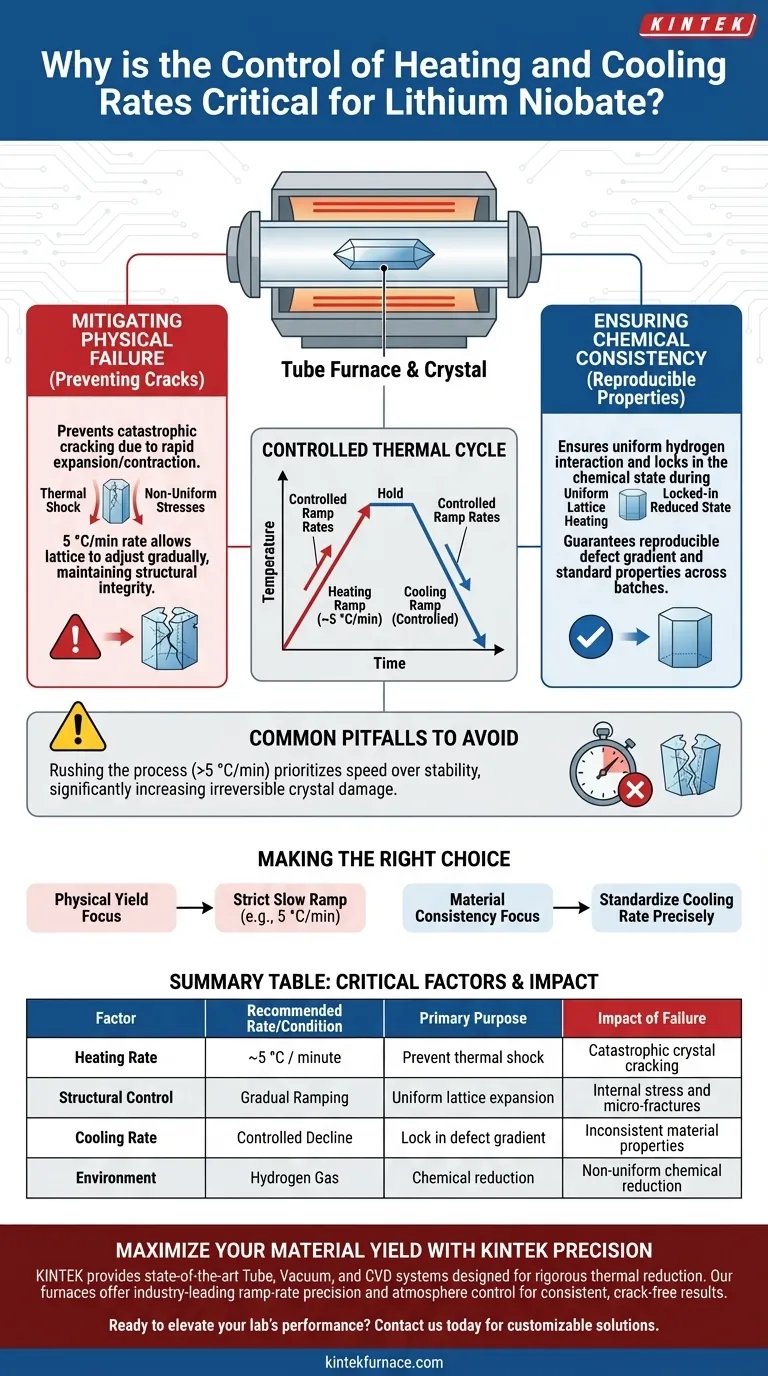
Precise thermal regulation is the absolute foundation of successful lithium niobate reduction. Controlling the heating and cooling rates within a tube furnace—typically around 5 °C per minute—is critical to prevent the crystal from cracking due to severe thermal shock and to ensure the chemical reduction process remains uniform and reproducible.

Regulating ramp rates protects the structural integrity of lithium niobate crystals by preventing thermal shock while ensuring the specific defect gradient distribution is locked in for consistent material properties.
Why is the control of heating and cooling rates in a tube furnace critical for the thermal reduction of lithium niobate?

Mitigating Physical Failure

Preventing Thermal Shock

The primary physical risk during thermal reduction is thermal shock. If the temperature changes too rapidly, the crystal cannot expand or contract uniformly.

This disparity creates immense internal pressure. Without strict rate control, this pressure frequently leads to catastrophic cracking, rendering the sample useless.

Eliminating Non-Uniform Stresses

Even if the crystal does not fracture immediately, uncontrolled temperature ramps can induce non-uniform stresses.

These residual stresses compromise the mechanical integrity of the material. A precise rate, such as 5 °C per minute, allows the lattice to adjust gradually, maintaining structural stability.

Ensuring Chemical Consistency

Uniform Lattice Heating

The thermal reduction process typically takes place in a hydrogen environment.

A slow and stable heating profile ensures that the entire crystal lattice reaches the target temperature uniformly. This uniformity is essential for the hydrogen to interact consistentlly with the material structure.

Locking in the Reduced State

The cooling phase is just as critical as the heating phase. Controlled cooling is required to lock in the reduced state effectively.

If cooling is haphazard, the chemical state of the crystal may shift unpredictably as it returns to room temperature.

Reproducibility of the Defect Gradient

For scientific and industrial applications, consistency is paramount.

Strict control over the thermal cycle ensures the defect gradient distribution is reproducible across different batches. This guarantees that the resulting optical and electronic properties remain standard from one run to the next.

Common Pitfalls to Avoid

The Risk of Rushing

The most common error in this process is prioritizing speed over stability.

Accelerating the ramp rate beyond 5 °C per minute significantly increases the probability of irreversible crystal damage. While slower rates extend the total process time, the cost of a failed, cracked sample far outweighs the time savings of a faster ramp.

Making the Right Choice for Your Goal

To achieve optimal results in lithium niobate reduction, tailor your approach based on your specific requirements:

  • If your primary focus is Physical Yield: Adhere strictly to a slow ramp rate (e.g., 5 °C/min) to eliminate the risk of cracking due to thermal shock.
  • If your primary focus is Material Consistency: Standardize the cooling rate precisely to ensure the defect gradient is identical in every batch.

Control the temperature to control the material properties.

Summary Table:

Factor Recommended Rate Primary Purpose Impact of Failure
Heating Rate ~5 °C / minute Prevent thermal shock Catastrophic crystal cracking
Structural Control Gradual Ramping Uniform lattice expansion Internal stress and micro-fractures
Cooling Rate Controlled Decline Lock in defect gradient Inconsistent material properties
Environment Hydrogen Gas Chemical reduction Non-uniform chemical reduction

Maximize Your Material Yield with KINTEK Precision

Don’t let thermal shock compromise your high-value lithium niobate crystals. KINTEK provides state-of-the-art Tube, Vacuum, and CVD systems designed for the rigorous demands of thermal reduction. Our furnaces offer industry-leading ramp-rate precision and atmosphere control, backed by expert R&D to ensure your results are consistent, reproducible, and crack-free.

Ready to elevate your lab's performance? Contact us today to discuss our customizable high-temp furnace solutions tailored for your unique research needs.

Visual Guide
Why is the control of heating and cooling rates in a tube furnace critical for the thermal reduction of lithium niobate? Visual Guide

References

  1. Yunjia Bao, Dongfeng Xue. Machine‐Learning‐Assisted Understanding of Depth‐Dependent Thermal Conductivity in Lithium Niobate Induced by Point Defects. DOI: 10.1002/aelm.202400944

This article is also based on technical information from Kintek Furnace Knowledge Base .

Related Products

People Also Ask

Related Products

1700℃ High Temperature Laboratory Tube Furnace with Quartz or Alumina Tube

1700℃ High Temperature Laboratory Tube Furnace with Quartz or Alumina Tube

KINTEK's Tube Furnace with Alumina Tube: Precision heating up to 1700°C for material synthesis, CVD, and sintering. Compact, customizable, and vacuum-ready. Explore now!

1400℃ High Temperature Laboratory Tube Furnace with Quartz and Alumina Tube

1400℃ High Temperature Laboratory Tube Furnace with Quartz and Alumina Tube

KINTEK's Tube Furnace with Alumina Tube: Precision high-temperature processing up to 2000°C for labs. Ideal for material synthesis, CVD, and sintering. Customizable options available.

1800℃ High Temperature Muffle Oven Furnace for Laboratory

1800℃ High Temperature Muffle Oven Furnace for Laboratory

KINTEK Muffle Furnaces: Precision 1800°C heating for labs. Energy-efficient, customizable, with PID control. Ideal for sintering, annealing, and research.

1700℃ High Temperature Muffle Oven Furnace for Laboratory

1700℃ High Temperature Muffle Oven Furnace for Laboratory

KT-17M Muffle Furnace: High-precision 1700°C lab furnace with PID control, energy efficiency, and customizable sizes for industrial & research applications.

High Temperature Muffle Oven Furnace for Laboratory Debinding and Pre Sintering

High Temperature Muffle Oven Furnace for Laboratory Debinding and Pre Sintering

KT-MD Debinding & Pre-Sintering Furnace for ceramics - precise temperature control, energy-efficient design, customizable sizes. Boost your lab efficiency today!

Molybdenum Vacuum Heat Treat Furnace

Molybdenum Vacuum Heat Treat Furnace

High-performance molybdenum vacuum furnace for precise 1400°C heat treatment. Ideal for sintering, brazing, and crystal growth. Durable, efficient, and customizable.

2200 ℃ Tungsten Vacuum Heat Treat and Sintering Furnace

2200 ℃ Tungsten Vacuum Heat Treat and Sintering Furnace

2200°C Tungsten Vacuum Furnace for high-temperature materials processing. Precise control, superior vacuum, customizable solutions. Ideal for research & industrial applications.

1400℃ Muffle Oven Furnace for Laboratory

1400℃ Muffle Oven Furnace for Laboratory

KT-14M Muffle Furnace: Precision 1400°C heating with SiC elements, PID control, and energy-efficient design. Ideal for labs.

Laboratory Muffle Oven Furnace with Bottom Lifting

Laboratory Muffle Oven Furnace with Bottom Lifting

Boost lab efficiency with KT-BL Bottom Lifting Furnace: precise 1600℃ control, superior uniformity, and enhanced productivity for material science and R&D.

600T Vacuum Induction Hot Press Vacuum Heat Treat and Sintering Furnace

600T Vacuum Induction Hot Press Vacuum Heat Treat and Sintering Furnace

600T Vacuum Induction Hot Press Furnace for precise sintering. Advanced 600T pressure, 2200°C heating, vacuum/atmosphere control. Ideal for research & production.

Vacuum Heat Treat Sintering and Brazing Furnace

Vacuum Heat Treat Sintering and Brazing Furnace

KINTEK Vacuum Brazing Furnaces deliver precision, clean joints with superior temperature control. Customizable for diverse metals, ideal for aerospace, medical, and thermal applications. Get a quote!

Vacuum Heat Treat Sintering Furnace with Pressure for Vacuum Sintering

Vacuum Heat Treat Sintering Furnace with Pressure for Vacuum Sintering

KINTEK's Vacuum Pressure Sintering Furnace offers 2100℃ precision for ceramics, metals, and composites. Customizable, high-performance, and contamination-free. Get a quote now!

Vertical Laboratory Quartz Tube Furnace Tubular Furnace

Vertical Laboratory Quartz Tube Furnace Tubular Furnace

Precision KINTEK Vertical Tube Furnace: 1800℃ heating, PID control, customizable for labs. Ideal for CVD, crystal growth & materials testing.

Split Chamber CVD Tube Furnace with Vacuum Station CVD Machine

Split Chamber CVD Tube Furnace with Vacuum Station CVD Machine

Split Chamber CVD Tube Furnace with Vacuum Station - High precision 1200°C lab furnace for advanced materials research. Customizable solutions available.

Magnesium Extraction and Purification Condensing Tube Furnace

Magnesium Extraction and Purification Condensing Tube Furnace

Magnesium purification tube furnace for high-purity metal production. Achieve ≤10Pa vacuum, dual-zone heating. Ideal for aerospace, electronics, and lab research.

Vacuum Heat Treat Sintering Furnace Molybdenum Wire Vacuum Sintering Furnace

Vacuum Heat Treat Sintering Furnace Molybdenum Wire Vacuum Sintering Furnace

KINTEK's Vacuum Molybdenum Wire Sintering Furnace excels in high-temperature, high-vacuum processes for sintering, annealing, and material research. Achieve precise 1700°C heating with uniform results. Custom solutions available.

Laboratory Quartz Tube Furnace RTP Heating Tubular Furnace

Laboratory Quartz Tube Furnace RTP Heating Tubular Furnace

KINTEK's RTP Rapid Heating Tube Furnace delivers precise temperature control, rapid heating up to 100°C/sec, and versatile atmosphere options for advanced lab applications.

High Pressure Laboratory Vacuum Tube Furnace Quartz Tubular Furnace

High Pressure Laboratory Vacuum Tube Furnace Quartz Tubular Furnace

KINTEK High Pressure Tube Furnace: Precision heating up to 1100°C with 15Mpa pressure control. Ideal for sintering, crystal growth, and lab research. Customizable solutions available.

Vacuum Heat Treat Furnace with Ceramic Fiber Liner

Vacuum Heat Treat Furnace with Ceramic Fiber Liner

KINTEK's Vacuum Furnace with Ceramic Fiber Lining offers precise high-temperature processing up to 1700°C, ensuring uniform heat distribution and energy efficiency. Ideal for labs and production.

2200 ℃ Graphite Vacuum Heat Treat Furnace

2200 ℃ Graphite Vacuum Heat Treat Furnace

2200℃ Graphite Vacuum Furnace for high-temperature sintering. Precise PID control, 6*10⁻³Pa vacuum, durable graphite heating. Ideal for research & production.


Leave Your Message


















