A vacuum-sealed quartz tube is strictly required during the annealing of CoTeO4 to prevent the volatile loss of Tellurium (Te) at high temperatures. By creating a closed, vacuum-processed environment, the tube acts as a barrier that forces the chemical composition to remain stable while heat drives the structural organization of the material.
The core function of the vacuum seal is to maintain a specific vapor pressure equilibrium. This prevents the material from disintegrating through evaporation and instead forces the precursor elements to reorganize into a high-crystallinity, defect-free structure.
The Critical Role of the Closed Environment
Preventing Volatile Element Loss
High-temperature annealing, specifically at 600 °C, creates a hostile environment for volatile elements. Tellurium is particularly prone to evaporation at these temperatures.
If annealed in an open atmosphere, the Tellurium would simply escape the compound. The vacuum-sealed quartz tube traps these elements, ensuring the final material retains the correct chemical stoichiometry.
Establishing Vapor Pressure Equilibrium
Inside the sealed quartz tube, a unique micro-environment is established. As the temperature rises, a small amount of vapor is generated until it reaches saturation within the limited volume.
This creates a vapor pressure equilibrium. Once established, this pressure prevents further net evaporation of the solid material, stabilizing the compound for the duration of the long-term annealing process.
Mechanisms of Crystallization
Eliminating Lattice Defects
The primary goal of annealing is to improve the internal structure of the material. As heat is applied over extended periods, atoms within the CoTeO4 move to find their most energetically favorable positions.
The sealed environment allows this rearrangement to happen without chemical degradation. This process systematically eliminates internal lattice defects, which are common in precursor materials.
Facilitating Grain Growth
With the chemical composition locked in by the vacuum seal, the thermal energy is directed entirely toward physical transformation. This facilitates significant grain growth.
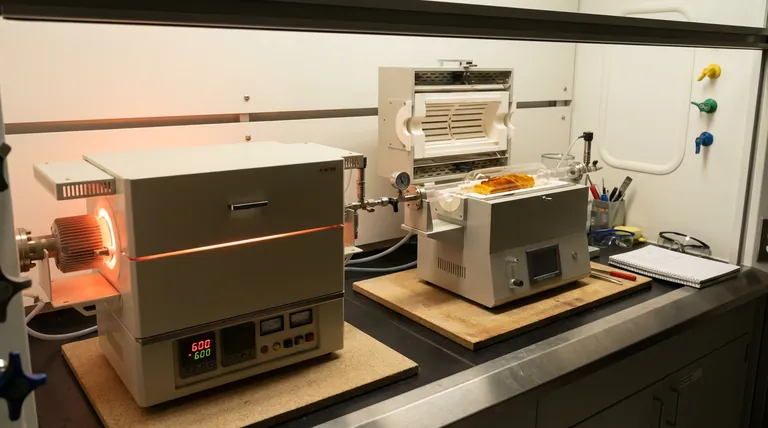
This growth transforms the raw precursor into a highly crystalline material. In the case of CoTeO4, this successful crystallization is visually indicated when the material transforms into a distinct amber color.
Common Pitfalls to Avoid
The Risk of Open-Air Annealing
It is a common mistake to assume that all annealing can occur in standard open-air furnaces. For CoTeO4, open-air processing creates an open system where equilibrium cannot be reached.
This leads to uncontrolled mass loss. You will likely end up with a material that is chemically deficient in Tellurium and structurally weak due to voids left by evaporated elements.
Importance of the Vacuum Step
Simply sealing the tube is often insufficient; the vacuum processing prior to sealing is critical. Removing air prevents unwanted oxidation reactions that could compete with the crystallization process.
Leaving air inside the tube could introduce impurities or alter the oxidation state of the Cobalt or Tellurium, compromising the purity of the final crystal.
Making the Right Choice for Your Goal
When designing your synthesis protocol, consider your specific material requirements:
- If your primary focus is Chemical Purity: Ensure the tube is thoroughly vacuumed and sealed to prevent the escape of volatile Tellurium, maintaining exact stoichiometry.
- If your primary focus is Structural Stability: Prioritize the long-term duration of the anneal at 600 °C within the sealed environment to maximize defect elimination and grain size.
The vacuum-sealed tube is not just a container; it is an active thermodynamic tool that forces the material to evolve structurally rather than degrade chemically.
Summary Table:
| Feature | Purpose in CoTeO4 Annealing | Benefit to Material |
|---|---|---|
| Vacuum Seal | Prevents volatile Tellurium (Te) escape | Maintains chemical stoichiometry |
| Quartz Tube | Provides a closed thermodynamic system | Establishes vapor pressure equilibrium |
| 600 °C Heat | Drives atomic rearrangement | Eliminates lattice defects & promotes grain growth |
| Oxygen Removal | Eliminates reactive atmosphere | Prevents unwanted oxidation and impurities |
Maximize Your Material Purity with KINTEK
Precise crystallization of volatile compounds like CoTeO4 requires absolute control over your thermal environment. Backed by expert R&D and manufacturing, KINTEK offers high-performance Muffle, Tube, Rotary, Vacuum, and CVD systems—all customizable to meet your unique laboratory needs. Whether you are performing vacuum-sealed quartz tube annealing or complex chemical vapor deposition, our equipment ensures the stability and uniformity your research demands.
Ready to elevate your lab's high-temperature capabilities? Contact us today to consult with our technical team!
References
- Matthias Weil, Harishchandra Singh. CoTeO<sub>4</sub> – a wide-bandgap material adopting the dirutile structure type. DOI: 10.1039/d3ma01106b
This article is also based on technical information from Kintek Furnace Knowledge Base .
Related Products
- High Pressure Laboratory Vacuum Tube Furnace
- Vacuum Sealed Continuous Working Rotary Tube Furnace Rotating Tube Furnace
- CF KF Flange Vacuum Electrode Feedthrough Lead Sealing Assembly for Vacuum Systems
- Vertical Laboratory Quartz Tube Furnace Tubular Furnace
- Multi Zone Laboratory Quartz Tube Furnace Tubular Furnace
People Also Ask
- What role does a high vacuum tube furnace play in Co-Al sintering? Master High-Purity Porous Material Synthesis
- What are the different types of tube furnaces available? Find the Perfect Fit for Your Lab's Needs
- What are the main advantages of vacuum tube furnaces in the market? Achieve Purity and Precision in Material Processing
- What is the role of a vacuum tube furnace during the final thermal treatment stage of Fe3O4@CSAC catalysts?
- What conditions do tube furnaces provide for Au-Seeded TiO2 nanowires? Master Precision Thermal Synthesis