
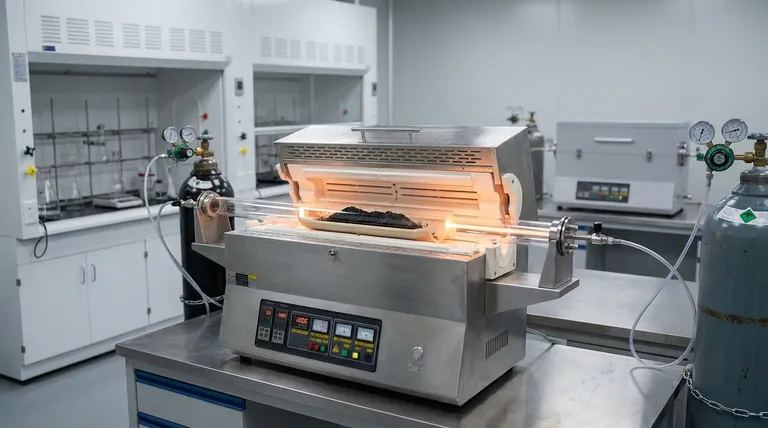
The primary function of an industrial tube furnace during secondary carbonization is to provide a rigorous, stable high-temperature heat source, typically maintained around 1000°C. By executing a precise temperature control curve, the furnace ensures the biomass material undergoes thorough pyrolysis in a controlled environment. This process transforms the initial charcoal into a highly consistent precursor material, readying it for subsequent activation and desilication.
The tube furnace distinguishes itself by decoupling heat generation from the chemical environment, allowing for the complete reorganization of the carbon skeleton without the risk of oxidative combustion.
Precise Thermal Management
Establishing High-Temperature Stability
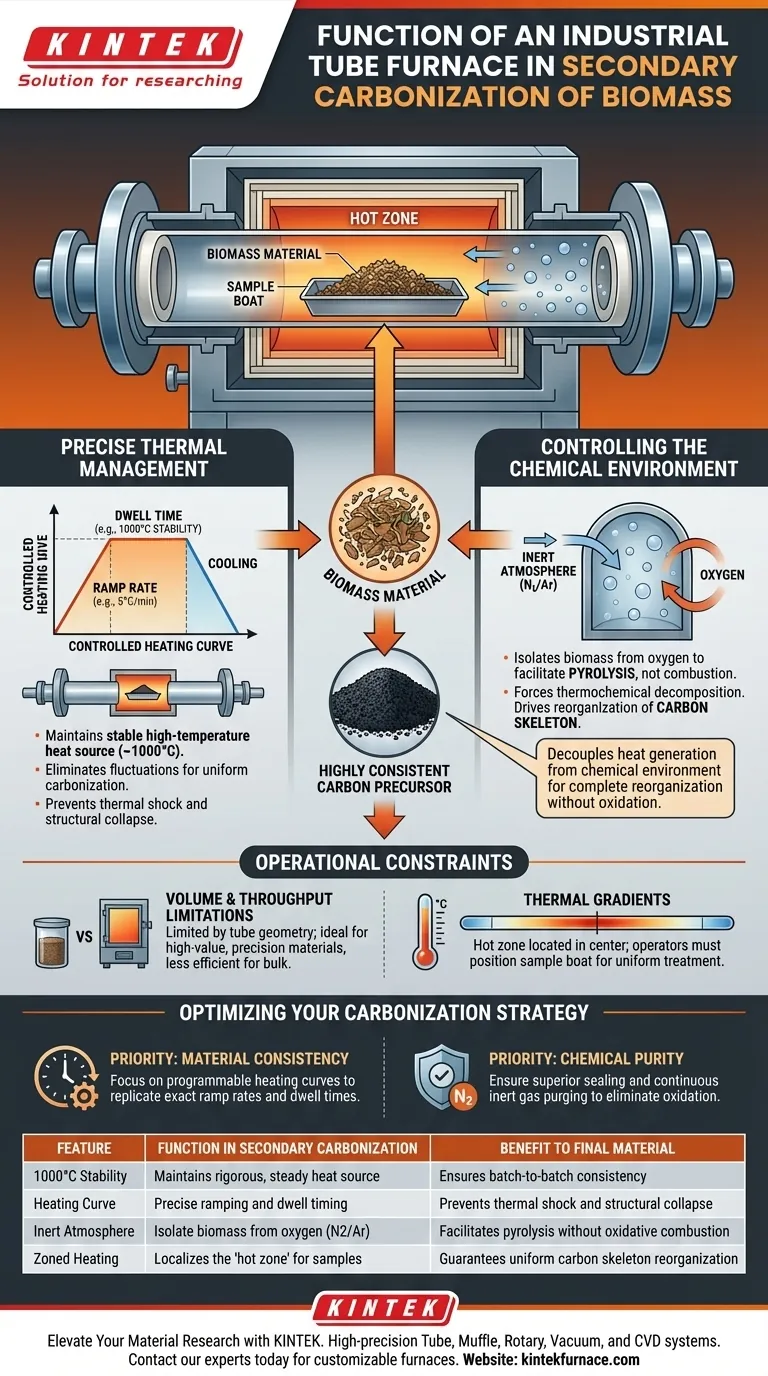
The core requirement for secondary carbonization is maintaining a steady temperature, often reaching 1000°C.
The industrial tube furnace acts as a thermal stabilizer, eliminating fluctuations that could lead to uneven carbonization. This stability is essential for ensuring that every batch of material achieves the same degree of carbonization.
The Role of the Heating Curve
Success in this phase relies on more than just reaching a peak temperature; it requires a specific heating curve.
The furnace controls the rate of temperature increase (e.g., 5°C per minute) and holding times. This controlled ramping allows for the orderly evolution of volatiles and the gradual structural transformation of the biomass, preventing thermal shock or structural collapse.
Controlling the Chemical Environment
Facilitating Oxygen-Free Pyrolysis
While the primary reference highlights the thermal aspect, the "controlled environment" provided by the tube furnace is physically realized through an inert atmosphere.
By sealing the chamber and introducing gases like nitrogen or argon, the furnace isolates the biomass from oxygen. This prevents the material from burning to ash at 1000°C, forcing it instead to undergo thermochemical decomposition.
Structural Reorganization
The environment created by the furnace drives the reorganization of carbon elements.
Under these strictly controlled conditions, organic matter dehydrates and reassembles into a stable biomass carbon skeleton. This process is critical for defining the material's final porosity and preparing it for advanced chemical treatments, such as desilication.
Understanding the Operational Constraints
Volume and Throughput Limitations
While tube furnaces offer superior control, they are inherently limited by the geometry of the tube.
Unlike rotary kilns or fluidized beds, the stationary tube design restricts the volume of material that can be processed in a single batch. This makes them ideal for high-value, precision materials but potentially less efficient for bulk, low-grade commodity production.
Thermal Gradients
Despite their precision, tube furnaces can experience temperature gradients along the length of the tube.
The "hot zone" is often located in the center, with temperatures dropping near the ends. Operators must carefully position the sample boat within this constant temperature zone to ensure the material at the edges receives the same thermal treatment as the material in the center.
Optimizing Your Carbonization Strategy
To maximize the utility of an industrial tube furnace for biomass processing, consider the following strategic priorities:
- If your primary focus is Material Consistency: Prioritize a furnace with programmable heating curves to replicate exact ramp rates and dwell times across every batch.
- If your primary focus is Chemical Purity: Ensure the furnace has superior sealing capabilities and continuous inert gas purging to completely eliminate oxidation side reactions.
By leveraging the tube furnace for its precision rather than its volume, you ensure the production of a high-quality, stable carbon precursor.
Summary Table:
| Feature | Function in Secondary Carbonization | Benefit to Final Material |
|---|---|---|
| 1000°C Stability | Maintains rigorous, steady heat source | Ensures batch-to-batch consistency |
| Heating Curve | Precise ramping and dwell timing | Prevents thermal shock and structural collapse |
| Inert Atmosphere | Isolate biomass from oxygen (N2/Ar) | Facilitates pyrolysis without oxidative combustion |
| Zoned Heating | Localizes the 'hot zone' for samples | Guarantees uniform carbon skeleton reorganization |
Elevate Your Material Research with KINTEK
Unlock the full potential of your biomass processing with KINTEK’s high-precision thermal solutions. Backed by expert R&D and world-class manufacturing, we provide high-performance Tube, Muffle, Rotary, Vacuum, and CVD systems tailored to your specific temperature curves and atmospheric requirements.
Whether you need customized laboratory units or industrial-scale furnaces, KINTEK offers the stability and control necessary for consistent, high-purity carbon precursors. Don't settle for inconsistent results—Contact our experts today to find the perfect customizable furnace for your unique needs!
Visual Guide
References
- Yuto YANAGIHARA, Mudtorlep Nisoa. New Silica Removal Technique by Vacuum Heating toward High-Performance Cryosorption Pumps Based on Biomass-Based Activated Carbon. DOI: 10.1585/pfr.19.1205012
This article is also based on technical information from Kintek Furnace Knowledge Base .
Related Products
- Electric Rotary Kiln Small Rotary Furnace Biomass Pyrolysis Plant Rotating Furnace
- Vertical Laboratory Quartz Tube Furnace Tubular Furnace
- High Pressure Laboratory Vacuum Tube Furnace
- Slide PECVD Tube Furnace with Liquid Gasifier PECVD Machine
- Laboratory Quartz Tube Furnace RTP Heating Tubular Furnace
People Also Ask
- What are the key components of a rotary kiln electric furnace? Unlock Efficient Thermal Processing
- What are the main applications of a rotary kiln electric furnace? Achieve Uniform Heat Treatment for Powders
- What is the significance of the refractory lining in a rotary kiln electric furnace? Unlock Efficiency and Longevity
- What is the benefit of adjustable speed control in rotary kilns? Optimize Efficiency and Quality
- What are the two main types of rotary kilns based on heating method? Choose the Right One for Your Process



















