
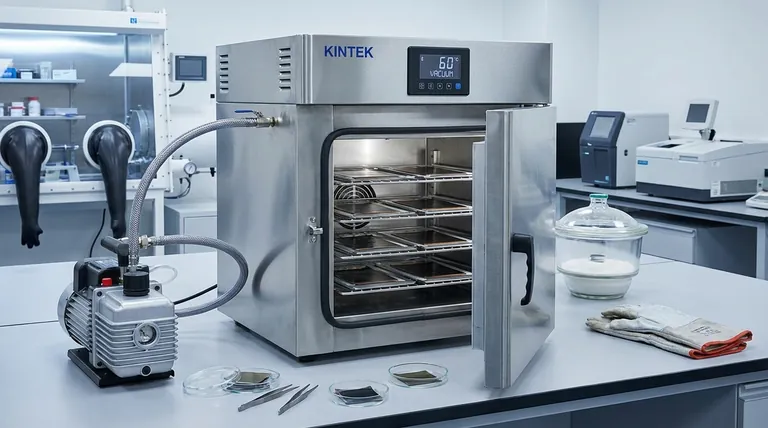
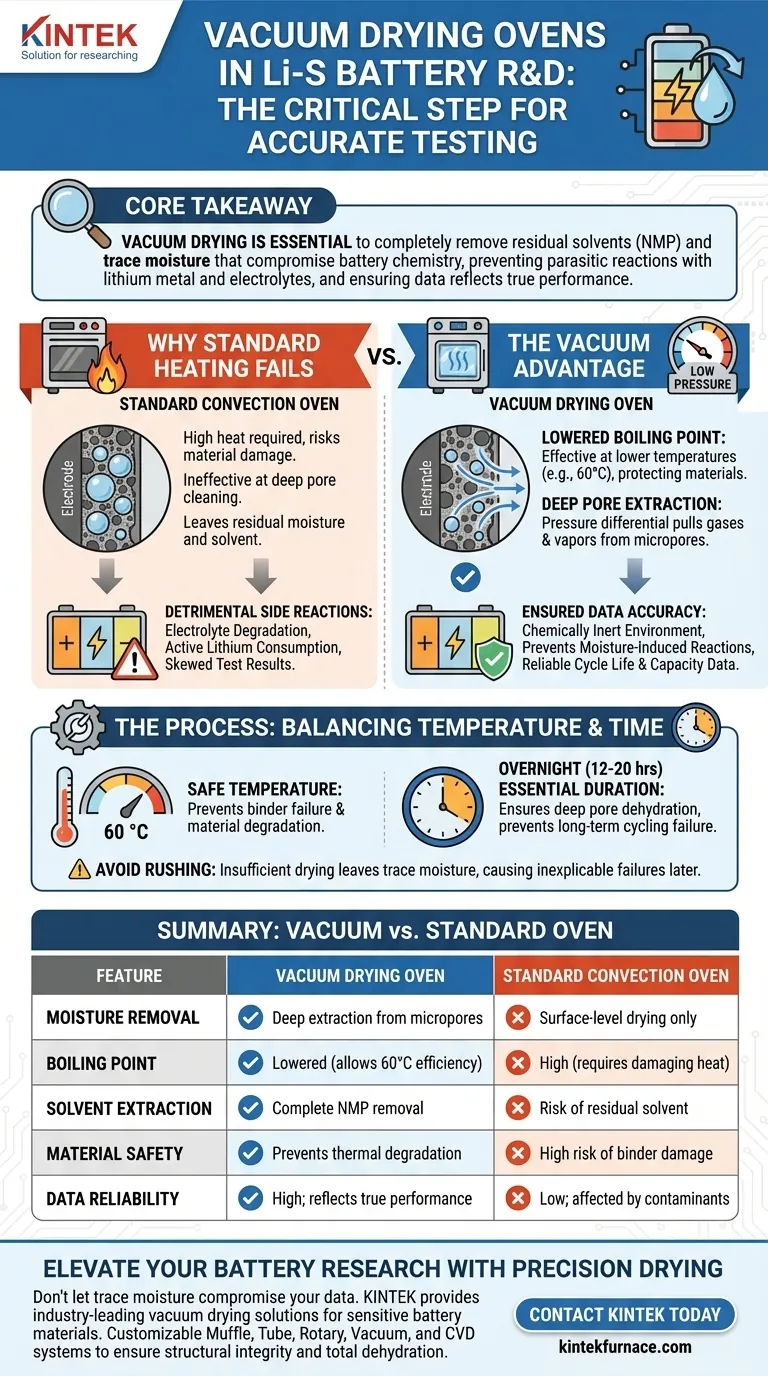
A vacuum drying oven is strictly required to ensure the complete removal of solvents and trace moisture that would otherwise compromise the battery's chemistry. Specifically, treating electrode plates at 60 °C under vacuum ensures that N-Methyl-2-pyrrolidone (NMP) and gases trapped within micropores are fully extracted without damaging the electrode structure.
Core Takeaway The presence of even microscopic amounts of water or residual solvent causes parasitic side reactions with lithium metal and organic electrolytes. Vacuum drying is the only reliable method to deeply dehydrate the electrode's porous structure, ensuring that your electrochemical test data reflects the true performance of the material rather than artifacts caused by contamination.
The Critical Role of Dehydration and Solvent Removal
Eliminating Residual Solvents and Moisture
The primary function of the vacuum oven is the thorough removal of volatile components used during the manufacturing process.
Coated electrode plates retain residual solvents, such as N-Methyl-2-pyrrolidone (NMP), and physically adsorbed moisture. Because electrodes are porous, these contaminants often become trapped deep within the micropores, making them impossible to remove through simple air drying.
Preventing Detrimental Side Reactions
If moisture remains in the electrode, it becomes a distinct chemical hazard once the battery is assembled.
Water molecules react aggressively with lithium metal anodes and organic electrolytes. This leads to the degradation of the electrolyte and the consumption of active lithium, creating unstable byproducts that skew test results.
Ensuring Data Accuracy
For electrochemical testing to be valid, the environment must be chemically inert regarding contaminants.
Vacuum drying prevents these moisture-induced side reactions. By ensuring the electrode is chemically dry, you guarantee that the data collected regarding cycle life, capacity, and efficiency is a result of the battery design, not an error in preparation.
Why Vacuum is Superior to Standard Heating
Lowering the Boiling Point
Standard convection ovens rely on high heat to evaporate liquids, which can be damaging to sensitive battery components.
The vacuum environment significantly lowers the boiling point of solvents and water. This allows for rapid, effective drying at lower temperatures (such as 60 °C), protecting the electrode materials from thermal degradation or oxidation that might occur at higher temperatures.
Deep Pore Extraction
Heat alone often fails to clear the complex internal architecture of a battery electrode.
The pressure differential created by the vacuum pump physically pulls gases and vapors out of the micropores. This mechanical action is essential for clearing the deep internal structure of the electrode, ensuring no pockets of gas or moisture remain to disrupt ion transport.
Understanding the Trade-offs
Temperature vs. Structural Integrity
While heat accelerates drying, excessive temperatures can cause the active material to peel from the current collector or damage the polymeric binders.
You must balance the need for dryness with the thermal stability of your specific materials. The primary guideline suggests 60 °C, which is generally safe for preventing binder failure while still effectively removing NMP under vacuum.
Drying Time vs. Process Efficiency
Deep vacuum drying is not a rapid process; it typically requires overnight treatment (or 12-20 hours depending on the protocol).
Cutting this time short to speed up workflow is a common pitfall. Insufficient drying time leaves trace moisture in the deepest pores, which will inevitably surface during long-term cycling tests, causing inexplicable failure later in the research.
Making the Right Choice for Your Goal
To ensure your electrochemical testing yields publication-quality data, apply the following principles:
- If your primary focus is Initial Performance Data: Ensure you use a vacuum to lower the boiling point of solvents like NMP, preventing thermal damage that could skew initial capacity readings.
- If your primary focus is Long-Term Cycling Stability: Prioritize the duration of the drying process (overnight) to ensure deep pore dehydration, as trace moisture is the primary cause of electrolyte degradation over time.
Ultimate success in battery testing relies not just on the materials you choose, but on the rigorous elimination of the contaminants that destroy them.
Summary Table:
| Feature | Vacuum Drying Oven | Standard Convection Oven |
|---|---|---|
| Moisture Removal | Deep extraction from micropores | Surface-level drying only |
| Boiling Point | Lowered (allows 60°C efficiency) | High (requires damaging heat) |
| Solvent Extraction | Complete NMP removal | Risk of residual solvent |
| Material Safety | Prevents thermal degradation | High risk of binder damage |
| Data Reliability | High; reflects true performance | Low; affected by contaminants |
Elevate Your Battery Research with Precision Drying
Don't let trace moisture and residual solvents compromise your electrochemical data. KINTEK provides industry-leading vacuum drying solutions designed specifically for sensitive battery materials.
Backed by expert R&D and manufacturing, KINTEK offers Muffle, Tube, Rotary, Vacuum, and CVD systems, all customizable for your unique laboratory needs. Whether you are scaling up production or conducting fundamental research, our high-temp furnaces ensure the structural integrity of your electrodes while achieving total dehydration.
Ready to optimize your testing preparation? Contact KINTEK today to find the perfect customizable furnace solution for your lab.
Visual Guide
References
- Ka Chun Li, Xijun Hu. Fe<sub>3</sub>O<sub>4</sub>@Fe Core–Shell Okara-Derived Activated Carbon for Superior Polysulfide Control in Lithium–Sulfur Batteries. DOI: 10.1021/acs.jpcc.5c02606
This article is also based on technical information from Kintek Furnace Knowledge Base .
Related Products
- Vacuum Heat Treat Sintering and Brazing Furnace
- Vacuum Heat Treat Sintering Furnace Molybdenum Wire Vacuum Sintering Furnace
- Dental Porcelain Zirconia Sintering Ceramic Vacuum Press Furnace
- Molybdenum Vacuum Heat Treat Furnace
- Vacuum Hot Press Furnace Machine Heated Vacuum Press
People Also Ask
- How does vacuum heat treating affect the grain structure of metal alloys? Achieve Precise Microstructure Control
- What are the benefits of using vacuum heat treating furnaces for metal alloys? Achieve Superior Metal Properties and Performance
- What is one of the most important uses of vacuum heat treating furnaces in aerospace? Achieve Superior Strength in Aircraft Alloys
- What is the temperature of a vacuum furnace brazing? Optimize Your Joint Strength and Cleanliness
- What are the steps involved in a typical vacuum brazing treatment? Master the Process for Strong, Clean Joints












