
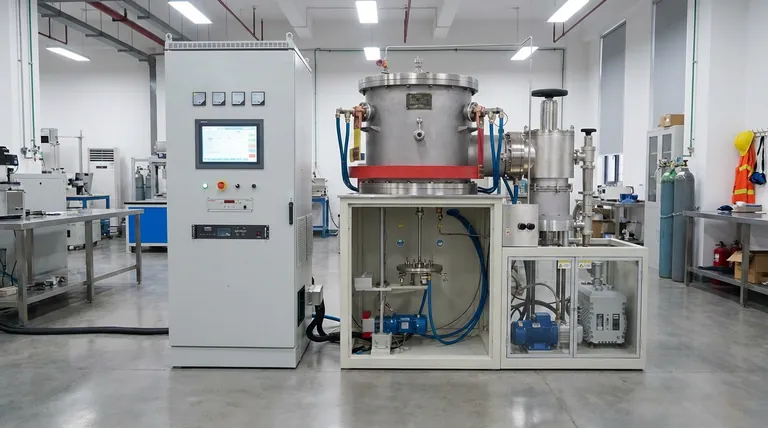
High vacuum systems and vacuum sealing are utilized to ensure absolute chemical purity and compositional accuracy. Specifically, this process involves evacuating quartz tubes containing the raw materials to an ultra-high vacuum level (below 10^-5 Torr) prior to sealing. This creates a requisite "zero-oxygen" environment for the high-temperature melting phase.
Core Takeaway Synthesizing Tungsten-doped Germanium Telluride requires navigating the conflict between high heat (1373 K) and material reactivity. The vacuum process creates a sterile isolation chamber that prevents oxygen from degrading the alloy while simultaneously preventing volatile components from escaping, ensuring the final material matches the intended chemical formula.
Securing Material Integrity Under Heat
Prevention of Oxidation
The primary danger during synthesis is the reaction of raw materials with atmospheric oxygen.
At the melting temperature of 1373 K, elements such as Germanium and Tungsten are highly susceptible to oxidation. The high vacuum system removes air from the reaction vessel, creating a zero-oxygen environment. This prevents the formation of unwanted oxides that would degrade the electronic and structural properties of the alloy.
Maintaining Stoichiometry (Chemical Balance)
Beyond oxidation, the synthesis must account for the volatility of specific components.
Tellurium, a key component of the alloy, has a high vapor pressure and tends to volatilize (evaporate) at synthesis temperatures. By vacuum sealing the materials inside a quartz tube, you create a closed system. This containment prevents volatile elements from escaping the reaction zone, ensuring the final alloy maintains the precise stoichiometric ratio required.
Protecting the Synthesis Environment
Shielding Furnace Components
The benefits of this process extend beyond the alloy itself to the equipment being used.
During the melting process, volatile vapors can be corrosive. If these vapors were allowed to escape into the main furnace chamber, they could damage heating elements and sensors. The sealed quartz tube acts as a physical barrier, protecting internal furnace components from exposure to these corrosive gases.
Removal of Contaminants
Before the tube is sealed, the vacuum plays an active role in purification.
The evacuation process aids in removing adsorbed gases and moisture from the surface of the raw materials. This ensures that when the temperature rises, there are no trapped impurities that could introduce defects into the crystal lattice of the alloy.
Understanding the Trade-offs
The Risk of Tube Failure
While quartz sealing is effective, it introduces a single point of failure.
At 1373 K, the quartz tube is under significant thermal stress. If the pressure inside the tube (due to volatile vapors) exceeds the strength of the quartz, or if the tube has microscopic flaws, it can rupture. A rupture not only ruins the sample via immediate oxidation but can also damage the furnace, negating the protective benefit of the seal.
Complexity and Cost
Achieving a vacuum of 10^-5 Torr requires sophisticated pumping systems (often a combination of rotary and diffusion or turbomolecular pumps).
This adds time and cost to the synthesis process compared to inert gas flow methods. However, for high-performance semiconductor or thermoelectric materials like GeTe, the superior purity provided by high vacuum is often non-negotiable despite the added complexity.
Making the Right Choice for Your Goal
When designing your synthesis protocol, consider your primary objectives:
- If your primary focus is Electronic Purity: Prioritize achieving the lowest possible base pressure (<10^-5 Torr) to eliminate all traces of oxygen and moisture.
- If your primary focus is Compositional Accuracy: Ensure the quartz tube sealing is robust and thick-walled to withstand the vapor pressure of Tellurium without rupturing.
- If your primary focus is Equipment Longevity: Inspect quartz ampoules rigorously for scratches before heating to prevent leaks that could release corrosive vapors into your furnace.
The vacuum seal is not just a packaging step; it is the defining control variable that stabilizes the chemistry of the entire reaction.
Summary Table:
| Feature | Purpose in Synthesis | Benefit to Material |
|---|---|---|
| High Vacuum (<10^-5 Torr) | Removes atmospheric oxygen/moisture | Prevents oxidation and ensures chemical purity |
| Vacuum Sealing | Creates a closed quartz ampoule | Maintains stoichiometry by preventing volatile loss |
| Quartz Barrier | Physical isolation | Protects furnace heating elements from corrosive vapors |
| Surface Degassing | Removal of adsorbed gases | Eliminates crystal lattice defects and impurities |
Elevate Your Synthesis Precision with KINTEK
Don't let oxidation or volatile loss compromise your advanced material research. KINTEK provides industry-leading lab solutions backed by expert R&D and manufacturing. From high-performance vacuum systems to customizable Muffle, Tube, Rotary, and CVD systems, our high-temperature furnaces are engineered to meet the rigorous demands of semiconductor and alloy synthesis.
Ready to achieve absolute chemical purity? Contact our specialists today to discover how our customizable furnace solutions can optimize your lab's performance and protect your critical equipment.
Visual Guide

References
- Zhengtang Cai, Han Li. Ultra-Low Thermal Conductivity and Improved Thermoelectric Performance in Tungsten-Doped GeTe. DOI: 10.3390/nano14080722
This article is also based on technical information from Kintek Furnace Knowledge Base .
Related Products
- 2200 ℃ Tungsten Vacuum Heat Treat and Sintering Furnace
- High Pressure Laboratory Vacuum Tube Furnace
- Molybdenum Vacuum Heat Treat Furnace
- 2200 ℃ Graphite Vacuum Heat Treat Furnace
- 9MPa Air Pressure Vacuum Heat Treat and Sintering Furnace
People Also Ask
- How does a tungsten-heated vacuum sintering furnace prepare (TbxY1-x)2O3 ceramics? Achieve 99%+ Density & Purity
- How do compaction pressure and vacuum sintering optimize porous ceramics? Maximize Density & Toughness
- What wear-resistance enhancements are achieved by powder coating? The Role of Vacuum Sintering Furnaces
- What role does a high-temperature vacuum sintering furnace play in the densification of WC-10(Ni, Ni/Co) alloys?
- What core role does a high-temperature vacuum sintering furnace play in Sm:YAG ceramics? Mastering Optical Clarity



















