Knowledge Why is a high-temperature vacuum furnace required for in situ heating experiments involving Tantalum?
Author avatar

Tech Team · Kintek Furnace

Updated 1 day ago

Why is a high-temperature vacuum furnace required for in situ heating experiments involving Tantalum?


The primary requirement for a high-temperature vacuum furnace when experimenting with Tantalum is its extreme chemical reactivity with atmospheric gases. When heated, Tantalum aggressively bonds with oxygen and nitrogen, causing immediate oxidation and structural embrittlement that ruins the sample. A vacuum environment is the only reliable method to isolate the material, allowing it to reach temperatures up to 1500 K without contamination ensuring data accuracy.

By eliminating reactive gases, a vacuum furnace protects Tantalum from chemical degradation during heating. This pristine environment is essential for observing true material behaviors, such as recovery and recrystallization, without the interference of oxidation.
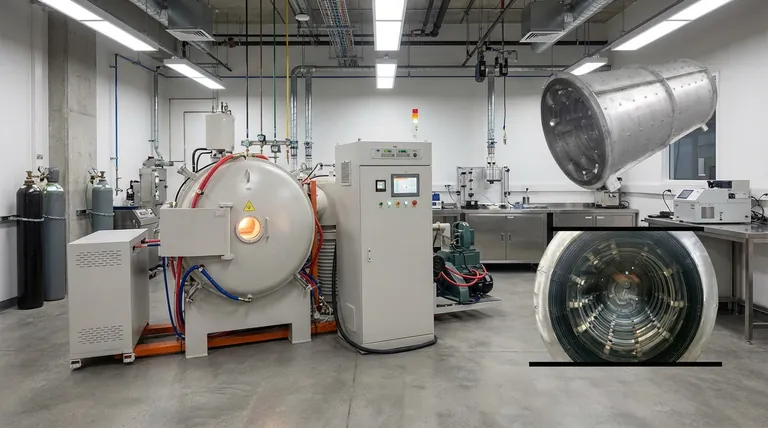
Why is a high-temperature vacuum furnace required for in situ heating experiments involving Tantalum?

The Chemical Vulnerability of Tantalum

Reactivity at Elevated Temperatures

While Tantalum is robust at room temperature, it becomes highly sensitive once heat is applied. It reacts readily with oxygen and nitrogen, effectively acting as a "getter" for these gases.

The Consequences of Exposure

If heating occurs in a standard atmosphere, the material suffers from oxidation and embrittlement. This fundamentally alters the mechanical properties of the sample, rendering any data collected regarding its native structure invalid.

Ensuring Experimental Precision

Controlled High-Temperature Environments

To study Tantalum effectively, you must reach high thermal states—often up to 1500 K—without compromising purity. A high-quality vacuum furnace maintains a contaminant-free zone even at these extreme extremes.

Stability for Real-Time Monitoring

Advanced vacuum furnaces utilize specific components, such as tungsten mesh heating elements, to provide consistent thermal conditions. This stability is critical for in situ experiments, such as neutron diffraction, where fluctuations would obscure the results.

Critical Factors for Data Integrity

The Importance of Heating Rate

Precise control over the temperature ramp is just as important as the maximum temperature. A steady rate, such as 2.5 K/min, is necessary to capture transient material changes.

Avoiding "Smearing" of Data

If the heating rate is uncontrolled or too fast, you risk missing the distinct phases of recovery and recrystallization. The stable environment of the vacuum furnace ensures that these microstructural evolutions are captured in real-time, free from oxidation artifacts.

Optimizing Your Experimental Setup

To ensure the validity of your Tantalum research, you must prioritize environmental control alongside thermal capabilities.

  • If your primary focus is material purity: Ensure your furnace maintains a deep vacuum continuously up to 1500 K to strictly prevent embrittlement caused by gas absorption.
  • If your primary focus is dynamic observation: Utilize stable heating elements like tungsten mesh to permit precise ramp rates (e.g., 2.5 K/min), enabling clear visibility of microstructural changes during neutron diffraction.

Rigorous environmental control is the only way to distinguish true material evolution from chemical contamination.

Summary Table:

Feature Requirement for Tantalum Experiments Purpose/Benefit
Atmosphere High Vacuum Prevents oxidation and nitrogen-induced embrittlement
Max Temp Up to 1500 K Reaches critical thermal states for material study
Heating Element Tungsten Mesh Provides stability and uniformity for in situ monitoring
Ramp Rate 2.5 K/min Ensures precise capture of recovery and recrystallization
Data Integrity Contaminant-free Zone Eliminates chemical artifacts during neutron diffraction

Elevate Your Materials Research with KINTEK

Precision is non-negotiable when working with reactive materials like Tantalum. At KINTEK, we understand that the integrity of your data depends on a pristine thermal environment. Backed by expert R&D and world-class manufacturing, we offer a comprehensive range of Vacuum, Muffle, Tube, Rotary, and CVD systems designed to meet the most rigorous lab requirements.

Whether you need a specialized tungsten mesh heating system for neutron diffraction or a custom-built high-temp furnace for unique material applications, our team is ready to deliver a solution tailored to your exact needs.

Protect your samples and ensure experimental accuracy—contact KINTEK today for a consultation!

Visual Guide

Why is a high-temperature vacuum furnace required for in situ heating experiments involving Tantalum? Visual Guide

References

  1. Donald W. Brown, Sven C. Vogel. Microstructural Evolution of Tantalum During Deformation and Subsequent Annealing. DOI: 10.1007/s11661-024-07459-9

This article is also based on technical information from Kintek Furnace Knowledge Base .

Related Products

People Also Ask

Related Products

Molybdenum Vacuum Heat Treat Furnace

Molybdenum Vacuum Heat Treat Furnace

High-performance molybdenum vacuum furnace for precise 1400°C heat treatment. Ideal for sintering, brazing, and crystal growth. Durable, efficient, and customizable.

2200 ℃ Tungsten Vacuum Heat Treat and Sintering Furnace

2200 ℃ Tungsten Vacuum Heat Treat and Sintering Furnace

2200°C Tungsten Vacuum Furnace for high-temperature materials processing. Precise control, superior vacuum, customizable solutions. Ideal for research & industrial applications.

Vacuum Heat Treat Furnace with Ceramic Fiber Liner

Vacuum Heat Treat Furnace with Ceramic Fiber Liner

KINTEK's Vacuum Furnace with Ceramic Fiber Lining offers precise high-temperature processing up to 1700°C, ensuring uniform heat distribution and energy efficiency. Ideal for labs and production.

Vacuum Heat Treat Sintering Furnace Molybdenum Wire Vacuum Sintering Furnace

Vacuum Heat Treat Sintering Furnace Molybdenum Wire Vacuum Sintering Furnace

KINTEK's Vacuum Molybdenum Wire Sintering Furnace excels in high-temperature, high-vacuum processes for sintering, annealing, and material research. Achieve precise 1700°C heating with uniform results. Custom solutions available.

2200 ℃ Graphite Vacuum Heat Treat Furnace

2200 ℃ Graphite Vacuum Heat Treat Furnace

2200℃ Graphite Vacuum Furnace for high-temperature sintering. Precise PID control, 6*10⁻³Pa vacuum, durable graphite heating. Ideal for research & production.

Vacuum Heat Treat Sintering and Brazing Furnace

Vacuum Heat Treat Sintering and Brazing Furnace

KINTEK Vacuum Brazing Furnaces deliver precision, clean joints with superior temperature control. Customizable for diverse metals, ideal for aerospace, medical, and thermal applications. Get a quote!

Vacuum Hot Press Furnace Machine Heated Vacuum Press Tube Furnace

Vacuum Hot Press Furnace Machine Heated Vacuum Press Tube Furnace

Discover KINTEK's advanced Vacuum Tube Hot Press Furnace for precise high-temperature sintering, hot pressing, and material bonding. Customizable solutions for labs.

600T Vacuum Induction Hot Press Vacuum Heat Treat and Sintering Furnace

600T Vacuum Induction Hot Press Vacuum Heat Treat and Sintering Furnace

600T Vacuum Induction Hot Press Furnace for precise sintering. Advanced 600T pressure, 2200°C heating, vacuum/atmosphere control. Ideal for research & production.

Vacuum Heat Treat Sintering Furnace with Pressure for Vacuum Sintering

Vacuum Heat Treat Sintering Furnace with Pressure for Vacuum Sintering

KINTEK's Vacuum Pressure Sintering Furnace offers 2100℃ precision for ceramics, metals, and composites. Customizable, high-performance, and contamination-free. Get a quote now!

1700℃ High Temperature Laboratory Tube Furnace with Quartz or Alumina Tube

1700℃ High Temperature Laboratory Tube Furnace with Quartz or Alumina Tube

KINTEK's Tube Furnace with Alumina Tube: Precision heating up to 1700°C for material synthesis, CVD, and sintering. Compact, customizable, and vacuum-ready. Explore now!

Small Vacuum Heat Treat and Tungsten Wire Sintering Furnace

Small Vacuum Heat Treat and Tungsten Wire Sintering Furnace

Compact vacuum tungsten wire sintering furnace for labs. Precise, mobile design with superior vacuum integrity. Ideal for advanced material research. Contact us!

High Pressure Laboratory Vacuum Tube Furnace Quartz Tubular Furnace

High Pressure Laboratory Vacuum Tube Furnace Quartz Tubular Furnace

KINTEK High Pressure Tube Furnace: Precision heating up to 1100°C with 15Mpa pressure control. Ideal for sintering, crystal growth, and lab research. Customizable solutions available.

Laboratory Muffle Oven Furnace with Bottom Lifting

Laboratory Muffle Oven Furnace with Bottom Lifting

Boost lab efficiency with KT-BL Bottom Lifting Furnace: precise 1600℃ control, superior uniformity, and enhanced productivity for material science and R&D.

1400℃ High Temperature Laboratory Tube Furnace with Quartz and Alumina Tube

1400℃ High Temperature Laboratory Tube Furnace with Quartz and Alumina Tube

KINTEK's Tube Furnace with Alumina Tube: Precision high-temperature processing up to 2000°C for labs. Ideal for material synthesis, CVD, and sintering. Customizable options available.

1700℃ Controlled Inert Nitrogen Atmosphere Furnace

1700℃ Controlled Inert Nitrogen Atmosphere Furnace

KT-17A Controlled Atmosphere Furnace: Precise 1700°C heating with vacuum & gas control. Ideal for sintering, research & material processing. Explore now!

Vacuum Hot Press Furnace Machine for Lamination and Heating

Vacuum Hot Press Furnace Machine for Lamination and Heating

KINTEK Vacuum Lamination Press: Precision bonding for wafer, thin-film & LCP applications. 500°C max temp, 20-ton pressure, CE certified. Custom solutions available.

Laboratory Vacuum Tilt Rotary Tube Furnace Rotating Tube Furnace

Laboratory Vacuum Tilt Rotary Tube Furnace Rotating Tube Furnace

KINTEK Laboratory Rotary Furnace: Precision heating for calcination, drying, sintering. Customizable solutions with vacuum & controlled atmosphere. Enhance research now!

Vertical Laboratory Quartz Tube Furnace Tubular Furnace

Vertical Laboratory Quartz Tube Furnace Tubular Furnace

Precision KINTEK Vertical Tube Furnace: 1800℃ heating, PID control, customizable for labs. Ideal for CVD, crystal growth & materials testing.

Vacuum Sealed Continuous Working Rotary Tube Furnace Rotating Tube Furnace

Vacuum Sealed Continuous Working Rotary Tube Furnace Rotating Tube Furnace

Precision rotary tube furnace for continuous vacuum processing. Ideal for calcination, sintering, and heat treatment. Customizable up to 1600℃.

Split Chamber CVD Tube Furnace with Vacuum Station CVD Machine

Split Chamber CVD Tube Furnace with Vacuum Station CVD Machine

Split Chamber CVD Tube Furnace with Vacuum Station - High precision 1200°C lab furnace for advanced materials research. Customizable solutions available.


Leave Your Message



















