
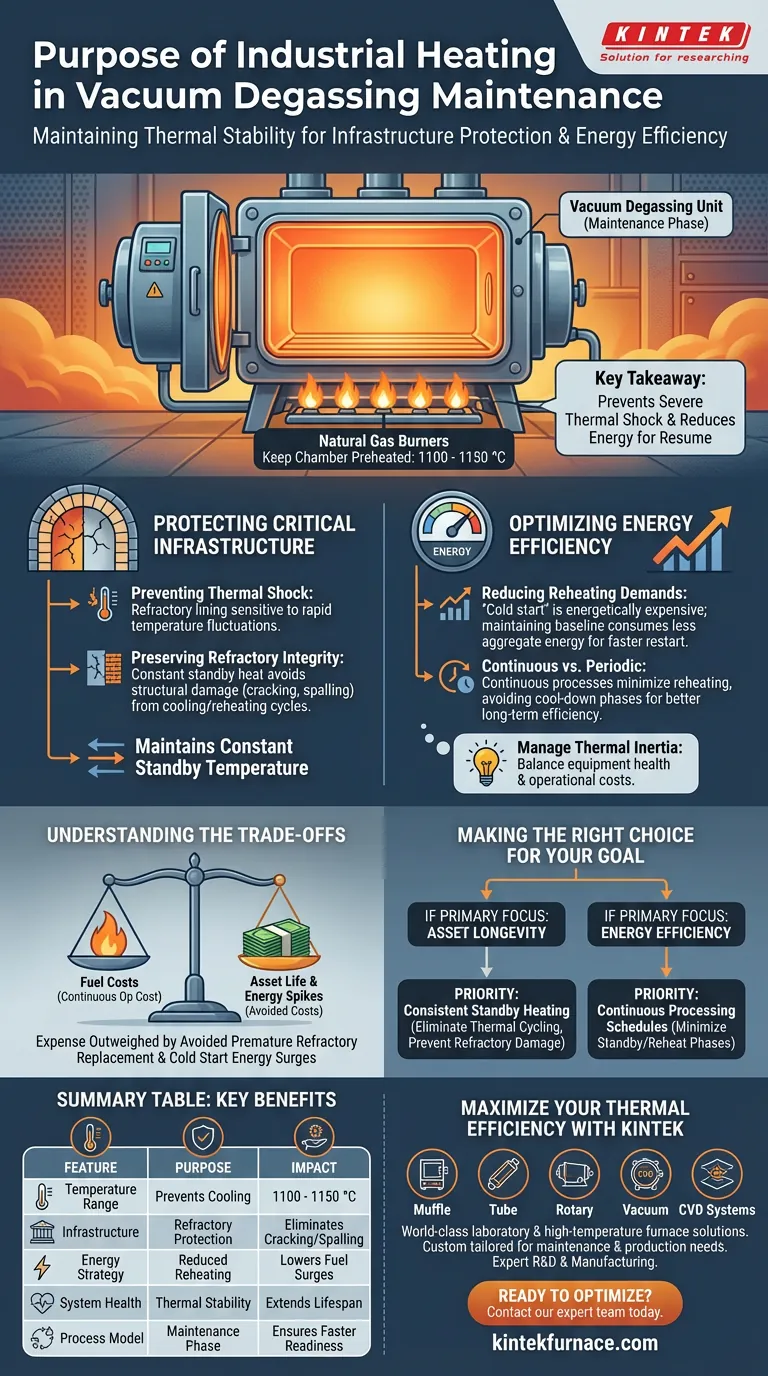
Industrial heating systems are critical for maintaining thermal stability during the non-productive phases of vacuum degassing operations. Specifically, natural gas burners are utilized during downtime to keep the vacuum chamber preheated to temperatures between 1100 and 1150 °C.
By maintaining high temperatures during standby, operators prevent severe thermal shock to the refractory lining and significantly reduce the energy required to resume production.
Protecting Critical Infrastructure
Preventing Thermal Shock
The refractory lining of a vacuum degassing unit is designed to withstand extreme heat, but it is highly sensitive to rapid temperature fluctuations.
If the unit were allowed to cool down completely during maintenance, the subsequent reheating process would create significant stress.
Preserving Refractory Integrity
Maintaing a constant standby temperature prevents this thermal shock.
By keeping the chamber between 1100 and 1150 °C, you avoid the structural damage—such as cracking or spalling—that often results from aggressive cooling and reheating cycles.
Optimizing Energy Efficiency
Reducing Reheating Demands
It may seem counterintuitive to consume fuel during a non-productive phase, but a "cold start" is energetically expensive.
Reheating a massive industrial vessel from ambient temperature to operating levels requires a tremendous surge of energy.
maintaining a steady baseline temperature ensures that the transition back to formal production is faster and consumes less aggregate energy.
Continuous vs. Periodic Processing
This thermal principle explains why continuous degassing processes are generally preferred over periodic ones.
Continuous operations minimize the frequency of reheating cycles.
By avoiding the cool-down phase entirely, continuous processes act as a more energy-efficient model for long-term production.
Understanding the Trade-offs
Balancing Fuel Costs and Asset Life
While preheating is technically superior, it does incur a continuous operational cost.
Operators must account for the consumption of natural gas or other fuels during downtime, even when no product is being improved.
However, this expense is almost always outweighed by the avoided costs of premature refractory replacement and the energy spikes associated with cold starts.
Making the Right Choice for Your Goal
To maximize the lifespan and efficiency of your vacuum degassing unit, align your heating strategy with your operational priorities.
- If your primary focus is Asset Longevity: Prioritize consistent standby heating to eliminate thermal cycling stress and prevent damage to expensive refractory linings.
- If your primary focus is Energy Efficiency: Shift towards continuous processing schedules to minimize the total number of standby or reheat phases required.
Managing thermal inertia is the key to balancing equipment health with operational costs.
Summary Table:
| Feature | Standby Heating Purpose | Impact on Operations |
|---|---|---|
| Temperature Range | 1100 - 1150 °C | Prevents refractory cooling |
| Infrastructure | Refractory Protection | Eliminates cracking and spalling |
| Energy Strategy | Reduced Reheating | Lowers fuel surges during restart |
| System Health | Thermal Stability | Extends lifespan of degassing units |
| Process Model | Maintenance Phase | Ensures faster production readiness |
Maximize Your Thermal Efficiency with KINTEK
Protect your industrial infrastructure from the costly effects of thermal shock. KINTEK provides world-class laboratory and high-temperature furnace solutions designed to maintain precision and durability. Backed by expert R&D and manufacturing, we offer customizable Muffle, Tube, Rotary, Vacuum, and CVD systems tailored to your specific maintenance and production needs.
Ready to optimize your heating strategy and safeguard your refractory assets? Contact our expert team today to discover how our high-performance systems can streamline your operations.
Visual Guide
References
- Viacheslav A. Murashov, Dmitry D. Lvov. Steel degassing in continuous steel melting units. DOI: 10.18799/24131830/2024/1/4154
This article is also based on technical information from Kintek Furnace Knowledge Base .
Related Products
- Vacuum Heat Treat Sintering Furnace with Pressure for Vacuum Sintering
- Vacuum Heat Treat Sintering and Brazing Furnace
- Vacuum Hot Press Furnace Machine Heated Vacuum Press
People Also Ask
- What are the benefits of using vacuum heat treating furnaces for metal alloys? Achieve Superior Metal Properties and Performance
- What is one of the most important uses of vacuum heat treating furnaces in aerospace? Achieve Superior Strength in Aircraft Alloys
- How does vacuum heat treating affect the grain structure of metal alloys? Achieve Precise Microstructure Control
- What are the key components of a vacuum sintering furnace? Essential Parts for Precision Material Processing
- What is the purpose of setting a mid-temperature dwell stage? Eliminate Defects in Vacuum Sintering


